
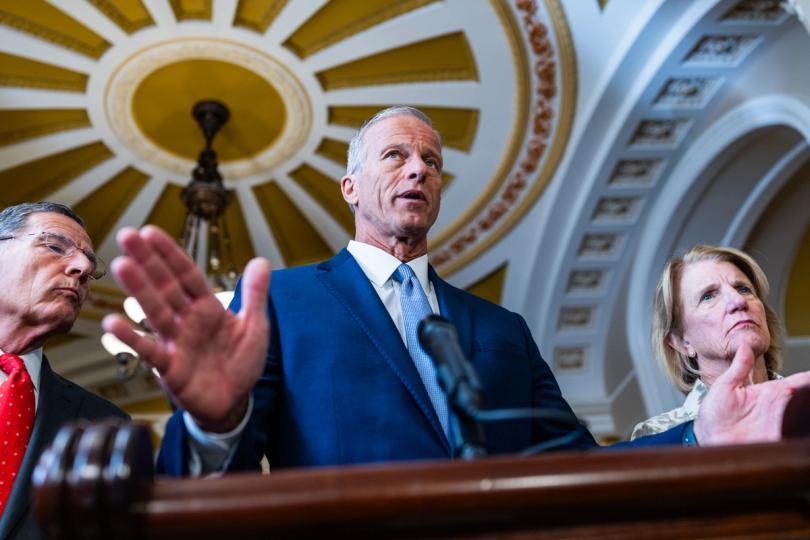
The deadline to get the crypto market structure bill done before senators scatter will likely be missed, says Majority Leader Thune, though it may get a start before then.
Updated Jul 23, 2026, 9:18 p.m. Published Jul 23, 2026, 8:16 p.m.

- U.S. Senate Majority Leader John Thune predicts that the crypto Clarity Act won’t find runway to pass by the time the Senate starts its long summer break.
- Missing the pre-recess deadline is a significant blow to the possibilities of 2026 passage, but Thune told reporters that he hopes to still get the floor process started before the summer break, which will see lawmakers focusing on the election campaigns of the midterm elections.
- White House crypto adviser Patrick Witt quickly pushed back, telling CoinDesk he still thinks the first week of August still has potential.
Industry and congressional negotiators working on crypto market structure legislation had focused on August 7 as the day that the Digital Asset Market Clarity Act needed to get done if it were to have a reasonable chance at a 2026 passage. That's probably not going to happen, according to Senate Majority Leader John Thune.
However, the Clarity Act may be able to make a start in its Senate floor process before the long summer recess, Thune indicated, which may soften the blow of missing its primary window.
"I would like to at least get Clarity started," he told reporters on Thursday. "We'll see where the votes are."
Getting it rolling before the recess could put it in a potential viability for the brief window of floor time waiting in September, though election politics will be looming and other priorities will battle for lawmakers' time. The legislation has also faced a contentious debate since the final working draft emerged this week, with members of both parties taking issue with various sections, and a large number of Democrats taking a stand against its approach to limiting senior government officials — most notably President Donald Trump — in their crypto business activities.
The crypto industry and its lawmaker allies had held out optimism that the Senate could finish the wide-ranging Clarity Act in the next couple of weeks. Dragging it into the later months of the year sharply reduces its odds for passage in 2026.
Thune's staff indicated that the next immediate priority for Senate floor time will be a bipartisan bill to impose sanctions on Russian leadership and tariffs for trading partners — legislation that was championed by Senator Lindsey Graham before he died earlier this month. The majority leader signaled the bill is expected to get to the floor next week, though Graham's funeral is expected to occupy senators' attention in the middle of the week.
White House crypto adviser Patrick Witt responded to Thune’s remarks in an interview with CoinDesk on Thursday, arguing that the first week in August should still be open for potential Senate action. Witt said he was “perplexed” by Thune’s sentiment and that he’s “slightly more optimistic,” though he agreed that the bill is unlikely to get a final vote in July.
“There's that first week of August that the Senate is in session,” Witt said in the interview with CoinDesk TV. “So I wouldn't count it out.”
The midterm congressional elections are in November, and lawmakers are expected to use their summer break to campaign. The House of Representatives and Senate return for about three weeks in September, and if the Senate manages to pass Clarity, the House will still have to follow suit.
Clarity — even more than last year’s Guiding and Establishing National Innovation for U.S. Stablecoins (GENIUS) Act — is the crypto industry first priority in crypto policy, with the hope it finally secures a permanent legal foundation for U.S. crypto activity.
The Senate's floor process is a multi-stage affair that can take a few days or even longer to advance legislation past the 60-vote threshold needed in that chamber. At this stage, the crypto bill is hardly guaranteed to muster even a majority, as some Republican senators have also raised concerns with its treatment of stablecoin yield and the language of the government-ethics provision.
Senator Cynthia Lummis, a Wyoming Republican who has been a lead Clarity Act negotiator, told CoinDesk in a Wednesday interview that the most contentious sections are still open for revision that she said could bring Democrats to support it.
Republicans and industry insiders had hoped that getting the bill to the Senate floor might sharpen its urgency and help drive deals among the lawmakers to iron out the final disagreements. That could still happen if Thune can find some floor time before recess.
UPDATE (July 23, 2026, 20:51 UTC): Adds response from White House official.
Crypto Flows, Share and the Selective Rotation

Crypto Flows, Share and the Selective Rotation
Markets repositioned since June, but Binance held share (~55% user funds, ~24% spot) and drew net inflows in early July while the tracked market saw outflows.
Markets repositioned since June, but Binance held share (~55% user funds, ~24% spot) and drew net inflows in early July while the tracked market saw outflows.
Why it matters:
Markets repositioned since June, but Binance held share (~55% user funds, ~24% spot) and drew net inflows in early July while the tracked market saw outflows.
0 Comments
Log in to join the conversation.No comments yet. Be the first to share your thoughts.