
[Submitted on 21 Jul 2026]
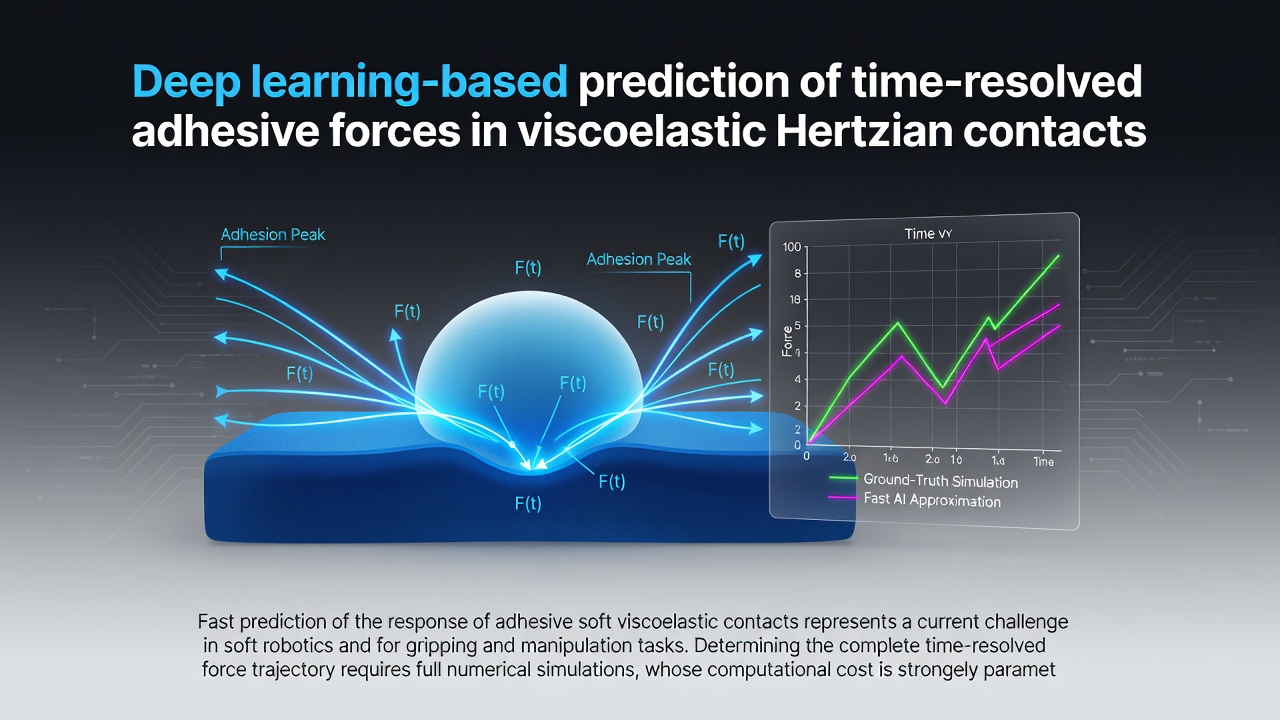
Abstract:Fast prediction of the response of adhesive soft viscoelastic contacts represents a current challenge in soft robotics and for gripping and manipulation tasks. Determining the complete time-resolved force trajectory requires full numerical simulations, whose computational cost is strongly parameter-dependent, making them impractical for real-time application or design-optimization loops. In this work, we overcome this limitation by training a scalar-conditioned, stateful, sequence-to-sequence deep learning model to predict the full force evolution from a prescribed displacement history for both short- and long-range adhesion regimes. The data set spans four orders of magnitude in loading and unloading rates and includes varied dwell times, with the Tabor parameter ranging from $0.2$ to $3.2$. To enable learning across these heterogeneous time scales, we introduce a fixed-measurement-step (FMS) representation that converts variable-length trajectories into fixed-length sequences while preserving their physical-time information. Different architectures were trained, including long short-term memory (LSTM) networks, temporal convolutional neural (TCN) networks, and time-distributed dense layers with three different Tabor-conditioning mechanisms. The models were compared using global waveform and error metrics. We found that the best-performing model has an LSTM architecture with concatenated conditioning, which achieves a held-out mean-squared error of $5.0\times10^{-4}$, a median pull-off-force error of $\approx2.2\%$, and a median hysteresis error of $\approx1.1\%$. For the held-out protocols, the model predicts a complete force trajectory with a median inference time of $0.16$ s. The model is tested across unseen parameter combinations and against analytical limiting cases, providing a rapid surrogate for repeated numerical evaluations with potential use in control-oriented applications.
Submission history
From: Ali Maghami [view email]
[v1]
Tue, 21 Jul 2026 12:48:48 UTC (7,359 KB)
0 Comments
Log in to join the conversation.No comments yet. Be the first to share your thoughts.