
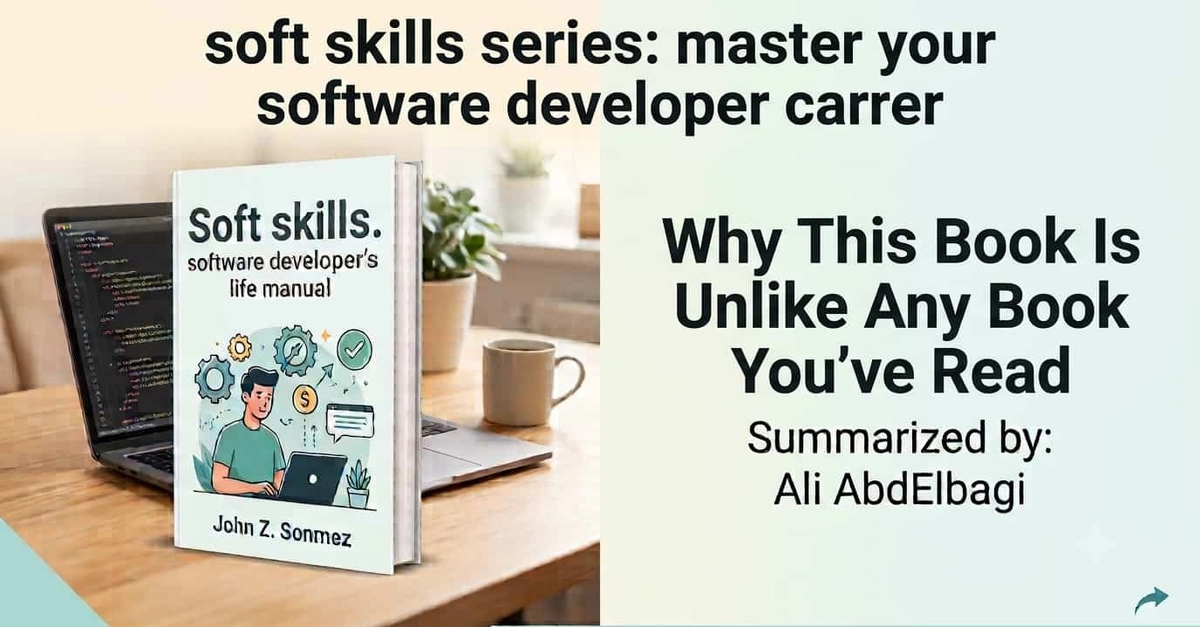
Why is this book unlike any other book you've read?
The author begins the first chapter with this question, saying that most books related to software development are about software development, but this book is not like that; it is not just about software development, but about making you a good developer.
By “good” he means that you will not only be excellent at solving software problems and detecting errors, but also at developing your career path, achieving your goals, and living a better life.
He mentions a very important point, which is that this book is not about what you can do, but about you , yourself, about your career, your life, your body, your mind, and also your soul.
The author adopts an approach to software development based on the belief that if you want to become better, you need to focus on yourself as a whole, not on one or two aspects of your life.
Then he goes on to mention the seven chapters of the book, where he says:
The book begins with the career path, explaining why he chose to start with this particular topic. He justifies this by stating that developers don't manage their careers well, and mentions that this chapter will help them climb the career ladder, start an investment company, or even become entrepreneurs and create their own project. The author says he did all three of these things and will share his mistakes so you can avoid them. He will also cover important topics such as:
- How to write a compelling resume
- Mastering job interviews
- Working remotely
In the second chapter, entitled “Marketing Yourself,” the author mentions that developers feel uncomfortable with the word “marketing,” but the author assures the reader that by the end of this chapter, your view of this word will change, and you will understand its importance. He says that this chapter will not include topics such as how to become rich in a short period or the like, but it will contain practical advice on building a personal brand for yourself, and how to become known by speaking, teaching others, or writing, and some methods that you have not considered.
In the third chapter, which is the chapter on “Learning”, which talks about the skill of self-learning, and how developers should teach themselves in the right way, he says that the teaching methods we used to take in schools and universities are deficient, because they make you get used to someone else teaching you and giving you lessons. He clarifies that he does not mean that having a teacher is wrong, but in the first place you should rely on your abilities and curiosity to get as much knowledge as possible, instead of sitting to listen to a boring lecture and taking notes.
The author will guide you through a self-learning method using 10 steps. These ten steps are his own creation, which he used in his professional life to acquire knowledge. He mentions that he used these steps to create more than 50 training courses over a two-year period. He also mentions that this chapter covers other important topics such as:
- How do you find a good mentor, and how can you be a mentor to others?
- Do you need traditional education or a certificate to be successful?
In the fourth chapter, which is the "Productivity" chapter, which is the thing that software developers suffer from the most, and it is the first obstacle on your path to success, and sometimes you are good at everything except overcoming procrastination, chaos and laziness.
In this chapter, the author shares a method for improving productivity, and also addresses topics such as: burnout, watching too much television, finding motivators, and working hard.
As for the fifth chapter, which is the "Financial" chapter, the author believes that this topic is ignored by many, and he says that you can be the most successful software developer in the world, but if you do not manage money well, you will end up bankrupt and sitting on the side of the road begging.
The author takes you on a world tour of economics and personal finance, telling you the basics of making financial decisions and planning your financial future. The author explains that he may not be a financial expert, but since the age of 18 he has been a real estate investor. He says that he will not go into much detail on this subject because it requires books and chapters, but he will be content with explaining the basics of managing financial income, avoiding debt, and the story of his retirement at the age of 33. He says that this is not difficult, but anyone can retire early.
In the “Fitness” chapter, which is the sixth chapter, the writer talks about losing weight, gaining muscle, and obtaining excellent physical fitness.
The writer takes you through the basics of diet and nutrition, explains how the food you eat affects your body, and how to develop a plan to lose weight, gain muscle, or both.
Finally, in the "spiritual aspect," which is the last chapter, the author focuses on helping you reprogram your brain to create positive behavior for success, and briefly touches on the emotional aspect and relationships, because most people who work in the technical field suffer in this aspect. The writer provides a selection of books, and these books are recommended by a group of successful people whom the writer has met, so that he is asked to recommend a book that everyone should read.
The chapter has ended: “Why is this book not like any other book you have read?”
0 Comments
Log in to join the conversation.No comments yet. Be the first to share your thoughts.