
Posted on March 30, 2025 — 10500 words (42 minutes)
To visit a tree or graph in breadth-first order, there are two main implementation approaches: queue-based or level-based. Our goal here is to develop a level-based approach where the levels of the breadth-first walk are constructed compositionally and dynamically.
Compositionality means that for every node, its descendants—the other nodes reachable from it—are defined by composing the descendants of its children. Dynamism means that the children of a node are generated only when that node is visited; we will see that this requirement corresponds to asking for a monadic unfold.
A prior solution, using the Phases applicative functor,
is compositional but not dynamic in that sense. The essence of Phases
is a zipping operation in free applicative functors.
What if we did zipping in free monads instead?
This is a Literate Haskell post. The source code is on Gitlab. A reusable version of this code is now available on Hackage: the weave library.
Table of contents
- Background: breadth-first folds and traversals
- Problem statement: Breadth-first unfolds
- Queue-based unfold
- Some uses of unfolds
- “Global” level-based unfold
- In search of compositionality
- The weave applicative
- A wrinkle in time
- Out of sight, out of mind
- Laziness for the win
- Laziness without end
- Microbenchmarks: Queues vs Global Levels vs Weaves
- Conclusion
- Recap table
{-# LANGUAGE DeriveAnyClass #-}
{-# LANGUAGE DeriveTraversable #-}
{-# LANGUAGE DeriveGeneric #-}
{-# LANGUAGE GADTs #-}
{-# LANGUAGE LambdaCase #-}
{-# LANGUAGE PackageImports #-}
{-# LANGUAGE PatternSynonyms #-}
{-# LANGUAGE RankNTypes #-}
{-# LANGUAGE ScopedTypeVariables #-}
{-# LANGUAGE ViewPatterns #-}
{-# OPTIONS_GHC -Wno-x-partial -Wno-unused-matches -Wno-unused-top-binds -Wno-unused-imports #-}

import "deepseq" Control.DeepSeq (NFData)
import Data.Foldable (toList)
import Data.Function ((&))
import Data.Functor ((<&>))
import Data.Functor.Identity (Identity(..), runIdentity)
import GHC.Generics (Generic)
import "tasty" Test.Tasty (TestTree, localOption)
import "tasty-hunit" Test.Tasty.HUnit ((@?=), testCase)
import "tasty-bench" Test.Tasty.Bench (bgroup, bench, defaultMain, nf, bcompare)
-- import "tasty-bench" Test.Tasty.Bench (mutatorCpuTime)
import "tasty-expected-failure" Test.Tasty.ExpectedFailure (expectFail)
import "some" Data.Some.Newtype (Some(Some))
import "transformers" Control.Monad.Trans.State
import qualified "containers" Data.Set as Set
import "containers" Data.Set (Set)
Background: breadth-first folds and traversals
Our running example will be the type of binary trees:
data Tree a = Leaf | Node a (Tree a) (Tree a)
  deriving (Eq, Show, Generic, NFData)
A breadth-first walk explores the tree level by level; every level contains the
nodes at the same distance from the root. The list of levels of a tree can be defined
recursively—it is a fold. For a tree Node x l r, the first level contains
just the root node x, and the subsequent levels are obtained by appending the
levels of the subtrees l and r pairwise.
levels :: Tree a -> [[a]]
levels Leaf = []
levels (Node x l r) = [x] : zipLevels (levels l) (levels r)
zipLevels :: [[a]] -> [[a]] -> [[a]]
zipLevels [] yss = yss
zipLevels xss [] = xss
zipLevels (xs : xss) (ys : yss) = (xs ++ ys) : zipLevels xss yss(We can’t just use zipWith because it throws away the end of a list when the
other list is empty.)
Finally, we concatenate the levels together to obtain the list of nodes in breadth-first order.
toListBF :: Tree a -> [a]
toListBF = concat . levels
Thanks to laziness, the list will indeed be produced by walking the tree in breadth-first order. So far so good.
The above function lets us fold a tree in breadth-first order. The next level of difficulty is to traverse a tree, producing a tree with the same shape as the original tree, only with modified labels.
traverseBF :: Applicative m => (a -> m b) -> Tree a -> m (Tree b)This has the exact same type as traverse, which you might obtain with
deriving (Foldable, Traversable). The stock-derived Traversable—enabled
by the DeriveTraversable extension—is a depth-first traversal, but the laws
of traverse don’t specify the order in which nodes should be visited,
so you could make it a breadth-first traversal if you wanted.
To define a breadth-first traversal is a surprisingly non-trivial exercise, as pointed out by Chris Okasaki in Breadth-first numbering: lessons from a small exercise in algorithm design (ICFP 2000).
“Breadth-first numbering” is a special case of “breadth-first traversal”
where the arrow (a -> m b) is specialized to a counter.
Okasaki presents a “numbering” solution based on queues and another solution
based on levels.
Both are easily adaptable to the more general “traversal” problem as we will
soon see.
There is a wonderful Discourse thread from 2024 on the topic of
breadth-first traversals.
The first post gives an elegant breadth-first numbering algorithm
which also appears in the appendix of Okasaki’s paper,
but sadly it does not generalize from “numbering” to
“traversal” beyond the special case m = State s.
Last but not least, another level-based solution to the breadth-first traversal
problem can be found in the
tree-traversals library by Noah Easterly.
It is built around an applicative transformer named Phases,
which is a list of actions—imagine the type “[m _]”—where each
element m _ represents one level of the tree.
The Phases applicative enables a compositional definition of a
breadth-first traversal, similarly to the levels function above:
the set of nodes reachable from the root is defined by combining the sets of
nodes reachable from its children. This concern of compositionality
is one of the main motivations behind this post.
Non-standard terminology
The broad family of algorithms being discussed is typically called
“breadth-first search” (BFS) or “breadth-first traversal”,
but in general these algorithms are not “searching” for anything,
and in Haskell, “traversal” is reserved for “things like traverse”.
Instead, this post will use “walks” as a term encompassing folds, traversals,
unfolds, or any concept that can be qualified with “breadth-first”.
Problem statement: Breadth-first unfolds
Both the fold toListBF and the traversal traverseBF had in common that they
receive a tree as an input. This explicit tree makes the notion of levels
“static”. With unfolds, we will have to deal with levels that exist only
“dynamically” as the result of unfolding the tree progressively.
To introduce the unfolding of a tree, it is convenient to introduce its “base functor”. We modify the tree type by replacing the recursive tree fields with an extra type parameter:
data TreeF a t = LeafF | NodeF a t t
  deriving (Functor, Foldable, Traversable)
An unfold generates a tree from a seed and a function which expands the seed into a leaf or a node containing more seeds. A pure unfold—or anamorphism—can be defined readily:
unfold :: (s -> TreeF a s) -> s -> Tree a
unfold f s = case f s of
  LeafF -> Leaf
  NodeF a l r -> Node a (unfold f l) (unfold f r)
The order in which nodes are evaluated depends on
how the resulting tree is consumed. Hence unfold
is neither inherently “depth-first” nor “breadth-first”.
The situation changes if we make the unfold monadic.
unfoldM :: Monad m => (s -> m (TreeF a s)) -> s -> m (Tree a)An implementation of unfoldM must decide upon an ordering between actions.
To see why adding an M to unfold imposes an ordering,
contemplate the fact that these expressions have the same meaning:
Node a (unfold f l) (unfold f r)
= ( let tl = unfold f l in
    let tr = unfold f r in
    Node a tl tr )
= ( let tr = unfold f r in
    let tl = unfold f l in
    Node a tl tr )
whereas these monadic expressions do not have the same meaning in general:
( unfoldM f l >>= \tl ->
  unfoldM f r >>= \tr ->
  pure (Node a tl tr) )
/=
( unfoldM f r >>= \tr ->
  unfoldM f l >>= \tl ->
  pure (Node a tl tr) )
Without further requirements, there is an “obvious” definition of unfoldM,
which is a depth-first unfold:
unfoldM_DF :: Monad m => (s -> m (TreeF a s)) -> s -> m (Tree a)
unfoldM_DF f s = f s >>= \case
  LeafF -> pure Leaf
  NodeF a l r -> liftA2 (Node a) (unfoldM_DF f l) (unfoldM_DF f r)
We unfold the left subtree l fully before unfolding the right one r.
The problem is to define a breadth-first unfoldM.
If you want to think about this problem on your own, you can stop reading here. The rest of this post presents solutions.
Queue-based unfold
The two breadth-first numbering algorithms in Okasaki’s paper can
actually be generalized to breadth-first unfolds.
Here is the first one that uses queues (using the function (<+) for “push” and
pattern-matching on (:>) for “pop”):
unfoldM_BF_Q :: Monad m => (s -> m (TreeF a s)) -> s -> m (Tree a)
unfoldM_BF_Q f b0 = go (b0 <+ Empty) <&> \case
    _ :> t -> t
    _ -> error "impossible"
  where
    go Empty = pure Empty
    go (q :> b) = f b >>= \case
      LeafF -> go q <&> \p -> Leaf <+ p
      NodeF a b1 b2 -> go (b2 <+ b1 <+ q) <&> \case
        p :> t1 :> t2 -> Node a t1 t2 <+ p
        _ -> error "impossible"
(The operator (<&>) is flip (<$>). I use it to avoid parentheses around
lambdas.)
unfoldM_BF_Q
data Q a = Q [a] [a]

pattern Empty :: Q a
pattern Empty = Q [] []

infixr 1 <+
(<+) :: a -> Q a -> Q a
x <+ Q xs ys = Q (x : xs) ys

pop :: Q a -> Maybe (Q a, a)
pop (Q xs (y : ys)) = Just (Q xs ys, y)
pop (Q xs []) = case reverse xs of
  [] -> Nothing
  y : ys -> Just (Q [] ys, y)

infixl 1 :>
pattern (:>) :: Q a -> a -> Q a
pattern q :> y <- (pop -> Just (q, y))

{-# COMPLETE Empty, (:>) #-}
As it happens, containers uses that queue-based technique to implement
breadth-first unfold for rose trees (Data.Tree.unfoldTreeM_BF).
There is a pending question of whether we can improve upon it.
This post might provide a theoretical alternative,
but it seems too slow to be worth serious consideration
(see the benchmark section).
If you’re frowning upon the use of error—as you should be—you can replace
error with dummy values here (Empty, Leaf), but
(1) that won’t be possible with tree structures that must be non-empty
(e.g., if Leaf contained a value) and (2) this is dead code, which
is harmless but no more elegant than making it obvious with error.
The correctness of this solution is also not quite obvious.
There are subtle ways to get this implementation wrong:
should the recursive call be b2 <+ b1 <+ q or b1 <+ b2 <+ q?
Should the pattern be p :> t1 :> t2 or p :> t2 :> t1?
For another version of this challenge, try implementing the unfold for another
tree type, such as finger trees or rose trees, without getting lost in the
order of pushes and pops (by the way, this is Data.Tree.unfoldTreeM_BF in
containers). The invariant is not complex but there is room for mistakes.
I believe that the compositional approach that will be presented later is more
robust on that front, although it is admittedly a subjective quality for which
is difficult to make a strong case.
Some uses of unfolds
Traversals from unfolds
One sense in which unfoldM is a more difficult problem than traverse is
that we can use unfoldM to implement traverse.
We do have to make light of the technicality that there is a Monad constraint
instead of Applicative, which makes unfoldM not suited to implement the
Traversable class.
A depth-first unfold gives a depth-first traversal:
traverse_DF :: Monad m => (a -> m b) -> Tree a -> m (Tree b)
traverse_DF = unfoldM_DF . traverseRoot

-- auxiliary function
traverseRoot :: Applicative m => (a -> m b) -> Tree a -> m (TreeF b (Tree a))
traverseRoot _ Leaf = pure LeafF
traverseRoot f (Node a l r) = f a <&> \b -> NodeF b l r
A breadth-first unfold gives a breadth-first traversal:
traverse_BF_Q :: Monad m => (a -> m b) -> Tree a -> m (Tree b)
traverse_BF_Q = unfoldM_BF_Q . traverseRoot
Unfolds in graphs
We can use a tree unfold to explore a graph. This usage distinguishes unfolds from folds and traversals, which only let you explore trees.
Given a type of vertices V, a directed graph is represented by a function
V -> F V, where F is a functor which describes the arity of each node.
The obvious choice for F is lists, but we will stick to TreeF here
so we can just reuse this post’s unfoldM implementations.
The TreeF functor restricts us graphs where each node has zero or two
outgoing edges; it is a weird restriction, but we will make do for the sake of
example.
        +-------+
        v       |
+->1--->2--->3  |
|  |    |    ^  |
|  v    v    |  |
|  4--->5--->6--+
|  |    |    ^
|  +----|----+
|       |
+-------+
The graph drawn above turns into the following function, where every vertex
is mapped either to NodeF with the same vertex as the first argument followed
by its two adjacent vertices, or to LeafF if it has no outgoing edges or does
not belong to the graph.
graph :: Int -> TreeF Int Int
graph 1 = NodeF 1 2 4
graph 2 = NodeF 2 3 5
graph 3 = LeafF
graph 4 = NodeF 4 5 6
graph 5 = NodeF 5 1 6
graph 6 = NodeF 6 2 3
graph _ = LeafF
If we simply feed that function to unfold, we will get the infinite tree
of all possible paths from a chosen starting vertex.
To obtain a finite tree, we want to keep track of vertices that we have
already visited, using a stateful memory. The following function wraps graph,
returning LeafF also if a vertex has already been visited.
visitGraph :: Int -> State (Set Int) (TreeF Int Int)
visitGraph vertex = do
  visited <- get
  if vertex `elem` visited then pure LeafF
  else do
    put (Set.insert vertex visited)
    pure (graph vertex)
Applying unfoldM_BF to that function produces a “breadth-first tree”
of the graph, an encoding of the trajectory of a breadth-first walk through the
graph. “Breadth-first trees” are a concept from graph theory with well-studied
properties.
-- Visit `graph` in breadth-first order
bfGraph_Q :: Int -> Tree Int
bfGraph_Q = (`evalState` Set.empty) . unfoldM_BF_Q visitGraph
testGraphQ :: TestTree
testGraphQ = testCase "Q-graph" $
bfGraph_Q 1 @?=
Node 1
(Node 2 Leaf
(Node 5 Leaf Leaf))
(Node 4 Leaf (Node 6 Leaf Leaf))Compile and run
This post is a compilable Literate Haskell file. You can run all of the tests
and benchmarks in here. The source repository provides the necessary
configuration to build it with cabal.
$ cabal build breadth-first-unfoldsTest cases can then be selected with the -p option and a pattern
(see the tasty documentation for details).
Run all tests and benchmarks by passing no option.
$ cabal exec breadth-first-unfolds -- -p "/Q-graph/||/S-graph/"
All
  Q-graph: OK
  S-graph: OK
“Global” level-based unfold
The other solution from Okasaki’s paper can also be adapted into a monadic unfold.
The starting point is to unfold a list of seeds [s] instead of a single seed:
we can traverse the list with the expansion function s -> m (TreeF a s) to
obtain another list of seeds, the next level of the breadth-first unfold,
and keep going.
Iterating this process naively yields a variant of monadic unfold without a
result. This no-result variant can be generalized from TreeF to
any foldable structure:
-- Inner loop: multi-seed unfold
unfoldsM_BF_G_ :: (Monad m, Foldable f) => (s -> m (f s)) -> [s] -> m ()
unfoldsM_BF_G_ f [] = pure ()
-- Read from right to left: traverse, flatten, recurse.
unfoldsM_BF_G_ f xs = unfoldsM_BF_G_ f . concatMap toList =<< traverse f xs

-- Top-level function: single-seed unfold
unfoldM_BF_G_ :: (Monad m, Foldable f) => (s -> m (f s)) -> s -> m ()
unfoldM_BF_G_ f = unfoldsM_BF_G_ f . (: [])
Modifying this solution to create the output tree requires a little more thought.
We must keep hold of the intermediate list of ts :: [TreeF a s] to
reconstruct trees after the recursive call returns.
unfoldsM_BF_G :: Monad m => (s -> m (TreeF a s)) -> [s] -> m [Tree a]
unfoldsM_BF_G f [] = pure []
-- traverse, flatten, recurse, reconstruct
unfoldsM_BF_G f xs = traverse f xs >>= \ts ->
  reconstruct ts <$> unfoldsM_BF_G f (concatMap toList ts)
The reconstruction function picks a root in the first list and completes it with subtrees from the second list:
reconstruct :: [TreeF a s] -> [Tree a] -> [Tree a]
reconstruct (LeafF : ts) us = Leaf : reconstruct ts us
reconstruct (NodeF a _ _ : ts) (l : r : us) = Node a l r : reconstruct ts us
reconstruct _ _ = error "impossible"
You could modify the final branch to produce [], but error makes it
explicit that this branch should never be reached by the unfold where it is
used.
The top-level unfold function wraps the seed in a singleton input list and extracts the root from a singleton output list.
unfoldM_BF_G :: Monad m => (s -> m (TreeF a s)) -> s -> m (Tree a)
unfoldM_BF_G f = fmap head . unfoldsM_BF_G f . (: [])testGraphG
bfGraph_G :: Int -> Tree Int
bfGraph_G = (`evalState` Set.empty) . unfoldM_BF_G visitGraph
testGraphG :: TestTree
testGraphG = testCase "Q-graph" $
bfGraph_G 1 @?=
Node 1
(Node 2 Leaf
(Node 5 Leaf Leaf))
(Node 4 Leaf (Node 6 Leaf Leaf))This solution is less brittle than the queue-based solution because
we always traverse lists left-to-right.
To avoid the uses of error in reconstruct,
you can probably create a specialized data structure in place of [TreeF a s],
but that is finicky in its own way.
In search of compositionality
Both of the solutions above (the queue-based and the “monolithic” level-based unfolds)
stem from a global view of breadth-first walks: we are iterating on a list or a
queue which holds all the seeds from one or two levels at a time.
That structure represents a “front line” between visited and unvisited
vertices, and every iteration advances the front line a little: with a queue we
advance it one vertex at a time, with a list we advance the whole front line
in an inner loop—one call to traverse—before recursing.
The opposite local view of breadth-first order is exemplified by the earlier
levels function: it only produces a list of lists of the vertices
reachable from the current root. It does so recursively, by composing
together the vertices reachable from its children. Our goal here is to find a
similarly local, compositional implementation of breadth-first unfolds.
Rather than defining unfoldM directly, which sequences the computations on
all levels into a single computation, we will introduce an intermediate
function weave that keeps levels separate—just as toListBF is defined
using levels.
The result of weave will be in an as yet unknown applicative functor F m
depending on m.
And because levels are kept separate, weave only needs
a constraint Applicative m to compose computations on the same level.
The goal is to implement this signature, where the result type F is also an
unknown:
weave :: Applicative m => (s -> m (TreeF a s)) -> s -> F m (Tree a)The name weave comes from visualizing a breadth-first walk
as a path zigzagging across a tree like this:
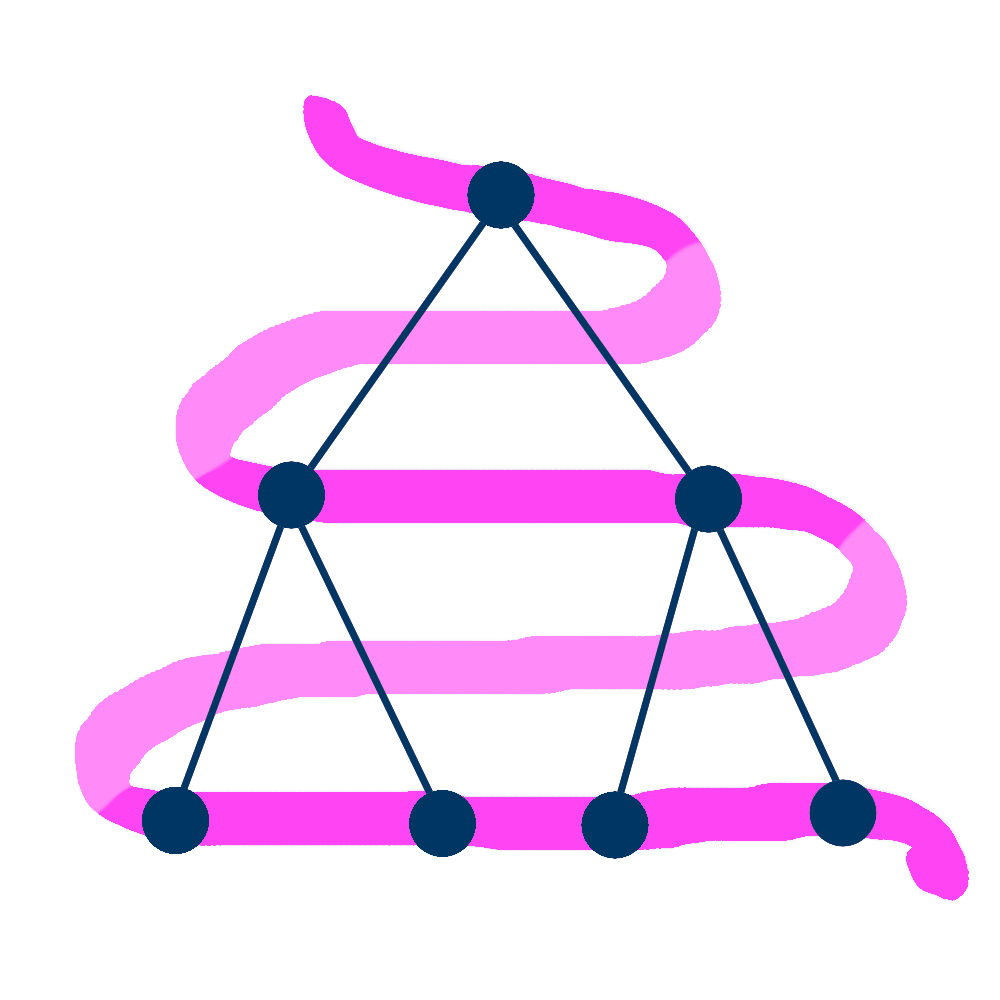
which is reminiscent of weaving as in the making of textile:
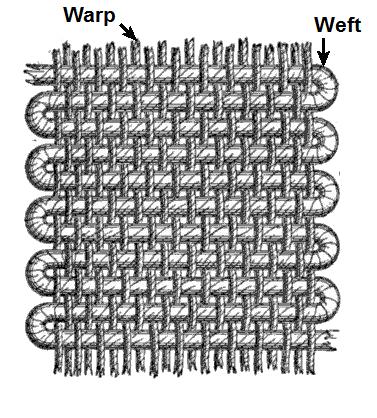
With only what we know so far, a bit of type-directed programming leads to the
following incomplete definition. We have constructed something of type
m (F m (Tree a)), while we expect F m (Tree a):
weave :: Applicative m => (s -> m (TreeF a s)) -> s -> F m (Tree a)
weave f s = _ (step <$> f s) where
  step :: TreeF a s -> F m (Tree a)
  step LeafF = pure Leaf
  step (NodeF a l r) = liftA2 NodeF (weave f l) (weave f r)
To fill the hole _, we postulate the following primitive, weft,
as part of the unknown definition of F:
weft :: Applicative m => m (F m a) -> F m aIntuitively, F m represents “multi-level computations”.
The weft function constructs a multi-level (F m)-computation from
one level of m-computation which returns the subsequent levels
as an (F m)-computation.
We fill the hole with weft, completing the definition of weave:
weave :: forall m s a. Applicative m => (s -> m (TreeF a s)) -> s -> F m (Tree a)
weave f s = weft (weaveF <$> f s) where
  weaveF :: TreeF a s -> F m (Tree a)
  weaveF LeafF = pure Leaf
  weaveF (NodeF a l r) = liftA2 (Node a) (weave f l) (weave f r)
The function weave defines a multi-level computation which represents
a breadth-first walk from a seed s:
- the first level of the walk is
f s, expanding the initial seed; - the auxiliary function
weaveFconstructs the remaining levels from the initial seed’s expansion:- if the seed expands to
LeafF, there are no more seeds, and we terminate with an empty computation (pure); - if the seed expands to
NodeF, we obtain two sub-seedslandr, they generate their own weaves recursively (weave f landweave f r), and we compose them (liftA2).
- if the seed expands to
One way to think about weft is as a generalization of the following primitives:
we can “embed” m-computations into F m,
and we can “delay” multi-level (F m)-computations, shifting the
m-computation on each level to the next level.
embed :: Applicative m => m a -> F m a
embed u = weft (pure <$> u)

delay :: Applicative m => F m a -> F m a
delay u = weft (pure u)
The key law relating these two operations is that embedded computations and delayed computations commute with each other:
embed u *> delay v = delay v <* embed uThe embed and delay operations are provided by the Phases applicative
functor that I mentioned earlier, which enables breadth-first traversals,
but not breadth-first unfolds. Thus, weft is a strictly more expressive
primitive than embed and delay.
Eventually, we will run a multi-level computation as a single m-computation
so that we can use weave to define unfoldM. The runner function will be
called mesh:
mesh :: Monad m => F m a -> m aIt is characterized by this law which says that mesh executes the first
level of the computation u :: m (F m a), then executes the remaining levels
recursively:
mesh (weft u) = u >>= meshPutting everything together, weave and mesh combine into a breadth-first unfold:
unfoldM_BF :: Monad m => (s -> m (TreeF a s)) -> s -> m (Tree a)
unfoldM_BF f s = mesh (weave f s)
It remains to find an applicative functor F equipped with weft and mesh.
The weave applicative
A basic approach to design a type is to make some of the operations it
should support into constructors. The weave applicative WeaveS has
constructors for pure and weft:
data WeaveS m a
  = EndS a
  | WeftS (m (WeaveS m a))
(The suffix “S” stands for Spoilers. Read on!)
We instantiate the unknown functor F with WeaveS.
Astute readers will have recognized WeaveS as the free monad.
Just as Phases has the same type definition as the free applicative functor but
a different Applicative instance, we will give WeaveS an Applicative
instance that does not coincide with the Applicative and Monad instances of
the free monad.
Starting with the easy functions,
weft is WeftS, and the equation for mesh above is basically its definition.
We just need to add an equation for EndS.
weft :: m (WeaveS m a) -> WeaveS m a
weft = WeftS

mesh :: Monad m => WeaveS m a -> m a
mesh (EndS a) = pure a
mesh (WeftS u) = u >>= mesh
Recall that WeaveS represents multi-level computations.
Computations are composed level-wise with the following liftS2.
The interesting case is the one where both arguments are WeftS: we compose
the first level with liftA2, and the subsequent ones with liftS2
recursively.
liftS2 :: Applicative m => (a -> b -> c) -> WeaveS m a -> WeaveS m b -> WeaveS m c
liftS2 f (EndS a) wb = f a <$> wb
liftS2 f wa (EndS b) = flip f b <$> wa
liftS2 f (WeftS wa) (WeftS wb) = WeftS ((liftA2 . liftS2) f wa wb)
liftS2 will be the liftA2 in WeaveS’s Applicative instance.
The Functor and Applicative instances show that WeaveS is an
applicative transformer: for every applicative functor m,
WeaveS m is also an applicative functor.
instance Functor m => Functor (WeaveS m) where
  fmap f (EndS a) = EndS (f a)
  fmap f (WeftS wa) = WeftS ((fmap . fmap) f wa)

instance Applicative m => Applicative (WeaveS m) where
  pure = EndS
  liftA2 = liftS2
That completes the definition of unfoldM_BF: a level-based, compositional
breadth-first unfold.
As a unit test, we copy the code for visiting a graph from earlier:
bfGraphS :: Int -> Tree Int
bfGraphS = (`evalState` Set.empty) . unfoldM_BF visitGraph
testGraphS :: TestTree
testGraphS = testCase "S-graph" $
bfGraphS 1 @?=
Node 1
(Node 2 Leaf
(Node 5 Leaf Leaf))
(Node 4 Leaf (Node 6 Leaf Leaf))Code golf
There is a variant of weave that I prefer:
weaveS :: Applicative m => (s -> m (TreeF a s)) -> s -> m (WeaveS m (Tree a))
weaveS f s = f s <&> \case
  LeafF -> pure Leaf
  NodeF a l r -> liftA2 (Node a) (weft (weaveS f l)) (weft (weaveS f r))
The outer weft constructor was moved into the recursive calls.
The result type has an extra m, which makes it more apparent that
we always start with a call to f. It’s the same vibe as replacing the type
[a] with NonEmpty a when we know that a list will always have at least one
element; weaveS always produces at least one level of computation.
We also replace (<$>) with its flipped version (<&>) for aesthetic reasons:
we can apply it to a lambda without parentheses, and that change makes the
logic flow naturally from left to right: we first expand the seed s using
f, and continue depending on whether the expansion produced LeafF or NodeF.
To define unfoldM, instead of applying mesh directly, we chain it with
(>>=).
unfoldM_BF_S :: Monad m => (s -> m (TreeF a s)) -> s -> m (Tree a)
unfoldM_BF_S f s = weaveS f s >>= mesh
A wrinkle in time
That solution is Obviously Correct™, but it has a terrible flaw: it does not run in linear time!
We can demonstrate this by generating a “thin” tree whose height
is equal to its size.
The height h is the seed of the unfolding, and we generate a NodeF as long
as it is non-zero, asking for a decreased height h - 1 on the right,
and a zero height on the left.
thinTreeS :: Int -> Tree ()
thinTreeS = runIdentity . unfoldM_BF_S f
  where
    f 0 = pure LeafF
    f h = pure (NodeF () 0 (h - 1))
Compare the running times of evaluating thinTreeS at height 100
(the baseline)
and at height 1000 (10x the baseline).
benchS :: TestTree
benchS = bgroup "S-thin"
  [ bench  "1x" (nf thinTreeS 100)
  , bench "10x" (nf thinTreeS 1000) & bcompare "S-thin.1x"
  ]
Benchmark output (relative):
| height | time |
|---|---|
| baseline | 1x |
| 10x | 105x |
$ cabal exec breadth-first-unfolds -- -p "S-thin"
All
  S-thin
    1x:  OK
      27.6 μs ± 2.6 μs, 267 KB allocated, 317 B  copied, 6.0 MB peak memory
    10x: OK
      2.90 ms ± 181 μs,  23 MB allocated, 178 KB copied, 7.0 MB peak memory, 105.35x
Multiplying the height by 10x makes the function run 100x slower. Dramatically quadratic.
Complexity analysis
We can compare this implementation with level from earlier, which is linear-time.
In particular, looking at zipLevels with liftS2—which play similar
roles—there is a crucial difference when one of the arguments is empty
([] or EndS):
zipLevels simply returns the other argument, whereas liftS2 calls (<$>),
continuing the recursion down the other argument.
So zipLevels stops working after reaching the end of either argument, whereas
liftS2 walks to the end of both arguments. There is at least one
call to liftS2 on every level which will walk to the bottom of the tree,
so we get a quadratic lower bound Ω(height2).
Out of sight, out of mind
The problematic combinators are fmap and liftS2, which weaveS uses to
construct the unfolded tree. If we don’t care about that tree—wanting only
the effect of a monadic unfold—then we can get rid of the complexity
associated with those combinators.
With no result to return, we remove the a type parameter from the definition
of WeaveS, yielding the oblivious (“O”) variant:
data WeaveO m
  = EndO
  | WeftO (m (WeaveO m))
We rewrite mesh into meshO, reducing a WeaveO m computation
into m () instead of m a.
meshO :: Monad m => WeaveO m -> m ()
meshO EndO = pure ()
meshO (WeftO u) = u >>= meshO
The Applicative instance for WeaveS becomes a Monoid instance for WeaveO.
liftA2 is replaced with (<>), zipping two computations level-wise.
instance Applicative m => Semigroup (WeaveO m) where
  EndO <> v = v
  u <> EndO = u
  WeftO u <> WeftO v = WeftO (liftA2 (<>) u v)

instance Applicative m => Monoid (WeaveO m) where
  mempty = EndO
  mappend = (<>)
To implement a breadth-first walk, we modify weaveS above by replacing
liftA2 (Node a) with (<>). Note that the type parameter a is no longer in
the result. It was only used in the tree that we decided to forget.
weaveO :: Applicative m => (s -> m (Tr
0 Comments
Log in to join the conversation.No comments yet. Be the first to share your thoughts.