
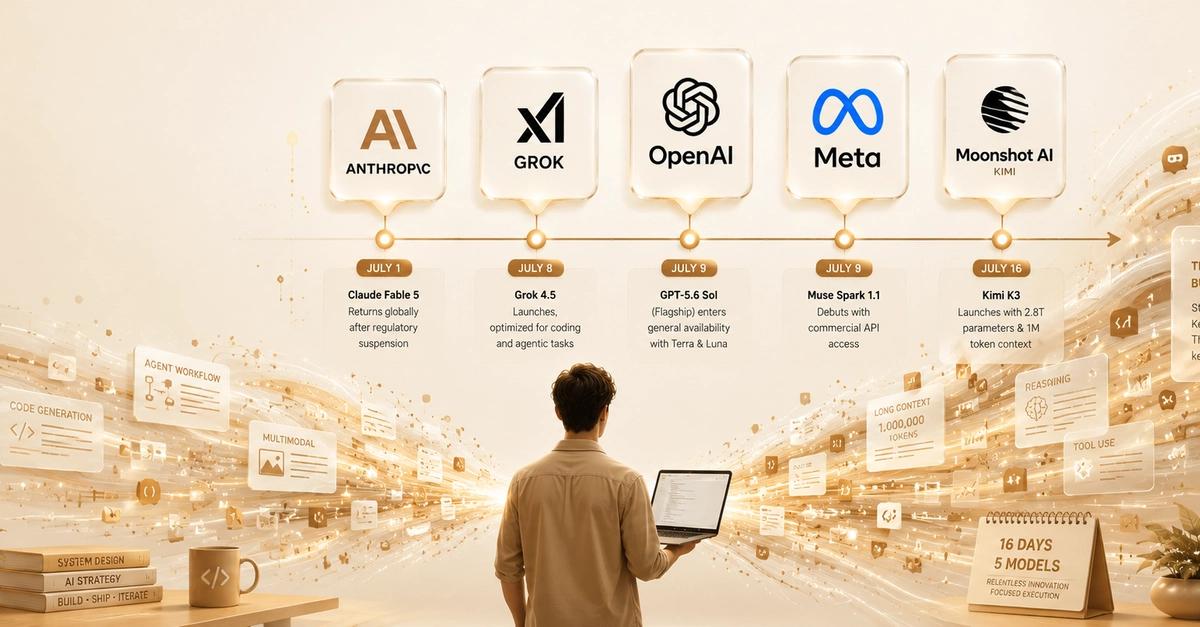
From Model Wars to Platform Wars: What 5 AI Launches in 16 Days Reveal About the Future
Between July 1 and July 16, 2026, the frontier AI landscape compressed months of progress into just over two weeks.
Five major models launched, returned to service, or entered broad availability:
- Anthropic restored Claude Fable 5
- SpaceXAI released Grok 4.5
- OpenAI launched the GPT-5.6 family led by Sol
- Meta debuted Muse Spark 1.1 via commercial API
- Moonshot AI unveiled Kimi K3
This wasn't just a busy release cycle.
It felt like a preview of the next phase of AI competition—one where multiple labs move almost simultaneously, capability gaps narrow rapidly, and ecosystems matter just as much as raw intelligence.
For developers, founders, and technical leaders, the biggest risk isn't falling behind on model releases. It's letting the constant stream of announcements distract you from actually building.
The 16-Day Timeline
The sequence was remarkable:
| Date | Event |
|---|---|
| July 1 | Claude Fable 5 returns globally after suspension |
| July 8 | Grok 4.5 launches |
| July 9 | GPT-5.6 Sol enters general availability |
| July 9 | Meta releases Muse Spark 1.1 |
| July 16 | Moonshot AI launches Kimi K3 |
What makes this unusual isn't just the number of releases.
It's that they came from different major AI labs, all claiming frontier-level capabilities.
According to Artificial Analysis, four frontier-class models launched within roughly eight days, while six separate labs now field models above 50 on the Intelligence Index—a dramatic increase from only a handful of leaders just months earlier.
The frontier is no longer a single company pulling ahead.
It's multiple companies moving in parallel.
The Real Story: Compression and Convergence
Historically, one lab would release a breakthrough model and enjoy months of clear leadership before competitors caught up.
That dynamic is fading.
Claude Fable 5 established itself as one of the strongest frontier models when it launched in June. Yet within weeks, GPT-5.6 Sol, Grok 4.5, Muse Spark 1.1, and Kimi K3 all entered the conversation.
The result is a frontier where capability differences are increasingly measured in percentages rather than generations.
For developers and businesses, that changes how decisions get made.
When quality differences become smaller, factors like cost, latency, reliability, context length, and workflow integration become far more important.
Breaking Down the Releases
1. Claude Fable 5: A Regulatory Reality Check
Claude Fable 5 may be remembered as much for its regulatory journey as for its technical capabilities.
Following concerns related to advanced model controls and export restrictions, Anthropic temporarily suspended access before restoring the model globally on July 1 with additional safeguards in place.
The episode highlighted an emerging reality:
- Government oversight is becoming part of the deployment pipeline for frontier AI systems.
- Model releases are no longer purely engineering events. They're increasingly regulatory events as well.
2. GPT-5.6 Sol: Efficiency Becomes the Battleground
OpenAI's GPT-5.6 family introduced a tiered approach:
- Sol as the flagship model
- Terra as the balanced middle tier
- Luna as the lower-cost option
Notably, OpenAI's messaging focused heavily on efficiency, performance-per-dollar, and production readiness.
That signals a broader industry shift.
The conversation is moving away from:
"Which model is smartest?"
toward:
"Which model delivers the most value for the cost?"
For production teams operating at scale, that distinction matters far more than a benchmark leaderboard.
3. Grok 4.5: Ecosystem as a Competitive Moat
Grok 4.5 represents more than another model launch.
It reflects the growing importance of ecosystem integration.
Positioned heavily around coding, autonomous workflows, and developer productivity, Grok 4.5 benefits from deep connections to Cursor and the broader SpaceXAI ecosystem.
Its competitive pricing further reinforces an important trend:
The future may be won less through raw model superiority and more through becoming the default intelligence layer inside tools developers already use every day.
4. Muse Spark 1.1: Meta's Commercial Pivot
For years, Meta's AI strategy centered around research and open-weight distribution.
Muse Spark 1.1 marks a notable shift.
With the introduction of commercial API access, Meta is now competing directly for developer spending alongside OpenAI, Anthropic, and SpaceXAI.
The model focuses heavily on:
- Agentic workflows
- Tool use
- Coding
- Multimodal reasoning
Whether Spark 1.1 wins every benchmark is almost secondary.
The larger story is that Meta has officially entered the pay-per-token battlefield.
5. Kimi K3: The Open-Weight Shockwave
Moonshot AI's Kimi K3 may be the most strategically significant release of the group.
Built as a massive Mixture-of-Experts model with 2.8 trillion parameters and a 1-million-token context window, Kimi K3 immediately drew attention across the industry.
The release reinforces a trend that's becoming impossible to ignore:
- Open-weight models are no longer niche alternatives.
- They're becoming legitimate frontier competitors.
- For years, many assumed the most capable AI systems would remain concentrated among a handful of U.S. companies.
Kimi K3 challenges that assumption.
The Shift From Model Wars to Platform Wars
One of the biggest takeaways from these sixteen days is that frontier labs are no longer competing solely on model quality.
They're competing on platforms.
OpenAI has ChatGPT, Codex, Operator, and enterprise integrations.
Anthropic has Claude Code and enterprise workflows.
SpaceXAI is building around Grok, Cursor, and its broader ecosystem.
Meta is investing heavily in agent infrastructure and developer tooling.
Moonshot AI is betting on open-weight adoption.
The winning question is increasingly shifting from:
"Which model is best?"
to:
"Which model fits naturally into the tools I already use?"
For many teams, workflow integration creates more value than a small benchmark advantage ever will.
Intelligence Is Becoming a Commodity
A year ago, frontier intelligence itself was the differentiator.
Today, multiple labs offer models capable of advanced coding, reasoning, research, and tool use.
As capabilities converge, intelligence becomes less of a moat.
The new differentiators are:
- Cost
- Speed
- Reliability
- Context length
- Ecosystem integration
- Enterprise readiness
In many ways, AI is beginning to resemble cloud infrastructure markets.
Raw capability still matters.
But operational advantages increasingly determine who wins.
Three Macro Trends Behind the Rush
1. Convergence at the Frontier
The quality gap between leading models is shrinking.
As differences narrow, purchasing decisions increasingly depend on economics, latency, reliability, and integration rather than pure intelligence scores.
The era of one dominant leader may be giving way to a tightly packed frontier.
2. Agentic Coding Is Becoming the Primary Battlefield
Every major release emphasized some combination of:
- Coding
- Tool use
- Autonomous execution
- Workflow automation
- Software engineering
The industry appears to be converging on a shared belief:
AI coworkers for developers may become one of the first truly massive commercial AI markets.
The race is no longer about building the best chatbot.
It's about building the best teammate.
3. Open Weights Are Now Serious Competitors
Kimi K3 joins a growing wave of powerful open-weight models emerging from companies such as DeepSeek and Alibaba's Qwen ecosystem.
These systems are no longer simply lower-cost alternatives.
They're increasingly credible frontier options.
The future likely won't belong exclusively to either closed or open models.
Instead, we'll probably see a hybrid ecosystem where both approaches coexist and push each other forward.
The Hidden Cost of Chasing Every Release
Here's the uncomfortable truth:
Most teams gain less from switching models every week than they think they do.
Every migration carries hidden costs:
- Rewriting prompts
- Retesting workflows
- Updating integrations
- Reconfiguring tooling
- Learning new model behavior
The productivity lost during those transitions often outweighs the capability gains.
My personal rule is simple:
Absorb the news. Keep your stack stable.
A Simple Evaluation Framework
When a new model launches, ask four questions:
- Does it solve a problem my current model cannot?
- Does it significantly reduce cost or increase efficiency?
- Does it integrate naturally into my existing workflow?
- Will the migration cost less than the expected gain?
If the answer to most of these is "no," waiting is usually the better decision.
Early adoption feels productive.
Measured adoption is productive.
Final Thoughts
The most interesting part of these sixteen days isn't that five frontier models launched.
It's that the industry is beginning to mature.
Regulation is becoming standard.
Open-weight competitors are closing the gap.
Coding agents are emerging as the primary commercial battlefield.
And frontier capabilities are converging faster than many expected.
In that environment, the advantage no longer belongs to whoever tries every new model first.
It belongs to the teams that evaluate carefully, adopt deliberately, and keep shipping while everyone else is benchmarking.
The firehose isn't slowing down.
Learning how to filter it may become one of the most valuable skills in modern software development.
Because in a world where a new "best model" appears every week, execution compounds faster than benchmarks.
0 Comments
Log in to join the conversation.No comments yet. Be the first to share your thoughts.