
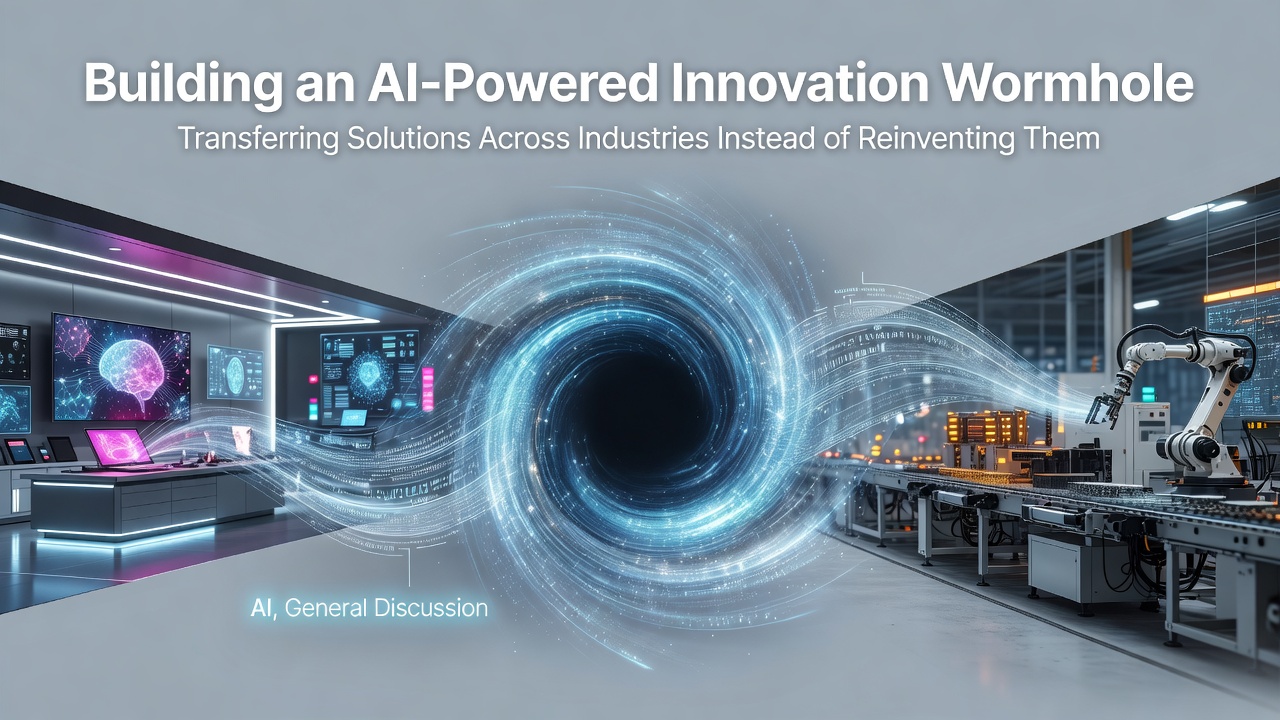
Innovation is often described as the creation of something entirely new. In reality, many breakthrough ideas are simply successful mechanisms transferred from one domain into another.
Nature inspired aerospace engineering. Video game matchmaking algorithms influenced logistics. Immune systems inspired cybersecurity. Financial risk models are now being applied to supply chain resilience.
The challenge isn't a lack of ideas.
The challenge is discovering where those ideas already exist.
The Innovation Gap
Organizations spend billions of dollars every year on research and development while unknowingly solving problems that have already been solved somewhere else.
Traditional consulting typically searches inside the client's industry.
Traditional search engines retrieve documents.
Traditional LLMs generate text.
None of these systems are explicitly designed to answer a much more valuable question:
Which proven mechanism from an entirely different industry can solve my problem?
This question became the foundation of what I call the Innovation Wormhole.
From Knowledge Retrieval to Mechanism Transfer
Instead of retrieving documents, the system retrieves mechanisms.
Instead of matching keywords, it matches problem structures.
Instead of generating ideas from scratch, it transfers validated solutions between industries.
Imagine a manufacturing company struggling with predictive maintenance.
Rather than searching only industrial papers, the platform might discover that astronomical signal processing uses nearly identical anomaly detection techniques.
The recommendation isn't merely:
"Read this paper."
It becomes:
- Why the solution works
- Which assumptions remain valid
- Required modifications
- Technical risks
- Expected ROI
- Evidence supporting the transfer
This is knowledge transfer rather than information retrieval.
The Core Architecture
The platform is organized as a pipeline of specialized reasoning modules.
1. Problem Decomposition
The customer's problem is transformed into a structured representation consisting of:
- Objectives
- Constraints
- Failure modes
- Desired outcomes
- Success metrics
This removes domain-specific language and exposes the underlying engineering problem.
2. Cross-Domain Knowledge Graph
A knowledge graph stores relationships among:
- Industries
- Problems
- Mechanisms
- Constraints
- Evidence
- Success metrics
Rather than asking:
"Which industries are similar?"
the graph asks:
"Which mechanisms solve structurally equivalent problems?"
3. Similarity Engine
The system searches for analogues using multiple dimensions:
- Structural similarity
- Functional similarity
- Behavioral similarity
- Causal similarity
The objective is not to copy an industry.
The objective is to transfer an effective mechanism.
4. Evidence Layer
Every recommendation is validated against:
- Scientific literature
- Case studies
- Patent databases
- Regulatory constraints
- Economic feasibility
Hallucinated innovation is useless.
Transferable evidence is valuable.
5. Human-in-the-Loop Validation
Domain experts remain part of the workflow.
AI accelerates discovery.
Experts validate applicability.
This hybrid approach balances scalability with reliability.
Why Existing AI Isn't Enough
Modern LLMs excel at generating explanations.
They are not optimized for discovering hidden structural equivalence across distant domains.
The real bottleneck is no longer content generation.
It is cross-domain reasoning.
The next generation of AI systems will likely focus less on producing more text and more on identifying transferable mechanisms between disconnected knowledge spaces.
Technical Challenges
Designing such a platform raises several research problems.
- How should structural similarity be represented?
- How can causal relationships be preserved during transfer?
- How do we quantify transferability?
- How should conflicting evidence be resolved?
- How can expert feedback continuously improve the system?
- How do we explain every recommendation transparently?
These challenges are closer to knowledge engineering and scientific reasoning than traditional prompt engineering.
Beyond Search: A Cognitive Infrastructure
I don't see this concept as another AI assistant.
I see it as a new layer of cognitive infrastructure.
Instead of helping people search faster, it helps organizations think across industries.
Imagine discovering that:
- Hospital workflows can optimize airports.
- Swarm intelligence can improve energy grids.
- Distributed consensus algorithms can redesign enterprise governance.
- Biological immune systems can strengthen cloud security.
Those connections already exist.
The missing technology is the bridge.
That bridge is the Innovation Wormhole.
Final Thoughts
The future of innovation may not belong to organizations with the largest R&D budgets.
It may belong to those capable of recognizing patterns hidden across completely unrelated domains.
Artificial intelligence should not merely answer questions.
Its greater purpose may be to reveal that the answer has existed all along—just somewhere no one thought to look.
What do you think?
Could cross-domain reasoning become the next major frontier for AI systems beyond Retrieval-Augmented Generation (RAG) and conventional knowledge graphs? I'd love to hear your thoughts in the comments.
created by Seyed Alireza Alhosseini Almodarresieh
0 Comments
Log in to join the conversation.No comments yet. Be the first to share your thoughts.