
[Submitted on 13 Jul 2026]
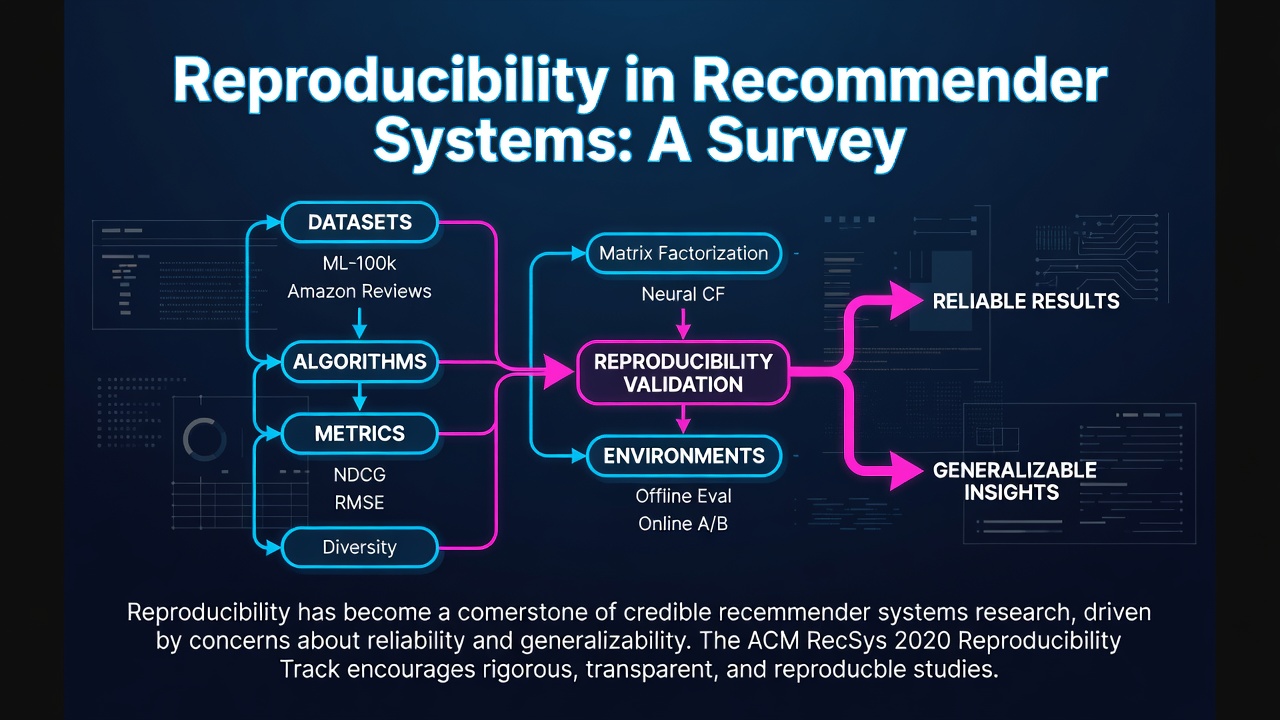
Abstract:Reproducibility has become a cornerstone of credible recommender systems research, driven by growing concerns about the reliability and generalizability of experimental results. In response, the ACM RecSys conference introduced a dedicated Reproducibility Track in 2020 to encourage rigorous, transparent, and repeatable research. This paper presents a structured analysis of the track from 2020 to 2025, covering 51 accepted papers. We classify contributions by type and analyze common patterns in datasets, algorithms, frameworks, and evaluation practices, with the goal of understanding how reproducibility is operationalized in practice within the community.
Our findings reveal three main trends. First, the track has expanded in scope, evolving from a focus on reproduction and replication to include benchmarking, resources, and methodological contributions. Second, reproducibility papers exhibit a consistent methodological profile, relying on a limited set of datasets, algorithms, and evaluation protocols. Third, reproducibility in practice often involves extending prior experiments rather than strictly replicating them, with studies frequently introducing additional models or evaluation criteria. Overall, reproducibility work has improved transparency and documentation, but has had limited impact on methodological diversity, highlighting a gap between the conceptual definition of reproducibility and its implementation.
Submission history
From: Alejandro Bellogin [view email]
[v1]
Mon, 13 Jul 2026 16:30:47 UTC (826 KB)
0 Comments
Log in to join the conversation.No comments yet. Be the first to share your thoughts.