
Originally published on tamiz.pro.
The initial promise of Generative AI was straightforward: automate knowledge work. Early implementations often looked like sophisticated chatbots—stateless, reactive, and driven by a single prompt-response cycle. But as the industry matured, the demand shifted from conversational interfaces to Agentic Workflows: systems that perceive, plan, act, and observe to achieve complex, multi-step goals.
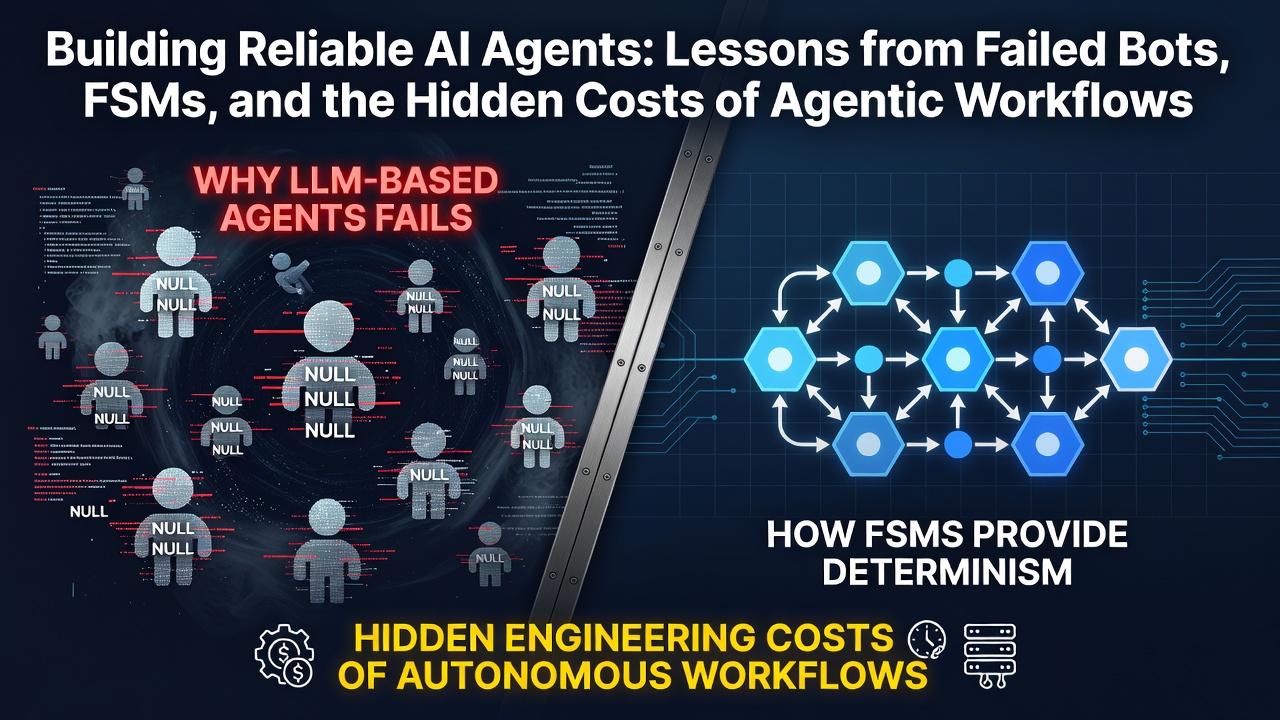
The transition from chatbot to agent is not merely an architectural upgrade; it is a fundamental shift in how we reason about software reliability. While the early wave of "agents" often collapsed under the weight of hallucination loops, infinite recursion, and unbounded cost, a new class of engineering patterns is emerging. By borrowing determinism from traditional computer science—specifically Finite State Machines (FSMs) and rigorous observability—we can build systems that are not just clever, but robust.
This deep-dive explores the architectural pitfalls of naive agentic designs, the critical role of state management in preventing failure loops, and the often-overlooked "hidden costs" that determine whether an agent stays in production or gets archived.
The Naive Agent: Why "Just Add LLM" Fails
Most failed AI agent projects share a common origin story. They begin with a powerful Large Language Model (LLM) and a tool definition (e.g., a Python function to query a database). The initial architecture is typically a simple loop:
- Input: User request.
- Think: LLM analyzes input and decides which tool to call.
- Act: System executes the tool.
- Repeat: LLM sees the output and decides the next step.
This pattern, often called ReAct (Reasoning + Acting), is elegant in theory but brittle in practice. When we remove the guardrails of traditional software engineering, three catastrophic failure modes emerge:
1. The Hallucination Loop
LLMs are probabilistic, not deterministic. If a tool call fails (e.g., a 500 error from a database), a naive agent may interpret the error message as valid data or, worse, hallucinate a successful completion to satisfy the user. Without explicit state validation, the agent enters a loop of retrying the same invalid action, consuming tokens and failing to resolve the user's intent.
2. Infinite Recursion
In complex workflows, an agent might decide it needs more information, call a tool to get it, and then decide it still needs more information. Without a hard limit on steps or a terminal state, the agent can enter an infinite loop of tool calls. This is not just a user experience failure; it is a financial liability. An infinite loop of token generation can burn through a budget in minutes.
3. Context Window Exhaustion
Every step in an agentic workflow adds history to the conversation context. As the agent performs more steps, the context window fills up. When the window is full, the LLM must summarize or drop earlier turns. This loss of context can cause the agent to forget its original goal or the results of previous actions, leading to disjointed and incoherent behavior.
The Deterministic Core: Finite State Machines (FSMs)
To build reliable agents, we must impose structure on the chaos of probabilistic generation. The most effective pattern for this is the Finite State Machine (FSM). An FSM is a mathematical model of computation consisting of a finite number of states, transitions between those states, and actions.
In the context of AI agents, an FSM does not replace the LLM; it governs it. The LLM becomes a component within the state machine, responsible for determining the next transition based on the current state and input. This separation of concerns is critical:
- The FSM handles logic: It enforces business rules, validates inputs, and ensures the agent only moves to valid next states.
- The LLM handles reasoning: It interprets natural language, generates tool calls, and synthesizes final answers.
Architectural Pattern: The Orchestrator Pattern
The Orchestrator pattern is a common implementation of FSMs for agents. In this model, a central controller (the FSM) manages the workflow. It maintains the current state and decides which sub-agent or tool to invoke next. The LLM is invoked only when necessary to make a decision or generate content.
from enum import Enum
from typing import Optional, Dict, Any

# Define the states of the agent
class AgentState(Enum):
    INIT = "init"
    PLAN = "plan"
    EXECUTE = "execute"
    VALIDATE = "validate"
    COMPLETE = "complete"
    FAILED = "failed"

class AgentFSM:
    def __init__(self):
        self.state = AgentState.INIT
        self.context: Dict[str, Any] = {}

    def transition(self, new_state: AgentState):
        # Enforce valid transitions
        valid_transitions = {
            AgentState.INIT: [AgentState.PLAN],
            AgentState.PLAN: [AgentState.EXECUTE, AgentState.FAILED],
            AgentState.EXECUTE: [AgentState.VALIDATE],
            AgentState.VALIDATE: [AgentState.COMPLETE, AgentState.PLAN], # Loop back if validation fails
            AgentState.COMPLETE: [],
            AgentState.FAILED: []
        }

        if new_state not in valid_transitions.get(self.state, []):
            raise ValueError(f"Invalid transition from {self.state} to {new_state}")

        self.state = new_state
        self.on_state_change(self.state)

    def on_state_change(self, state: AgentState):
        if state == AgentState.PLAN:
            self._plan_step()
        elif state == AgentState.EXECUTE:
            self._execute_step()
        elif state == AgentState.VALIDATE:
            self._validate_step()
        elif state == AgentState.COMPLETE:
            print("Agent completed successfully.")
        elif state == AgentState.FAILED:
            print("Agent failed. Check logs.")

    def _plan_step(self):
        # LLM is called here to generate a plan
        pass

    def _execute_step(self):
        # LLM is called here to decide tool usage
        pass

    def _validate_step(self):
        # Logic to check if the tool output is correct
        pass
Enter fullscreen mode Exit fullscreen mode
By using an FSM, we guarantee that the agent cannot enter an invalid state. We can also enforce step limits at the FSM level, preventing infinite loops regardless of what the LLM decides.
The Hidden Costs of Agentic Workflows
When engineering teams evaluate the viability of an AI agent, they often focus on accuracy metrics (e.g., "Does the agent answer correctly 90% of the time?") but neglect the operational costs. The "hidden costs" of agentic workflows are significant and can render a successful agent economically unviable.
1. Token Complexity and Latency
Each step in an agentic workflow involves sending a prompt to the LLM. If a workflow requires 10 steps, you are paying for 10 separate LLM calls. Furthermore, as the context window grows with each step, the input token count increases, driving up costs non-linearly.
Mitigation: Use smaller, specialized models for routing and classification tasks. Reserve expensive, large context models for final synthesis. Implement aggressive context management, such as summarizing past interactions or using vector retrieval to fetch only relevant context.
2. The Cost of Failure
In a traditional software system, a failed request is a single API call. In an agentic system, a failed goal might involve multiple tool calls, each consuming tokens. If an agent fails after 5 steps, you have paid for 5 steps of computation for zero value.
Mitigation: Implement early termination checks. After each tool execution, validate the output against a success criteria. If the criteria are not met, fail fast and return an error or ask for user clarification, rather than continuing to burn tokens.
3. Observability and Debugging Overhead
Debugging an agent is exponentially harder than debugging a script. You cannot simply print console.log and trace the execution flow because the LLM's decision-making process is opaque. When an agent fails, you need to know: Which state was it in? What was the prompt? What was the tool output? What was the LLM's reasoning?
Mitigation: Invest heavily in observability from day one. Use tracing tools like LangSmith, Langfuse, or Arize Phoenix to log every state transition, tool call, and LLM response. Structure your logs to include the full context of the decision-making process.
Best Practices for Production-Ready Agents
Building a reliable agent requires more than just an FSM. It requires a holistic approach to engineering. Here are key best practices for production deployment:
1. Human-in-the-Loop (HITL) for Critical Actions
For high-stakes actions (e.g., deleting a database record, sending an email to a customer), never let the agent act autonomously. Use the FSM to transition to a PENDING_APPROVAL state, where a human must explicitly approve the action.
2. Structured Output and Schema Validation
LLMs are notoriously bad at adhering to strict formats. To prevent parsing errors, use LLM providers that support structured output (e.g., JSON mode in OpenAI, Pydantic validation in LangChain). Define strict schemas for all tool inputs and outputs.
3. Idempotent Tool Design
Ensure that all tools used by the agent are idempotent. If an agent retries a failed step, the tool should produce the same result without causing side effects (e.g., creating duplicate records). This is crucial for recovery from transient errors.
4. Fallback Mechanisms
Every agent should have a fallback path. If the LLM cannot make a decision, or if the tool execution fails repeatedly, the system should gracefully degrade. This might mean returning a generic error message, escalating to a human, or providing a static, pre-defined answer.
Conclusion: Engineering Over Magic
The era of "magic" AI is over. Building reliable AI agents is no longer about finding the perfect prompt; it is about engineering robust systems that can handle uncertainty. By integrating Finite State Machines to enforce deterministic logic, implementing rigorous observability to track hidden costs, and designing for failure from the start, we can move beyond fragile prototypes to production-grade agentic workflows.
The future of AI engineering lies not in making the LLM smarter, but in making the system around it more reliable. As you build your next agent, remember: the LLM is just one component in a larger, deterministic machine.
Frequently Asked Questions
Q: Can I use an FSM with any LLM provider?
A: Yes. The FSM is an architectural pattern that runs in your application code (e.g., Python, TypeScript). It interacts with the LLM via API calls, so it is provider-agnostic. You can swap OpenAI, Anthropic, or local models without changing the FSM logic.
Q: How do I handle long-running agent workflows?
A: For workflows that take minutes or hours, use asynchronous task queues (e.g., Celery, BullMQ) and persist the FSM state to a database. This allows the system to recover from crashes and resume from the last state.
Q: Is the Orchestrator pattern better than the Multi-Agent pattern?
A: It depends. Orchestrator patterns are generally more deterministic and easier to debug because there is a single source of truth for the workflow. Multi-agent patterns (where agents talk to each other) are more flexible but significantly harder to control and debug. Start with Orchestrator for most use cases.
0 Comments
Log in to join the conversation.No comments yet. Be the first to share your thoughts.