
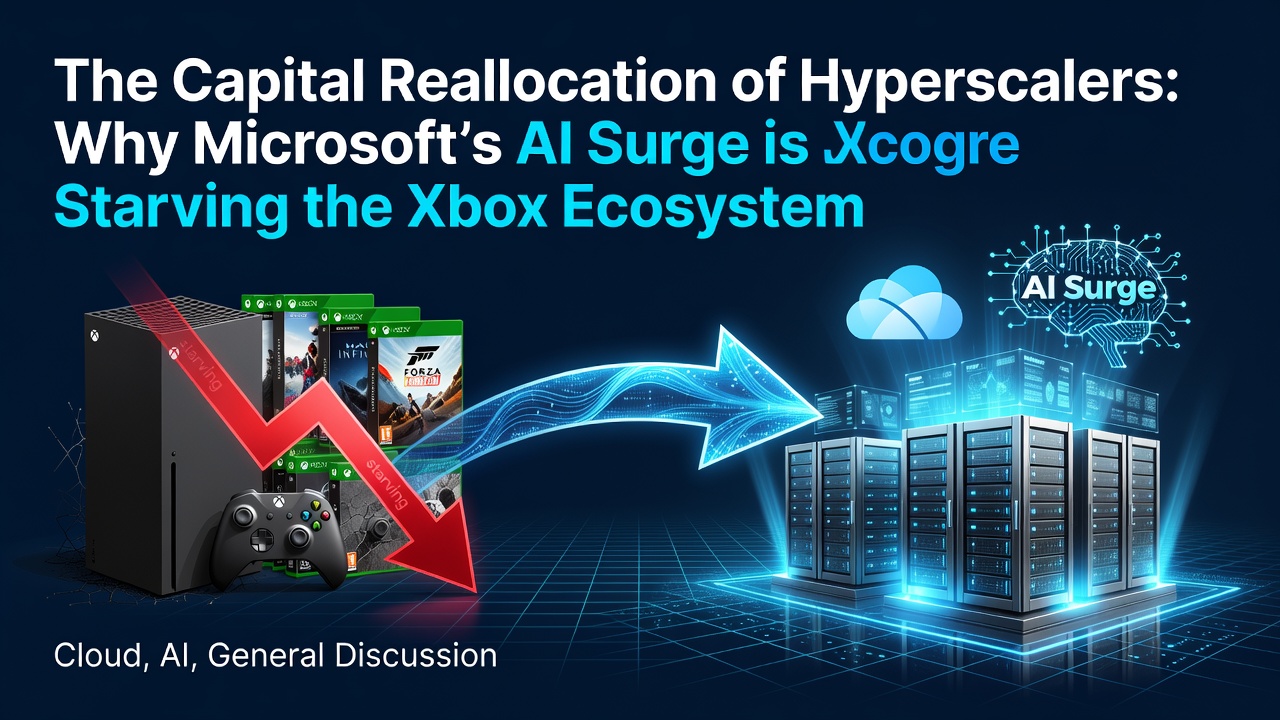

The Capital Reallocation of Hyperscalers: Why Microsoft’s AI Surge is Starving the Xbox Ecosystem
Context & Core Event Analysis
Microsoft's Q4 2026 earnings report highlights a stark divergence in its portfolio: while its Intelligent Cloud and AI divisions continue to surge, the Xbox gaming division is experiencing a pronounced contraction. Xbox hardware sales plummeted by 13 percent, and content and services revenue—historically anchored by the Game Pass subscription model—dipped by 10 percent.
This decline is not merely a cyclical gaming downturn; it represents a fundamental shift in Microsoft’s corporate priorities and capital allocation. Over the past several quarters, Microsoft has aggressively scaled its capital expenditures (CapEx) to build out global AI infrastructure, securing liquid-cooled data centers, high-bandwidth networking, and massive clusters of accelerators.
The contraction of Xbox indicates that the consumer hardware and subscription-based entertainment model is losing its status as a primary growth engine. As Microsoft pivots to become the foundational platform for the agentic AI era, the massive cash flows required to sustain first-party game development and subsidize console hardware are being weighed against the immediate, high-margin returns of enterprise cloud and AI services. In the zero-sum game of data center power allocation and capital expenditure, the consumer gaming division is paying the price.
Domain Knowledge & Technical Extension
From an infrastructure perspective, the divergence between Xbox and Azure AI reveals the brutal reality of opportunity cost in hyperscale computing. A modern gaming cloud infrastructure (such as Xbox Cloud Gaming) relies on custom server blades populated with console-class APUs. These proprietary chips occupy valuable rack space, consume power, and require specialized software stacks that do not easily translate to general-purpose enterprise workloads.
In contrast, the modern AI data center is optimized for dense compute, utilizing unified memory architectures, high-speed InfiniBand or RoCE (RDMA over Converged Ethernet) fabrics, and custom silicon like Microsoft's Maia accelerators. When power and physical space in data centers are the ultimate limiting factors of the AI era, dedicating megawatts of power to low-margin consumer game streaming becomes increasingly difficult to justify.
Furthermore, the software engineering overhead required to maintain a consumer gaming ecosystem—spanning digital rights management (DRM), anti-cheat systems, and cross-platform compatibility layers—is highly fragmented. Conversely, enterprise AI infrastructure leverages standardized containerization, unified API endpoints, and open-weights or proprietary model registries. By shifting engineering talent from legacy consumer platforms to optimizing LLM inference pipelines and developer tools (like GitHub Copilot and Azure AI Studio), Microsoft maximizes its developer-to-revenue efficiency.
Trade-off & TCO Breakdown
The structural trade-off here lies in the Total Cost of Ownership (TCO) of consumer subscription models versus enterprise API platforms.
- Consumer Subscription (Game Pass): High content acquisition costs (licensing third-party titles), continuous hardware subsidy write-offs, and high egress costs for cloud streaming. The TCO is highly sensitive to subscriber churn and escalating game development budgets.
- Enterprise AI Infrastructure: High initial CapEx for silicon and power infrastructure, but significantly lower marginal operating costs once models are deployed. Enterprise customers bear the integration and engineering maintenance costs of building applications on top of Azure APIs, shifting the operational burden away from Microsoft.
How long can a hyperscaler justify maintaining a capital-intensive, low-margin consumer hardware division when the marginal return on AI infrastructure investment is orders of magnitude higher? If the marginal utility of a dollar spent on AI compute capacity yields exponential enterprise lock-in, the strategic contraction of consumer hardware is not a failure, but a calculated retreat.
Comment: This is not proof that interactive consumer entertainment is fundamentally unviable for hyperscale platforms, nor that legacy hardware ecosystems can permanently sustain growth without continuous capital injection; it is proof that when compute power and data center real estate become the ultimate scarce resources, enterprise AI infrastructure will inevitably cannibalize the capital and engineering talent of lower-margin consumer divisions. (Personal view)
0 Comments
Log in to join the conversation.No comments yet. Be the first to share your thoughts.