
I’ve just seen the future of test and instrumentation and test, and it’s awesome, let me tell you! Yes, I know I said, “test and instrumentation and test.” Do I look like the sort of man who wouldn’t know if he said, “test and instrumentation and test”? (Don’t answer that.)
The thing is that there is a subtle difference between “test and instrumentation” and “instrumentation and test.” What’s that, you say? You are agog with excitement at the prospect of hearing more. Well, never let it be said that I failed to disappoint.
People often talk about “test and instrumentation” and “instrumentation and test” as though they’re interchangeable. They’re certainly close cousins, but I like to think the order tells a story. Test is something you do. Instrumentation is what makes it possible. Without instruments, testing quickly degenerates into educated guesswork. Without testing, even the world’s finest instruments are little more than expensive paperweights.
“Test and instrumentation” (T&I) suggests that testing is the primary activity, with instrumentation referring to the tools and equipment that make the testing possible. By comparison, “instrumentation and test” (I&T) suggests that instrumentation is the broader discipline, with testing being one of its major applications.
Just for giggles and grins, in most engineering disciplines, “test and measurement” (T&M) has become the established phrase because the two concepts are closely linked. However, different industries have settled on different conventions, such as “instrumentation and measurement” (I&M), which is common in process control and scientific research circles.
But we digress…
These days, we are spoilt for choice when it comes to test instrumentation. Things are much different from when I started out as a bright-eyed, bushy-tailed, newly minted engineer. Take the oscilloscope, for example (cue “traveling back in time” audio and visual effects). In the all-vacuum-tube era (1930s to 1960s), everything was implemented using thermionic valves for amplification, triggering, sweep generation, and control, along with a cathode ray tube (CRT) for display.
These instruments were masterpieces of analog engineering. If you looked inside a high-end oscilloscope from the 1950s or early 1960s, for example, you’d typically find 50–100 vacuum tubes, sometimes more. We’re talking about devices that could easily measure around 24 × 18 × 25 inches (61 × 46 × 64 cm) and weigh anywhere from 60 to 90 pounds (27 to 41 kg).
These weren’t instruments so much as pieces of laboratory furniture. If you lifted one of these monsters onto your workbench, you tended to leave it there. Moving it again required planning, determination, and one or more willing volunteers.
By the time I was studying engineering in the late 1970s, the world was in transition. Some laboratory oscilloscopes still glowed reassuringly with dozens of vacuum tubes secreted inside their cases, while newer models had embraced transistors. Regardless of what lurked inside, however, every oscilloscope still relied on a cathode-ray tube to display its traces.
Even in the early 2000s, it typically took two of us and a wheeled trolley to manhandle one of these CRT-based beasts into place. And then modern display technologies came to the fore. For example, I’m looking at the RIGOL DS1054 sitting next to me on my office desk (the oscilloscope is sitting on the desk… I’m sitting in my command chair… you know what I mean).
This bodacious beauty occupies less desk space than a modest-sized hardback book, weighs only about 7½ pounds (3.4 kg), offers four input channels, stores captured waveforms in memory, performs automatic measurements by the bucketload, and sports a bright color LCD that would have seemed like science fiction to the engineers who designed those early tube-based instruments. Better still, I can usually connect a probe, press the AUTO button, and be rewarded with a beautifully stable waveform within a second or so.
The problem is that—in the same way you can never have enough cutters, pliers, or screwdrivers (speaking for a friend)—you can never have enough test instrumentation. A digital multimeter tells you what happened. An oscilloscope tells you when it happened. A logic analyzer tells you why your digital interface is sulking. A spectrum analyzer reveals frequencies you didn’t even know were there. And don’t even get me started on protocol analyzers, vector network analyzers, arbitrary waveform generators, RF signal generators, frequency counters… the list goes on.
Each instrument answers a different question. Unfortunately, each answer usually prompts more questions, but such is the engineer’s lot in life (I try to be brave).
Or perhaps not…
As I said at the beginning, “I’ve just seen the future of test and instrumentation and test,” and it’s rather different from anything that’s gone before (Buck Rogers in the 25th Century would be proud).
The person we must blame for showing me this future is Daniel Shaddock, co-founder and CEO of Liquid Instruments. This isn’t someone who meandered his way into the world of test equipment by accident. Quite the opposite. He’s spent much of his career pushing the limits of precision measurement.
Daniel began as a physicist working on the Laser Interferometer Gravitational-Wave Observatory (LIGO), one of the most ambitious scientific instruments ever constructed. Detecting gravitational waves required measuring changes in distance so unimaginably small that, as Daniel explained, even a powerful gravitational wave passing between the Earth and the Sun would alter the distance separating them by little more than the diameter of a hydrogen atom. He later worked at NASA’s Jet Propulsion Laboratory (JPL), where an entirely different challenge presented itself. Instead of operating a room full of exquisitely delicate laboratory equipment, the goal was to package all that functionality into an autonomous spacecraft capable of operating for years without anyone touching it.
Although those two projects appear very different, they shared a common thread. In both cases, Daniel found himself asking the same question: what if we could move as much complexity as possible out of the hardware and into digital signal processing? At that time, field-programmable gate arrays (FPGAs) were becoming powerful enough to make this practical. Rather than building ever more complicated analog hardware, many functions could instead be implemented in reconfigurable digital logic. This idea would eventually become the foundation of Liquid Instruments.
“Liquid Instruments” isn’t a reference to plumbing supplies, though Daniel sheepishly admits they still receive the occasional inquiry from someone on a quest to buy pipes and fittings. Instead, “liquid” reflects the idea that the hardware itself is fluid. One moment it’s an oscilloscope. The next moment it’s a lock-in amplifier. Then it becomes a spectrum analyzer, a waveform generator, a phasemeter, or something else entirely. The instrument changes while the hardware remains the same.
In many ways, this represents the next logical step in the evolution of test instrumentation. During the 1950s, companies like Tektronix and Hewlett-Packard transformed the industry by producing dedicated hardware instruments in large numbers. The following decades saw the rise of modular platforms such as PXI, allowing engineers to combine multiple hardware modules within a common chassis. Valuable though these developments were, each new capability required yet another hardware module. The folks at Liquid Instruments have taken a different approach. Instead of hardware-defined instruments, their Moku systems use software-defined instruments running on extremely powerful FPGA-based hardware. It’s not simply another instrument—it’s a platform.
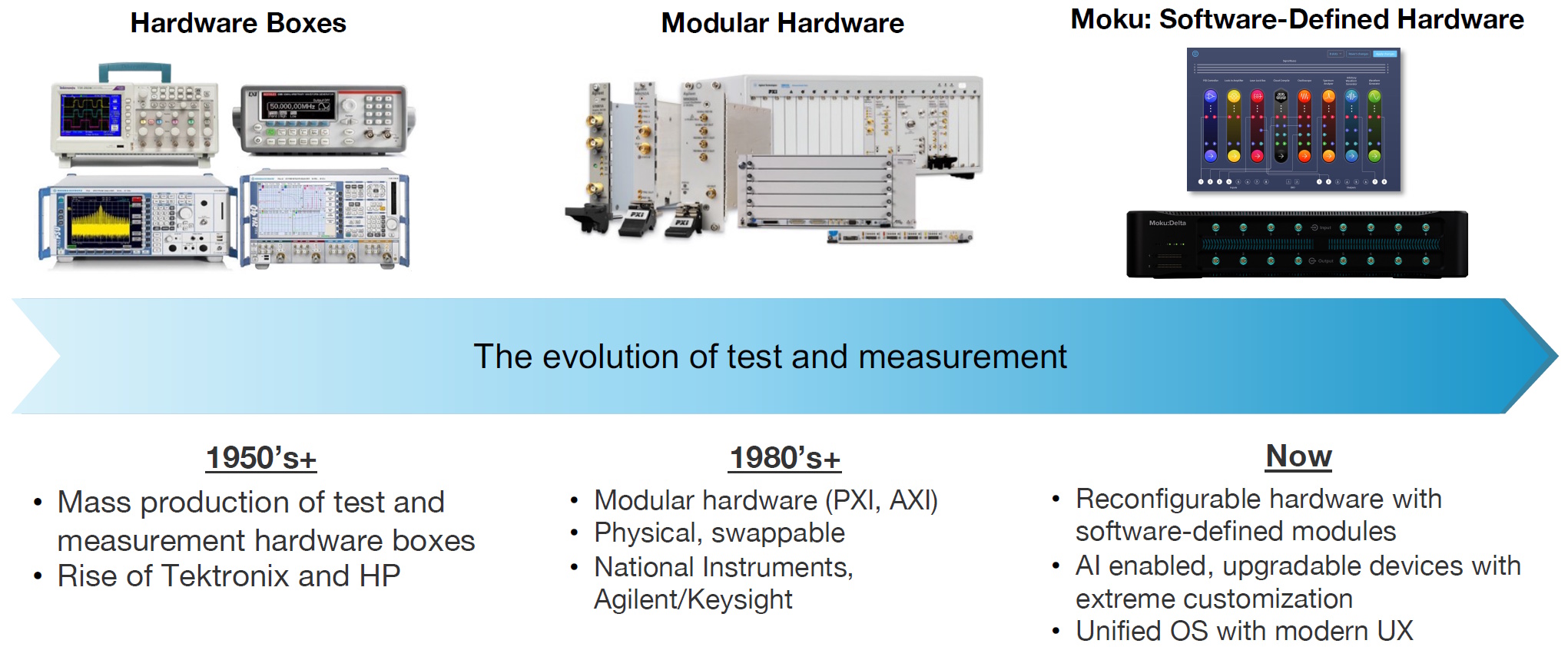
The evolution of test and measurement (Source: Liquid Instruments)
The Moku family spans Moku:Go, Moku:Lab, Moku:Pro (all shown in the image below), and the company’s newest flagship product, Moku:Delta (shown in the upper-right of the image above).
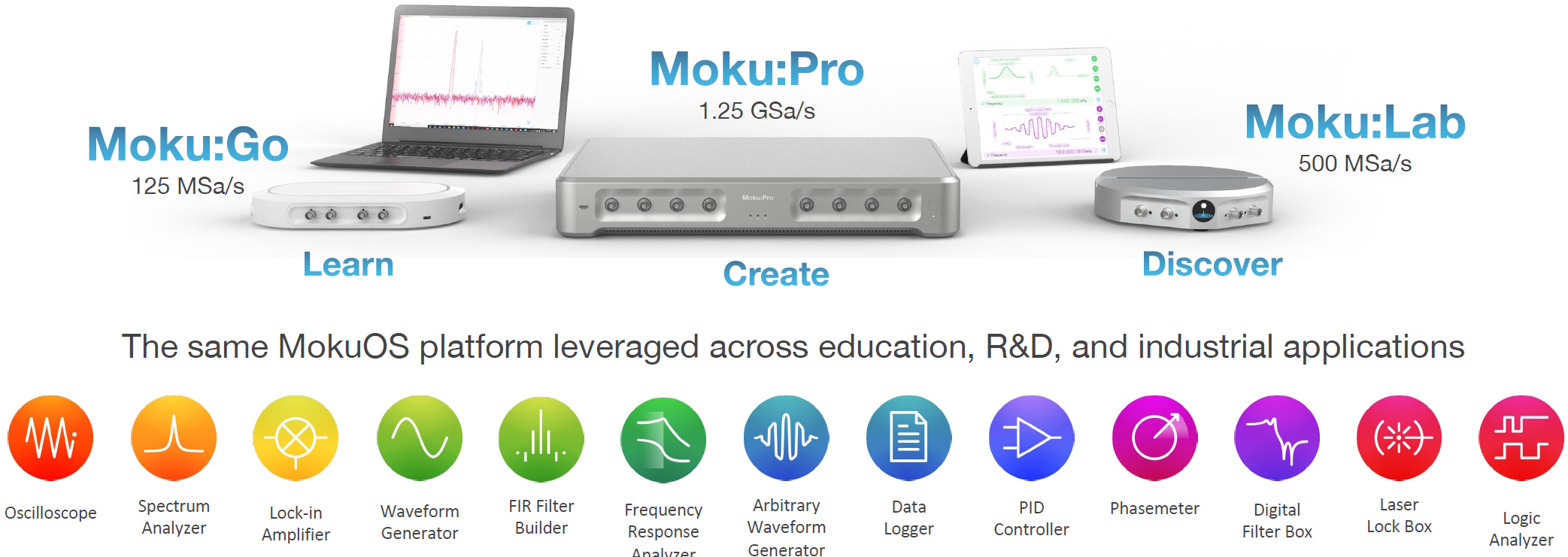
At first glance, these resemble elegant pieces of laboratory equipment. Under the hood, however, lurk some extremely serious FPGAs coupled with equally serious analog front ends. Daniel was keen to stress that these are not inexpensive FPGA development boards with connectors bolted to the front. Their heritage lies in precision metrology, and considerable engineering has gone into the analog signal conditioning before the signals ever reach the FPGA.
The result is laboratory-grade instrumentation that bears little resemblance to the traditional boxes lining most engineers’ benches. Rather than selecting one instrument at a time, users can instantiate multiple instruments simultaneously—including multiple copies of the same instrument if desired. Better still, these instruments don’t steal performance from one another. Unlike many conventional instruments, where enabling additional channels reduces bandwidth or sample rate, each Moku instrument continues to operate at full performance. That alone is enough to make many engineers sit up and pay attention.
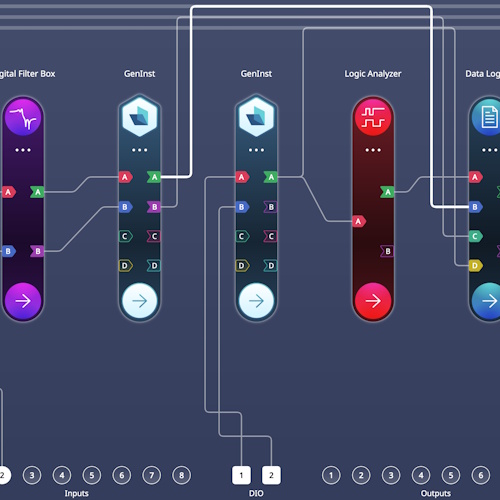
Things become even more interesting once you discover that these software-defined instruments can be connected together inside the FPGA. The output from a waveform generator can feed directly into a filter, whose output feeds a PID controller, whose output drives another processing stage before finally emerging at a physical connector. Instead of a bench covered with patch leads linking separate instruments, the signal path exists entirely within the reconfigurable hardware. The user simply drags virtual connections between instruments on the screen.
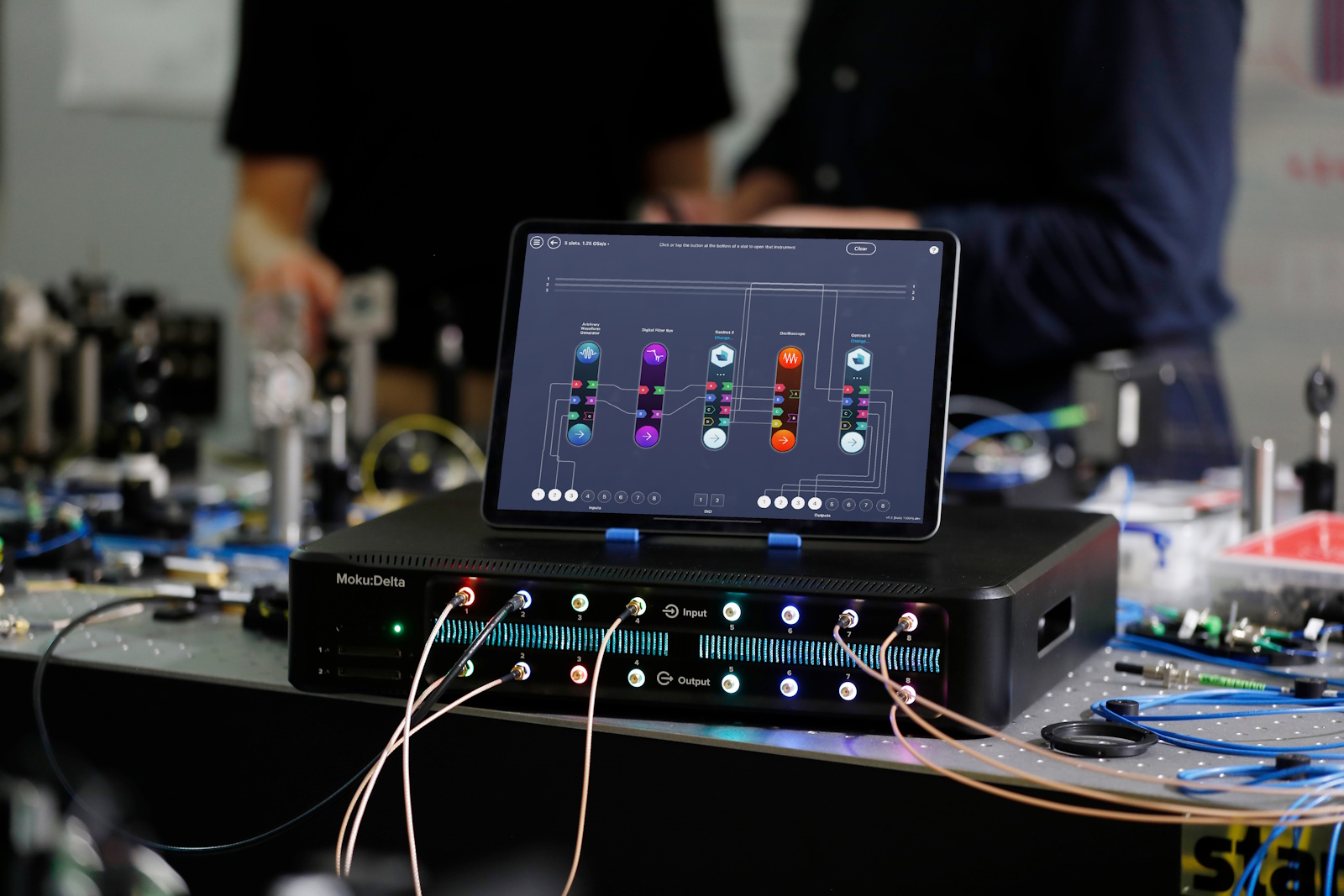
Daisy-chaining software-defined instruments (Source: Liquid Instruments)
Equally refreshing is the user interface. Engineers can display several instruments simultaneously on a single dashboard or spread them across multiple displays. Touch screens work naturally, as do conventional Windows and macOS systems. Python, MATLAB, and LabVIEW users are all catered for, while laboratories can network multiple systems together and control everything remotely. This all feels much less like operating a collection of individual instruments and much more like interacting with a modern software platform.
You can find a wealth of additional information about Moku:Delta on the Liquid Instruments website and their YouTube channel, including this video showing the unit’s launch event from the iconic stage of BMW Welt in Munich last year.
Had our conversation ended here, I would already have come away impressed. Software-defined instrumentation running on high-performance FPGA hardware is, by itself, a compelling proposition. But then Daniel showed me what the company unveiled just a few days ago as I pen these words, and I very nearly squealed in delight.
The guys and gals at Liquid Instruments call their new AI-enabled instrument creation platform GenInst Studio (“GenInst” being short for Generative Instrumentation).
Suppose you need a measurement instrument that doesn’t exist. Perhaps a custom filter combined with a bespoke controller and a measurement algorithm that no commercially available instrument provides. Traditionally, you had two choices. Either you approximated your requirements using standard instruments, accepting compromises along the way, or you hired FPGA specialists and spent weeks or months designing a custom solution.
GenInst completely changes the equation (no pun intended). Instead of cobbling an instrument together, you simply describe what you want in plain English (“I need a four-input trigger with independent thresholds and programmable timing”). GenInst analyses the request, develops an implementation, generates the required instrumentation, validates the design, and deploys it directly onto the Moku hardware. What once demanded specialist FPGA expertise can now be accomplished through a conversational interface in minutes rather than months.
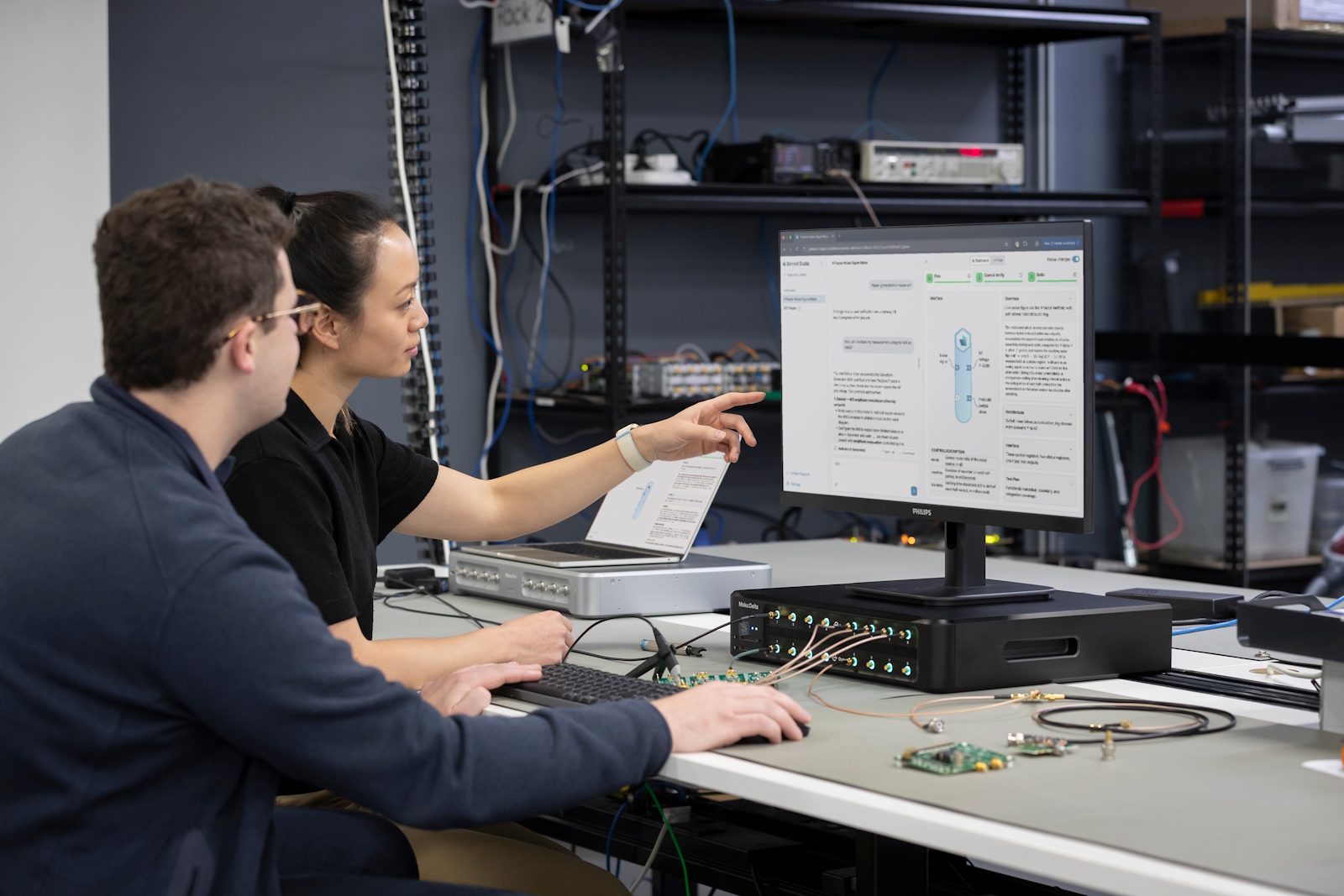
Users generating new test equipment functionality on-the-fly (Source: Liquid Instruments)
The interesting thing here isn’t the artificial intelligence itself. AI is simply the latest enabling technology. The real story is the continuing abstraction of instrumentation. Early engineers built hardware. Later engineers configured software-defined hardware. Now they simply describe the measurement problem they wish to solve, and the corresponding instrumentation appears almost as if by magic.
Perhaps the most reassuring aspect of GenInst is what it doesn’t do. It doesn’t ask engineers to trust AI-generated measurement algorithms running unchecked inside laboratory instruments. Instead, it leverages AI to configure, combine, and orchestrate proven instrumentation building blocks whose behavior has already been thoroughly characterized and validated. The intelligence lies in determining how to assemble the solution—not in replacing the underlying engineering with something mysterious or unpredictable.
For almost a century, we’ve been asking, “Which instruments do I need?” More often than not, however, the real question has been, “Which instruments do I actually have?” GenInst changes the question entirely. Now it’s simply, “What problem am I trying to solve?”
In fact, we’ve reached the point where we don’t even need to know what instrument(s) we need (that sentence very nearly got away from me). With GenInst, all we have to do is describe the measurement problem we’re trying to solve, and the instrument comes to us. As I said at the beginning, “I think I’ve just seen the future of test and instrumentation and test.” I’m confident Buck Rogers would approve.
0 Comments
Log in to join the conversation.No comments yet. Be the first to share your thoughts.