
[Submitted on 1 Oct 2025 (v1), last revised 24 Jul 2026 (this version, v2)]
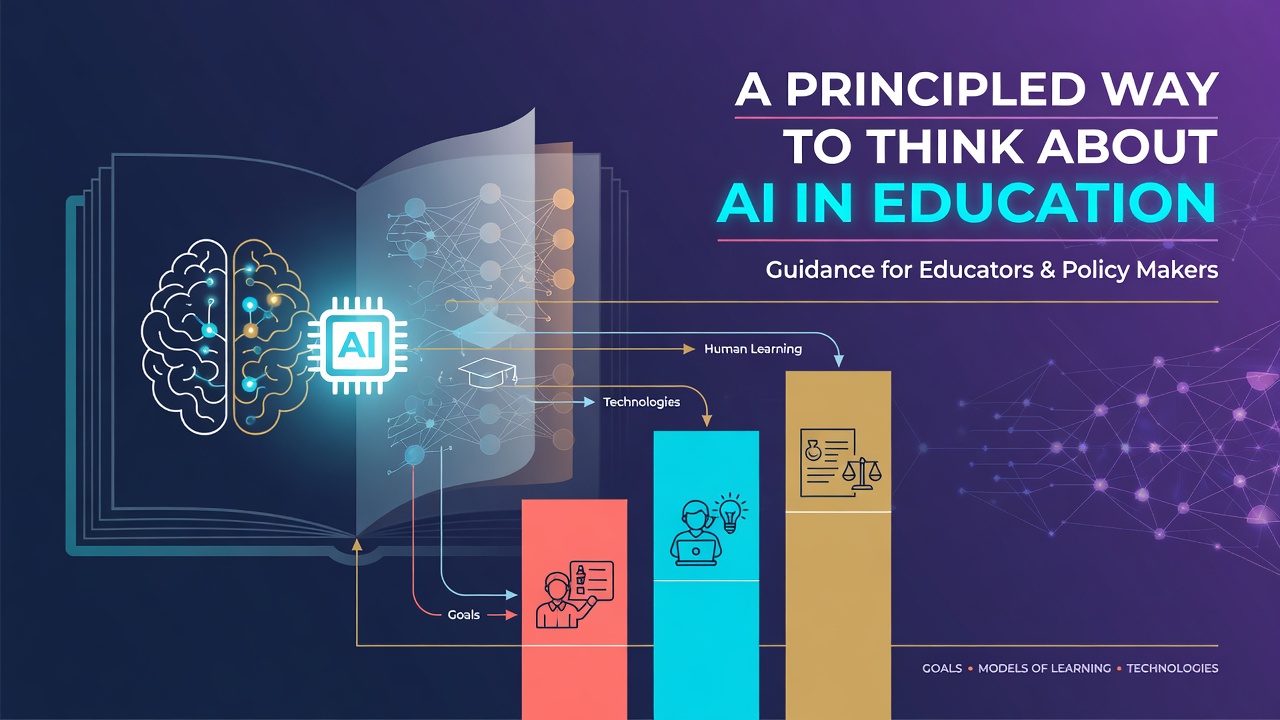
Abstract:The rapid emergence of generative artificial intelligence (AI) and related technologies has the potential to dramatically influence higher education, raising questions about the roles of institutions, educators, and students in a technology-rich future. While existing discourse often emphasizes either the promise and peril of AI or its immediate implementation, this paper advances a third path: a principled framework for guiding the use of AI in teaching and learning. Drawing on decades of scholarship in the learning sciences and uses of technology in education, I articulate a set of principles that connect broad educational goals to actionable practices. These principles clarify the respective roles of educators, learners, and technologies in shaping curricula, designing instruction, assessing learning, and cultivating community. The piece illustrates how a principled approach enables higher education to harness new tools while preserving its fundamental mission: advancing meaningful learning, supporting democratic societies, and preparing students for dynamic futures. Ultimately, this framework seeks to ensure that AI augments rather than displaces human capacities, aligning technology use with enduring educational values and goals. It is meant as a practical guide for anyone engaging in the use of new technology tools in their educational practices, or those people setting educational policies in the modern era.
A new preamble (Jul 2026) and modest updates throughout the paper contextualize it since initial sharing (Jul 2025). The good news is that the arguments and principles of action posted originally appear to still be relevant one year later
Submission history
From: Noah Finkelstein [view email]
[v1]
Wed, 1 Oct 2025 21:19:12 UTC (149 KB)
[v2]
Fri, 24 Jul 2026 12:39:30 UTC (316 KB)
0 Comments
Log in to join the conversation.No comments yet. Be the first to share your thoughts.