


Most teams building AI agents are treating memory and inference cost as something the next model release will eventually fix. They believe that a bigger context window, a smarter retriever, a cheaper token rate, etc. would absolve the need for a system for solving agent memory.
This posture is convenient but it is wrong. What an agent remembers, when it forgets, and how much it costs to reason are architectural decisions. They get made long before any model is involved, and no amount of model improvement fixes a bad architecture underneath it.
Memory is a lifecycle, not a buffer
Most agent systems today treat context as one shared blob: everything goes in, nothing meaningfully comes out, and the "solution" to running out of room is a bigger window. That is not a memory system, it is a pile.
A lifecycle approach breaks this into stages that each need their own design:
- Ingestion: what gets written to memory in the first place, and at what granularity
- Scoping: what is relevant to this agent, this user, this task, versus what is just noise that happened to be nearby
- Decay: what loses relevance over time and should be forgotten deliberately, not accidentally truncated when the buffer fills up
- Retrieval: what gets pulled back into context for a given turn, and why
Treat these as one undifferentiated blob and you get exactly the failure modes everyone complains about: agents that "forget" things that mattered and "remember" things that did not.
Where the cost actually goes
Most of the token spend in agent systems is not the reasoning itself, it is carrying forward context that no longer earns its place. Every stale fact, every resolved sub-task, every turn of small talk that gets re-sent on every subsequent call adds up, and it adds up silently, because nothing in a shared-buffer architecture prompts you to ask whether that context is still worth its cost.
Getting this right requires treating cost as a lifecycle property too, not a line item you optimize after the fact.
We argue a methodology and 5 primitives would be a better approach
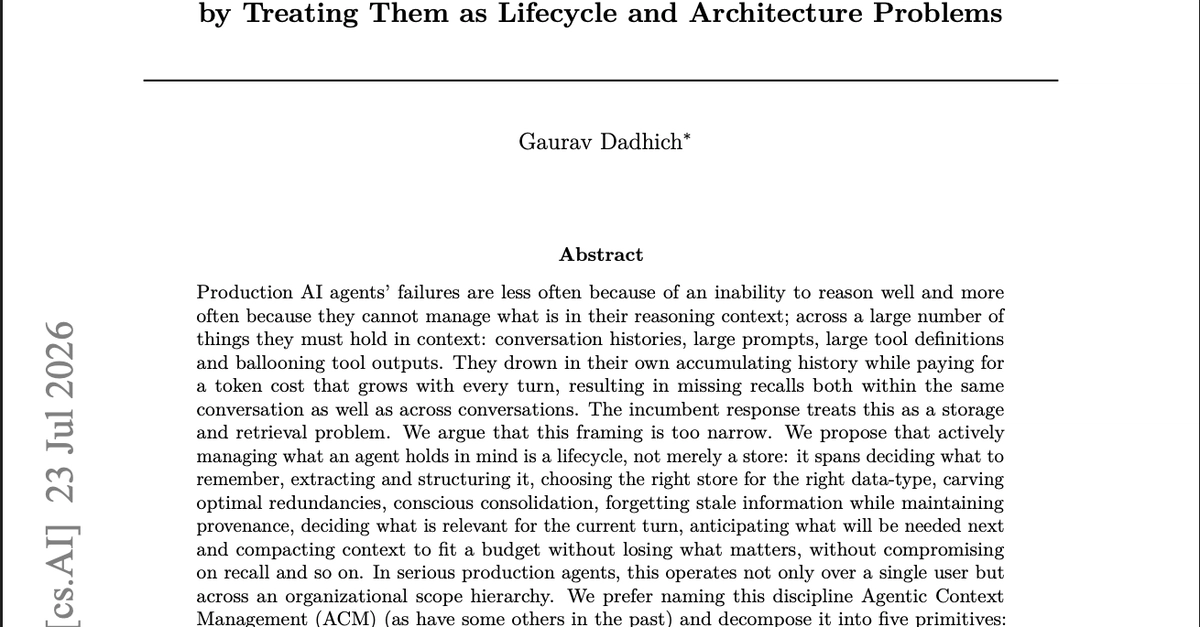
I wrote this up formally in a 23-page paper, "Agentic Context Management". It includes a full evaluation harness and the underlying study data, so the argument is not just conceptual, it is something you can check.
This is the same thinking behind the memory work we have been doing at Synap, now written up with data behind it.
Paper: arxiv.org/abs/2607.21503
Genuinely interested in where people think the lifecycle framing breaks down, especially anyone running multi-agent systems where scoping gets a lot harder.
About Author:
I am the founder of Maximem.ai - an agentic context management and agent memory company.
0 Comments
Log in to join the conversation.No comments yet. Be the first to share your thoughts.