
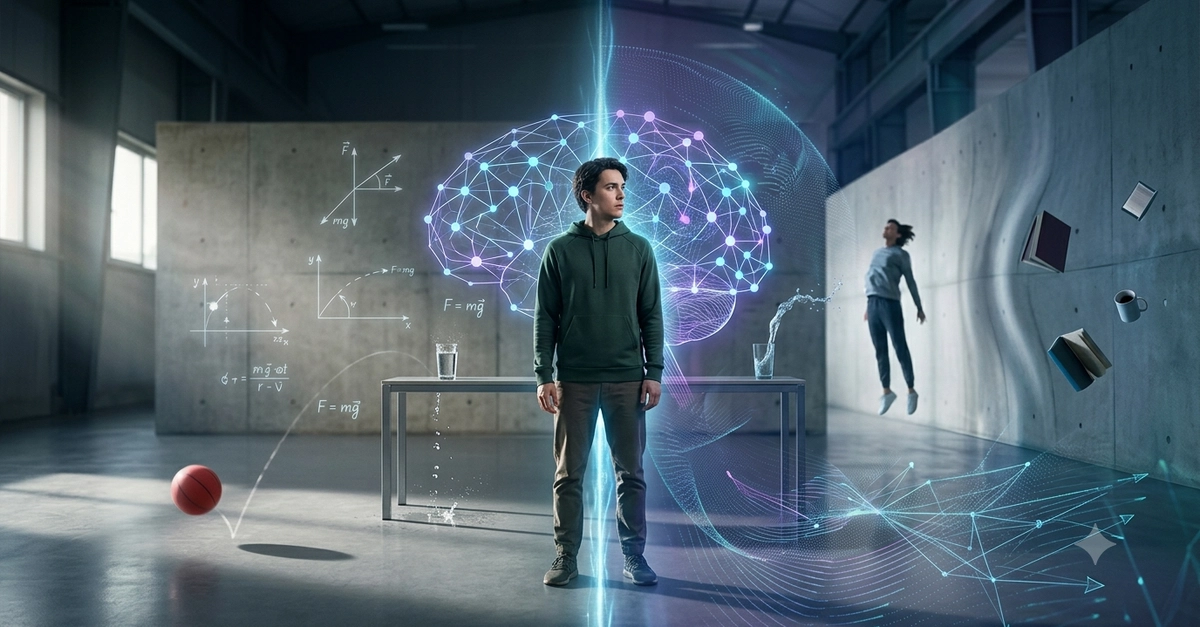
How synthetic reality may influence human intuition about motion, gravity, and causality
AI video generation has reached a point where a model can create scenes that look physically convincing at first glance:
- A person jumping impossible distances
- Objects moving without inertia
- Water flowing upward
- Animals performing human-like actions
- Buildings bending like rubber
- People interacting with impossible environments
For decades, humans learned physics by observing the real world.
A ball falls.
A glass breaks.
A person cannot walk through a wall.
Heavy objects require more force to move.
These observations create what cognitive scientists call intuitive physics: an internal mental model that predicts how objects should behave.
But what happens when the majority of visual experiences become synthetic?
Could AI-generated videos slowly change how future generations perceive reality?
Humans Do Not See Reality Directly
A common misconception is that our brain works like a camera:
Reality → Eyes → Brain → Understanding
Enter fullscreen mode Exit fullscreen mode
The actual process is closer to:
Reality
   ↓
Sensory input
   ↓
Brain prediction model
   ↓
Perception
Enter fullscreen mode Exit fullscreen mode
The brain is constantly predicting what should happen next.
When you see a ball thrown into the air, your brain automatically predicts:
- trajectory
- speed
- gravity
- collision point
- acceleration
This happens before conscious reasoning.
This capability is known as predictive processing.
Your brain is not only asking:
"What am I seeing?"
It is also asking:
"Does this match my internal model of how the world works?"
The Brain Learns Physics From Experience
Young children do not learn physics from equations.
They learn by interaction.
A baby discovers:
- Objects continue to exist when hidden
- Unsupported objects fall
- Solid objects cannot overlap
- Larger objects require more effort to move
Researchers call these abilities core knowledge systems.
Humans appear to have an innate expectation that the physical world follows consistent rules.
For example:
A child watching a ball roll behind a box expects it to continue moving.
A child watching a video where a ball disappears and appears somewhere else recognizes something is unusual.
The brain has a physics simulator.
What Changes When Videos Become Physically Incorrect?
Imagine a child growing up with thousands of hours of AI-generated videos.
Many videos may contain:
- impossible acceleration
- incorrect gravity
- unrealistic collisions
- objects changing shape
- characters violating biomechanics
Does the brain update its physics model?
The answer is:
Probably yes, but not in a simple way.
The human brain is highly adaptable.
It constantly adjusts based on experience.
For example:
Pilots
Pilots who use flight simulators develop new perceptual abilities.
Their brains adapt to:
- unusual movement
- instrument-based navigation
- artificial visual environments
Gamers
People who play first-person games become better at:
- spatial reasoning
- predicting movement
- controlling virtual cameras
The brain can learn artificial environments.
But There Is an Important Difference
Games and simulations usually have:
consistent fake physics
Enter fullscreen mode Exit fullscreen mode
AI-generated videos may have:
inconsistent fake physics
Enter fullscreen mode Exit fullscreen mode
This difference matters.
A game creates a new rule system:
World A:
Gravity = 9.8 m/s²
Collision = consistent
Movement = predictable
Enter fullscreen mode Exit fullscreen mode
Your brain learns:
"This world has different rules."
But AI-generated videos may show:
Video 1:
Gravity exists

Video 2:
Gravity disappears

Video 3:
Objects move backward in time

Video 4:
Humans stretch like cartoons
Enter fullscreen mode Exit fullscreen mode
The problem is not artificial reality.
The problem is unstable reality.
The Same Question Was Asked About Cartoons
This is not the first time humans have worried about artificial representations.
Cartoons have shown impossible physics for more than a century.
Examples:
- Characters surviving explosions
- Objects stretching
- Gravity stopping until someone notices
- Characters falling after realizing they are in the air
Yet most people do not believe these things happen.
Why?
Because humans categorize information.
The brain understands:
Cartoon world ≠ Real world
Enter fullscreen mode Exit fullscreen mode
The concern with AI-generated video is different:
AI video ≈ Real video
Enter fullscreen mode Exit fullscreen mode
The boundary becomes less obvious.
The New Problem: Loss of Reality Labels
Historically, humans had strong signals:
Real:
- camera imperfections
- physical limitations
- consistent lighting
- natural motion
Fake:
- animation style
- obvious CGI
- unrealistic rendering
Modern AI video reduces this gap.
A generated video may look like:
Real camera
+
Real person
+
Real environment
+
Impossible physics
Enter fullscreen mode Exit fullscreen mode
The viewer receives conflicting information:
Visual realism says:
"This happened."
Physics intuition says:
"This cannot happen."
Could This Affect Future Generations?
A realistic scenario:
A child sees thousands of AI-generated videos before having enough real-world experience.
Their visual dataset becomes:
Internet videos:
    70% synthetic
    30% real
Enter fullscreen mode Exit fullscreen mode
Their brain learns statistical patterns from this environment.
Modern AI systems work similarly.
A neural network learns from data distribution.
Humans also learn from experience distribution.
However, humans have additional sources:
- physical interaction
- social correction
- scientific education
- personal experience
Touching a falling object is stronger evidence than watching 10,000 videos.
The Bigger Risk Is Not Physics — It Is Trust
The most significant cognitive impact may not be:
"People believe impossible physics."
It may be:
"People stop knowing what evidence to trust."
AI-generated videos challenge our assumption:
Seeing = knowing
Enter fullscreen mode Exit fullscreen mode
For thousands of years:
"I saw it happen" was strong evidence.
Now:
"I saw a video" is no longer enough.
This affects:
- journalism
- education
- scientific communication
- politics
- social trust
Implications for Software Engineers Building AI Systems
As developers building generative AI products, we should think beyond model quality.
The question is not only:
"Can we generate realistic video?"
The bigger question:
"How will humans interpret these generated realities?"
Possible engineering solutions:
1. Provenance Metadata
Generated content should carry:
{
  source: "AI-generated",
  model: "video-model-x",
  timestamp: "...",
  generation_id: "..."
}
Enter fullscreen mode Exit fullscreen mode
Similar to image metadata standards.
2. Watermarking
Invisible signals could help detect synthetic media.
Challenges:
- attackers may remove them
- compression can damage them
3. Physics-Aware Generation
Future video models may need:
Visual realism
+
Physical simulation
Enter fullscreen mode Exit fullscreen mode
Instead of only learning:
"What pixels usually look like"
they need:
"How the world behaves."
Possible integration:
AI Video Model

        +

Physics Engine

        +

World Model
Enter fullscreen mode Exit fullscreen mode
The Future: Synthetic Reality Needs Synthetic Literacy
The next generation may not have a problem distinguishing:
real vs cartoon
Enter fullscreen mode Exit fullscreen mode
They will need to distinguish:
real event
generated event
simulated event
edited event
Enter fullscreen mode Exit fullscreen mode
Just as previous generations learned:
books are not reality
movies are not reality
games are not reality
Enter fullscreen mode Exit fullscreen mode
future generations must learn:
AI video is not automatically evidence
Enter fullscreen mode Exit fullscreen mode
Final Thoughts
AI-generated videos probably will not make humans forget basic physics.
Our brains are too strongly grounded in physical interaction.
However, synthetic media may change something deeper:
our relationship with visual evidence.
The challenge of the AI era is not only creating machines that can generate realities.
It is creating humans who can navigate a world where reality itself can be generated.
The future skill may not be:
"Can you create realistic images?"
It may be:
"Can you reason about reality when images are no longer reliable?"
0 Comments
Log in to join the conversation.No comments yet. Be the first to share your thoughts.