
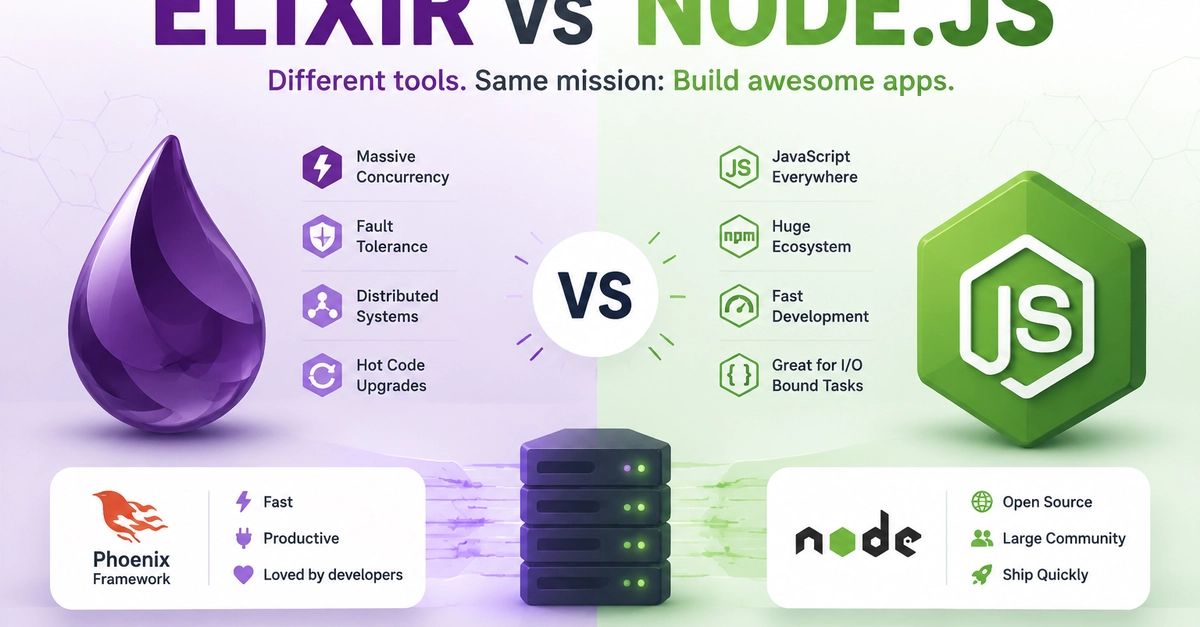
Modern backend development has been dominated by JavaScript runtimes like Node.js for many years. Node.js changed the way developers build web applications by bringing JavaScript to the server side and enabling fast development with a huge ecosystem.
But as applications become more distributed, real-time, and highly concurrent, many developers are looking at another technology: Elixir.
So, what is Elixir? Why would someone choose it over Node.js? Let's explore.
What is Elixir?
Elixir is a functional programming language built on top of the Erlang Virtual Machine (BEAM).
It was created by José Valim in 2011 with a goal of making scalable and maintainable applications easier to build.
Elixir inherits many powerful features from Erlang:
- Massive concurrency
- Fault tolerance
- Distributed systems support
- Hot code upgrades
- Real-time processing
Popular frameworks and tools in the Elixir ecosystem include:
- Phoenix — a high-performance web framework
- Ecto — database wrapper and query system
- LiveView — build interactive web applications without heavy frontend JavaScript
Companies use Elixir for systems where reliability and scalability matter, such as messaging platforms, fintech systems, and real-time applications.
Why Use Elixir?
1. Excellent Concurrency Model
One of Elixir's biggest advantages is its lightweight process model.
An Elixir application can run millions of isolated processes that communicate through messages.
Example:
spawn(fn ->
  IO.puts("Hello from a process")
end)
Enter fullscreen mode Exit fullscreen mode
These processes are extremely cheap compared to traditional operating system threads.
This makes Elixir a great choice for:
- Chat applications
- Multiplayer games
- Streaming systems
- IoT platforms
- Real-time dashboards
2. Built for Fault Tolerance
In many programming languages, an application crash can bring down the entire service.
Elixir uses the Erlang concept of "let it crash".
Instead of trying to prevent every possible failure, applications are designed to recover automatically.
Using Supervisors, Elixir can restart failed processes and keep the system running.
This is one reason Erlang-based systems power telecom infrastructure where uptime is critical.
3. Real-Time Applications with Phoenix
The Phoenix framework is one of the fastest web frameworks available.
Phoenix Channels and LiveView make building real-time features simple:
- Live notifications
- Collaborative tools
- Chat systems
- Real-time analytics
Developers can create interactive applications without writing large amounts of frontend JavaScript.
Elixir vs Node.js
Node.js and Elixir solve similar backend problems, but their approaches are very different.
| Category | Elixir | Node.js |
|---|---|---|
| Language style | Functional programming | JavaScript / event-driven |
| Runtime | BEAM VM | V8 Engine |
| Concurrency | Lightweight processes | Event loop + async I/O |
| Performance | Excellent for concurrent workloads | Excellent for I/O-heavy applications |
| Learning curve | Higher | Easier for JavaScript developers |
| Ecosystem | Smaller | Huge npm ecosystem |
| Real-time systems | Excellent | Very good |
| CPU-heavy tasks | Better with BEAM distribution | Requires worker processes |
| Scalability | Designed for distributed systems | Scales well with architecture |
Node.js Advantages
Node.js remains one of the best choices for many applications.
Huge Ecosystem
npm provides millions of packages.
You can quickly find libraries for:
- Authentication
- APIs
- Testing
- Frontend integration
- Cloud services
JavaScript Everywhere
Teams can use the same language across:
- Frontend
- Backend
- Mobile
- Serverless functions
This reduces context switching.
Fast Development
Node.js is especially productive for:
- REST APIs
- SaaS applications
- CRUD systems
- Startups building MVPs quickly
Where Elixir Has an Advantage
Elixir becomes attractive when your application requires:
Millions of Concurrent Connections
Examples:
- Messaging platforms
- Online games
- Financial systems
- Collaboration tools
High Availability
Applications that cannot easily go offline benefit from Erlang's reliability model.
Distributed Systems
Elixir was designed with distributed computing in mind.
Multiple servers can communicate naturally using BEAM features.
Should You Learn Elixir in 2026?
If you are already comfortable with Node.js, learning Elixir can expand your backend engineering skills.
Node.js teaches you:
- Event-driven programming
- JavaScript ecosystem
- API development
Elixir teaches you:
- Functional programming
- Concurrency patterns
- Distributed architecture
- Fault-tolerant system design
They are not direct competitors. They are tools designed for different problems.
A simple rule:
Choose Node.js when you need:
✅ Fast development
✅ Large ecosystem
✅ JavaScript compatibility
✅ Typical web applications
Choose Elixir when you need:
✅ Massive concurrency
✅ Real-time systems
✅ High reliability
✅ Distributed applications
Final Thoughts
Elixir is not here to replace Node.js.
Node.js remains one of the most practical backend technologies today.
However, Elixir introduces a different way of thinking about software architecture. Its concurrency model, fault tolerance, and scalability features make it a powerful choice for systems that need to run reliably under heavy load.
Learning Elixir is not just about learning another programming language — it is about learning a different approach to building software.
Sometimes the best tool is not the most popular one. It is the one that matches the problem you are trying to solve.
0 Comments
Log in to join the conversation.No comments yet. Be the first to share your thoughts.