
[Submitted on 28 Jul 2026]
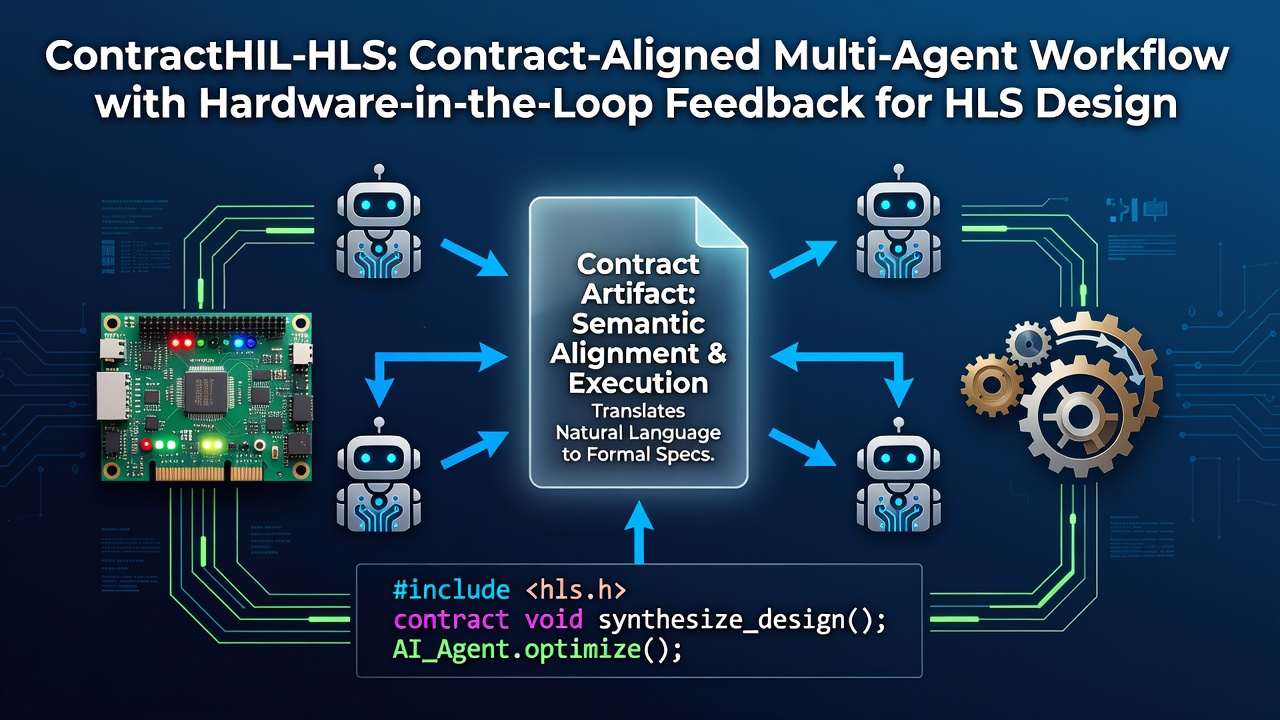
Abstract:This paper presents ContractHIL-HLS, a contract-aligned multi-agent workflow for practical high-level synthesis (HLS) engineering. The workflow makes three contributions. First, it introduces a structured contract as the semantic-alignment and task-execution artifact that translates natural language requirements into explicit interfaces, constraints, validation checks, and rollback rules. Second, it incorporates hardware information into the feedback loop by feeding HLS, Vivado, PYNQ runtime, power, and failure evidence back into generation, thereby extending LLM-assisted HLS from kernel code toward system- and board-level closure. Third, it decomposes agents by semantic lowering and execution tasks rather than by conversational roles: a Contract Agent lowers natural language into the contract, an HTML Agent renders the contract as persistent structured HTML, and a Hardware-in-the-Loop Agent implements and revises the design with measured evidence. We evaluate ContractHIL-HLS in two parts. On 94 locally executable HLS-Eval tasks, the structured contract provides the largest small design gain, improving the estimated single-sample testbench pass rate from 64.0% to 70.2%; the full flow reaches 70.4% pass@1 and 76.6% pass@5. Because HLS-Eval does not exercise board-level design, we also validate ContractHIL-HLS on a board tested ML-KEM/ML-DSA post-quantum cryptography (PQC) secure-message accelerator, where the retained dual-bitstream organization reduces six-message average text runtime from 207.3 ms to 52.4 ms with positive routed WNS on both images while preserving decrypted-message verification. We open-source our work at BJUT-CS316-LAB/ContractHIL-HLS (this https URL).
Submission history
From: Wenbo Zhang [view email]
[v1]
Tue, 28 Jul 2026 04:41:13 UTC (117 KB)
0 Comments
Log in to join the conversation.No comments yet. Be the first to share your thoughts.