
[Submitted on 29 Jan 2026 (v1), last revised 28 Jul 2026 (this version, v3)]
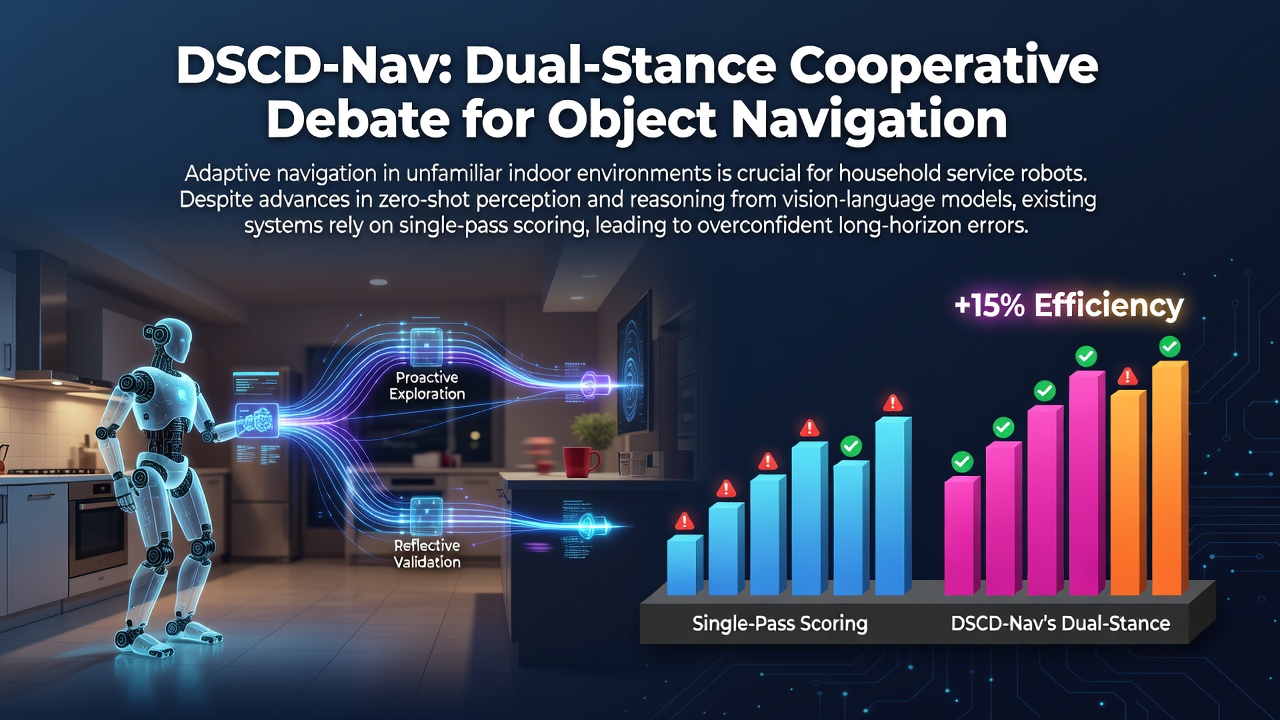
Abstract:Adaptive navigation in unfamiliar indoor environments is crucial for household service robots. Despite advances in zero-shot perception and reasoning from vision-language models, existing navigation systems still rely on single-pass scoring at the decision layer, leading to overconfident long-horizon errors and redundant exploration. To tackle these problems, we propose Dual-Stance Cooperative Debate Navigation (DSCD-Nav), a decision mechanism that replaces one-shot scoring with stance-based cross-checking and evidence-aware arbitration to improve action reliability under partial observability. Specifically, given the same observation and candidate action set, we explicitly construct two stances by conditioning the evaluation on diverse and complementary objectives: a Task-Scene Understanding (TSU) stance that prioritizes goal progress from scene-layout cues, and a Safety-Information Balancing (SIB) stance that emphasizes risk and information value. The stances conduct a cooperative debate and make policy by cross-checking their top candidates with cue-grounded arguments. Then, a Navigation Consensus Arbitration (NCA) agent is employed to consolidate both sides' reasons and evidence, optionally triggering lightweight micro-probing to verify uncertain choices, preserving NCA's primary intent while disambiguating. Experiments on HM3Dv1, HM3Dv2, and MP3D demonstrate consistent improvements in success and path efficiency while reducing exploration redundancy.
Submission history
From: Weitao An [view email]
[v1]
Thu, 29 Jan 2026 08:47:55 UTC (14,317 KB)
[v2]
Sat, 31 Jan 2026 05:43:40 UTC (14,317 KB)
[v3]
Tue, 28 Jul 2026 08:21:40 UTC (7,658 KB)
0 Comments
Log in to join the conversation.No comments yet. Be the first to share your thoughts.