
[Submitted on 3 May 2026]
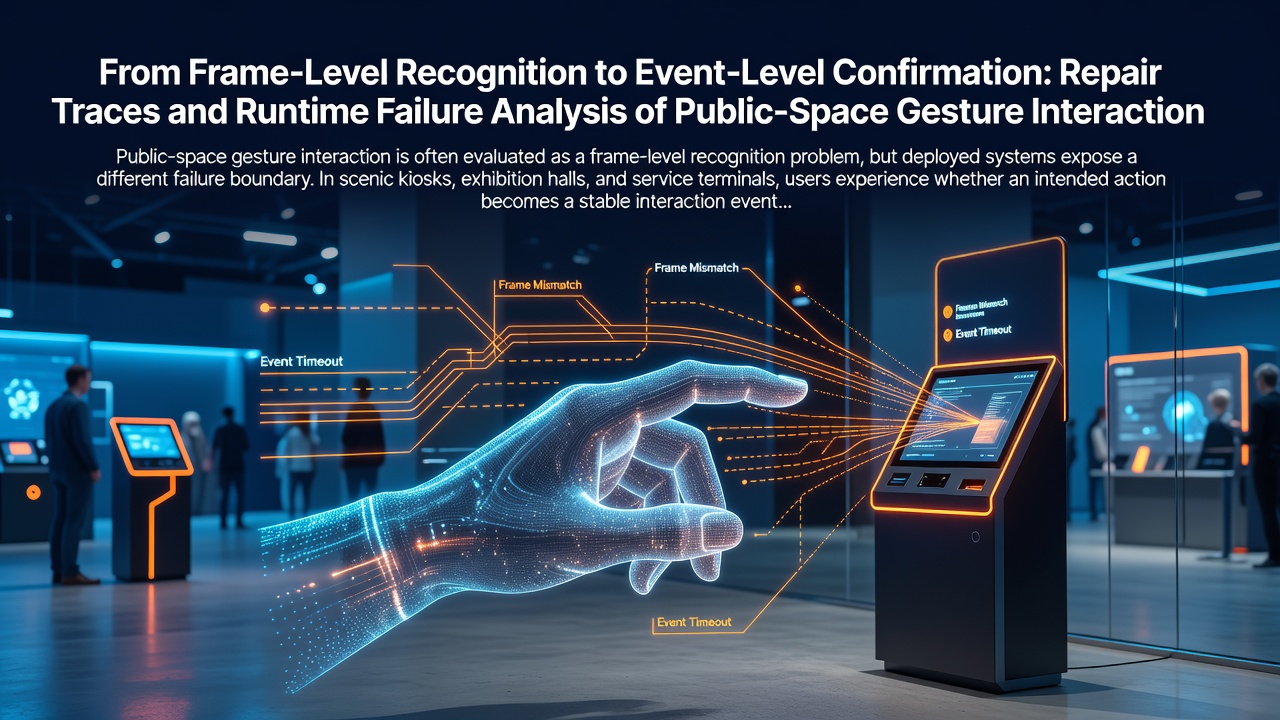
Abstract:Public-space gesture interaction is often evaluated as a frame-level recognition problem, but deployed systems expose a different failure boundary. In scenic kiosks, exhibition halls, and service terminals, users experience whether an intended action becomes a stable interaction event, not whether individual hand-landmark frames are correct. We call this the recognition-to-interaction gap.
This paper analyzes 8 engineering repair records from a scenic-area interactive kiosk project, covering 4 gesture tasks: two-hand bowing, single-hand fist shaking, two-hand catching control, and knowledge-graph node hovering. From these traces, we extract 20 failure instances and organize them into six non-exclusive working failure classes: model-output degeneration, temporal mismatch, geometric-scale instability, coordinate-rendering mismatch, runtime lifecycle failure, and feedback synchronization and recovery failure.
We further organize recurring repair mechanisms into an event-level runtime abstraction between the hand-landmark model and the interaction task. The contribution is deliberately bounded: a deployment-grounded failure taxonomy, an event-confirmation runtime abstraction, and case-study findings. We do not claim a new recognition model, large-scale user evaluation, or quantified accuracy gains.
Submission history
From: M Meng [view email]
[v1]
Sun, 3 May 2026 21:21:44 UTC (19,665 KB)
0 Comments
Log in to join the conversation.No comments yet. Be the first to share your thoughts.