
[Submitted on 28 Jul 2026]
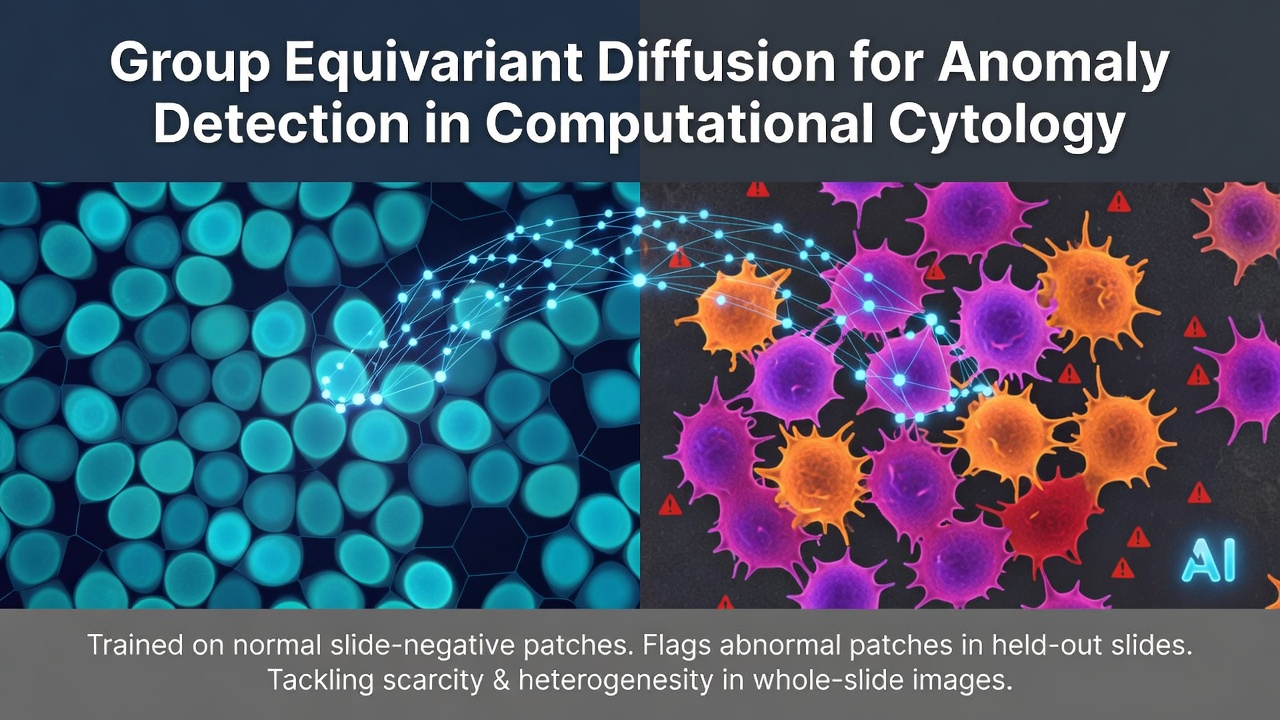
Abstract:Computational cytology on whole-slide images is challenging because malignant cells are rare, heterogeneous, and annotated slides are scarce. Anomaly detection frameworks can be trained on normal slide-negative patches and then applied at test time to flag abnormal patches in held-out slides. Most unsupervised anomaly detection approaches including generative ones (GAN-based and diffusion-based), are tuned to organ-level imaging and require large curated datasets. In cytology the signal is cell-centric: rotating or flipping a single-cell patch does not change its diagnostic class, yet standard diffusion models treat transformed views as distinct inputs, leading to transformation-dependent reconstructions and unstable anomaly scores. We propose a D4-equivariant diffusion framework that enforces rotation and reflection symmetry both architecturally, via a D4-equivariant U-Net, and at inference, via equivariant noise coupling and (optionally) frame averaging. This alignment with biological invariance yields transformation-consistent pseudo-healthy reconstructions and more stable anomaly ranking under symmetry. On two publicly available cytology datasets of bone marrow and peripheral blood smears, our D4-equivariant diffusion models achieve higher AUC and retrieve more abnormal cells in the top K predictions than non-equivariant generative baselines, a deep one-class, and a multiple instance learning based method, while substantially reducing score variance across rotations and flips. Code is available at this https URL.
Submission history
From: Swarnadip Chatterjee [view email]
[v1]
Tue, 28 Jul 2026 09:38:05 UTC (16,802 KB)
0 Comments
Log in to join the conversation.No comments yet. Be the first to share your thoughts.