
The rise of the intelligent institution
For modern universities, a seamless digital experience is an essential component to providing the resources and services that make an institution run. Following a rapid acceleration in digital transformation in recent years, students, staff, and partners now expect always-on services, consistent online experiences, and secure access to digital tools as a baseline.
For universities, “ultra-intelligence” is an operational necessity. But most institutions aren’t there yet. As colleges evolve, one thing is clear: Universities need to move from task-specific work and department-only strategy and take a bigger-picture, institution-wide approach to technology.
While many schools and universities are focused on higher education analytics and the promise of AI, they’re missing a key component to creating an ultra-intelligent institution: connected data.
Data silos in higher education institutions
Higher education institutions are often faced with silos as far as the eye can see: siloed tech tools, siloed teams, siloed budgets, and siloed resources spread across buildings, departments, and campuses. Universities often lack a common data repository from which to draw insights. Adopting a holistic approach to IT is a significant shift for most institutions, providing a unified point of visibility for aggregated analysis of all IT hardware, apps, and infrastructure.
With a fragmented data environment, institutions lack real-time visibility into big-picture issues. Multiple data systems across different departments and programs lead to unnecessary exposure to security threats and a lack of overall institutional governance around data handling.
To help break down these silos, a unified data platform can consolidate tech tools to reduce data sprawl, facilitate better collaboration, and become a truly data-driven institution. It’s easier said than done, however, especially when dealing with legacy apps and a culture that’s tied to existing technology and processes.
The efficacy of an ultra-intelligent institution depends on the data that flows through it, where data is stored, and the ability to correlate data from multiple sources. With siloed data layered across teams and departments, teams struggle with a lack of real-time visibility.
How can you make decisions based on data if you can’t see it all at once?
Higher education analytics starts with connected data
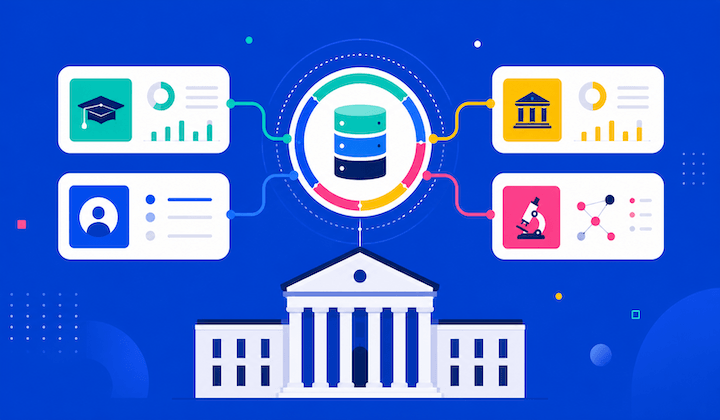
By rallying both institutional strategy and the IT services team around a unified data platform across academic, operational, and security systems, universities can aggregate, access, find, and act on all of their data from one source. Taking this approach can provide real-time access to critical information and the context to analyze that data and act on it quickly.
When thinking about how to break down silos and build a unified platform, one successful strategy is to start with consolidating institutional data on IT infrastructure and then expanding into adjacent use cases. These datasets typically have the fewest privacy- and policy-related concerns for consolidation and offer significant operational and financial ROI.
Elastic’s search-based platform helps ultra-intelligent institutions unify structured, unstructured, and semi-structured data from across their organization. With that data foundation in place, institutions can make faster, more informed decisions across critical areas — from application performance monitoring (APM) and threat hunting to protecting researchers’ intellectual property and keeping digital course catalogs and learning management systems reliable during enrollment surges.
From data visibility to higher education innovation
Building a holistic approach to IT in higher education requires a unified view into the entire IT environment. An end-to-end observability solution consolidates metrics, logs, and traces, so IT teams can see across them all, plus get the intelligence to detect anomalies, find patterns, and reduce mean time to resolution.
With real-time visibility into your entire network, you can turn your institutional data into action and have an immediate impact on:
Student services: As teams look to improve the student experience, holistic data insights can play a key role. Having the ability to quickly identify and predict issues can be instrumental in ensuring students can find the information they need, stay productive, and connect to the online tools and services that are essential to their day-to-day learning.
IT operations: With IT operations consolidated, you’ll have the ability to implement efficient, streamlined processes across departments and the flexibility to spread resources as needed. With agile IT operations, you can look forward and take steps to implement new technologies as they come to market.
Cybersecurity: As long as there are disconnected tools, systems, and data in your IT environment, there will be potential for gaps and hiding places where intrusions and malware can go undetected for months or even years. With a streamlined data strategy, your institution will be exposed to fewer vendors and vulnerabilities. And when faced with security threats, you’ll be able to act quickly and decisively, knowing what systems are compromised and require attention.
What intelligent institutions look like in practice
When an institution implements a unified data platform, it frees up countless hours for staff to experiment and innovate. Elastic’s agile platforms helped staff at these institutions create forward-looking solutions to complex technical problems.
Georgia State University increases data insights with AI-powered search
Georgia State University switched from native observability tools and streamlined its operations with a unified system built using Elasticsearch and Kibana dashboards on AWS. With that change, the IT team had time to experiment with new technologies and build a proof-of-concept AI-powered application to help students navigate the financial aid process. The tool assists students with personalized information and advice that helps guide them through the complicated and often confusing steps necessary to complete aid applications.
Texas A&M University System saves over 100 analyst hours per month with AI
The Texas A&M University System’s cybersecurity operations team is tasked with protecting the data of 11 campuses, eight state agencies, and the second-largest student body in the US. They switched from using multiple security products to employing Elastic Security automatically on all devices, reducing the volume of documentation during security workflows, duplicate detections, and false positives. The switch saved the team more than 100 work hours per month, lowered incident resolution time, and enabled the rapid integration of additional security features and updates.
The Maryland Innovation and Security Institute (MISI) operates a cost-effective security operations center
The Maryland Innovation and Security Institute (MISI) is a nonprofit organization that trains young cyber professionals and helps institutions better understand the technology they’re evaluating so they can make informed decisions prior to investment. MISI uses Elastic Observability and Elastic Security as well as the AWS GovCloud FedRAMP Moderate authorized Elastic Cloud offering on many of its projects, including helping cyber defenders build their security skills in real-world environments.
Building the foundation for higher education innovation and AI
A streamlined, efficient data strategy is the first step to building an ultra-intelligent institution. It is the foundation that enables innovation and lays the groundwork for AI-powered solutions.
AI holds promise and possibilities for higher education institutions, but in order to implement effective AI-powered tools, institutions must have a few key elements in place.
An effective AI strategy requires:
Access to trusted data: AI-powered solutions are only as strong as the data they’re built on. Without a solid foundation created from your institution’s proprietary data, your AI strategy will go nowhere.
Strong institutional governance: If you plan to integrate AI into your IT toolkit, it’s essential that your institution implements an AI governance framework that outlines the rules and regulations around the creation and use of artificial intelligence across the university.
Accessibility: In order for an institution to implement effective AI-powered solutions, you’ll need a unified platform that is widely available and easy for key stakeholders to access and use.
Intelligence is built, not bought
When it comes to building an ultra-intelligent university, one thing is for certain: There is no one quick fix. Intelligence at scale can’t be bought with a single product or tool. Instead, universities cultivate an environment of intelligence when they build and maintain streamlined, system-level capabilities across programs and departments. Connected, secure, real-time systems enable transparency and transformation.
The good news is that a unified data platform can solve multiple problems simultaneously. Not only can it improve the uptime and usability of IT systems, but ultra-intelligent institutions will also be able to leverage their unified data platform’s speed — coupled with AI/ML capabilities — to quickly detect and respond to cyber threats before they compromise valuable data and pose a threat to institutional infrastructure.
Elastic Security, which is built on the Elasticsearch Platform, enables you to protect, investigate, and respond to complex threats through the combined capabilities of SIEM, endpoint security, and cloud security.
Learn more about how Elastic can help your university become ultra-intelligent.
The release and timing of any features or functionality described in this post remain at Elastic's sole discretion. Any features or functionality not currently available may not be delivered on time or at all.
In this blog post, we may have used or referred to third party generative AI tools, which are owned and operated by their respective owners. Elastic does not have any control over the third party tools and we have no responsibility or liability for their content, operation or use, nor for any loss or damage that may arise from your use of such tools. Please exercise caution when using AI tools with personal, sensitive or confidential information. Any data you submit may be used for AI training or other purposes. There is no guarantee that information you provide will be kept secure or confidential. You should familiarize yourself with the privacy practices and terms of use of any generative AI tools prior to use.
Elastic, Elasticsearch, and associated marks are trademarks, logos or registered trademarks of elasticsearch B.V. in the United States and other countries. All other company and product names are trademarks, logos or registered trademarks of their respective owners.
0 Comments
Log in to join the conversation.No comments yet. Be the first to share your thoughts.