
[Submitted on 15 Jun 2026]
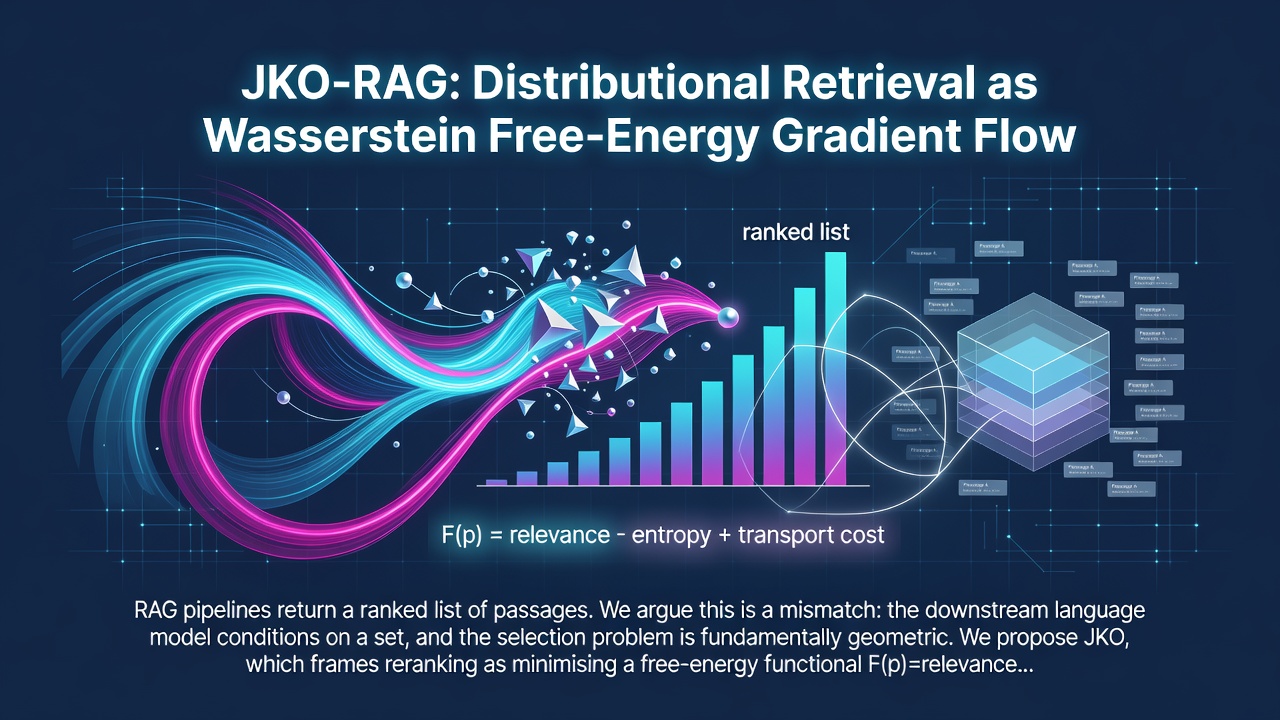
Abstract:RAG pipelines return a \emph{ranked list} of passages. We argue this is a mismatch: the downstream language model conditions on a \emph{set}, and the selection problem is fundamentally geometric. We propose \jko, which frames reranking as minimising a free-energy functional $F(p)=\text{relevance}+\text{entropy}+\text{redundancy}$ under Wasserstein-2 gradient flow via the Jordan--Kinderlehrer--Otto proximal scheme. The ground metric $C_{ij}=(1-\cos\langle z_i,z_j\rangle)^2$ encodes the semantic geometry of the embedding manifold. Our central contribution is a \emph{linear-response theory} explaining \emph{why} the Wasserstein geometry helps: the Wasserstein and KL retrieval maps differ only in their proximal Hessian -- dense and geometry-aware for $W^2$, diagonal and geometry-blind for KL -- and this difference damps the mass transport that query paraphrase induces. The theory yields a falsifiable prediction: the stability advantage is monotonically decreasing in step size $h$. We verify this empirically via free-energy descent, frequency-resolved perturbation response, the predicted $h$-dependence, and a certified-radius analysis. Four extensions are introduced: \textbf{\nmjko} (learned ground metric), \textbf{\bwjko} ($W^2$--KL interpolation), \textbf{\samjko} ($2\times$ speedup), and \textbf{\dualrank} (OT dual potentials as confidence signals). Across five BEIR benchmarks, \jko\ outperforms the cross-encoder on all five; the decisive advantage is robustness -- 22--38\% more stable under paraphrase, $2\times$ fewer leaked distractors.
Submission history
From: Murari Ambati [view email]
[v1]
Mon, 15 Jun 2026 04:34:49 UTC (87 KB)
0 Comments
Log in to join the conversation.No comments yet. Be the first to share your thoughts.