
Probabilistic computers might one day tackle certain problems well beyond standard computers while at the same time avoiding the many hardware challenges that currently vex quantum computing. Now scientists reveal they have created the largest probabilistic computer yet, one with 1 million “probabilistic bits,” a new study they suggest reveals the way forward to building even bigger machines.
Probabilistic bits, or p-bits, bridge the gap between the bits underlying regular computers and the qubits upon which quantum computers are based. Bits symbolize data as either a 0 or 1. Qubits, because of the bizarre nature of quantum physics, can exist in a state where they are either 0 or 1 or any state in between simultaneously. In contrast, p-bits flip between 0 or 1 with a tunable probability.
Why probabilistic computing?
A bit that flips back and forth between 0 and 1 might seem useless—indeed, in a regular computer this would be too noisy to operate. However, when many such noisy bits operate together in a correlated fashion, they can be used to solve a whole class of problems—stochastic problems—that operate on probabilities rather than concrete numbers. This includes optimization problems to, for instance, find the shortest route with which one can deliver a set of packages.
There are other kinds of machines that are also designed to tackle stochastic problems, such as quadratic unconstrained binary optimization (QUBO) devices or Ising machines. However, unlike those devices, probabilistic computers are not hardwired for a single problem, but are instead programmable general-purpose machines, says Kerem Çamsarı, an associate professor of electrical and computer engineering at the University of California, Santa Barbara.
In a 2019 Nature study, scientists developed a probabilistic computer with eight p-bits. By 2023, researchers had built a machine with 7,200 p-bits. However, these devices were each confined to a single chip. Networking together multiple such chips is not as simple as it is for regular GPUs or CPUs: the machine functions on correlated fluctuations, and syncing up those fluctuations across a set of wires is no easy feat. This raised questions as to whether probabilistic computers could scale to larger sizes, and what problems they might face if they tried.
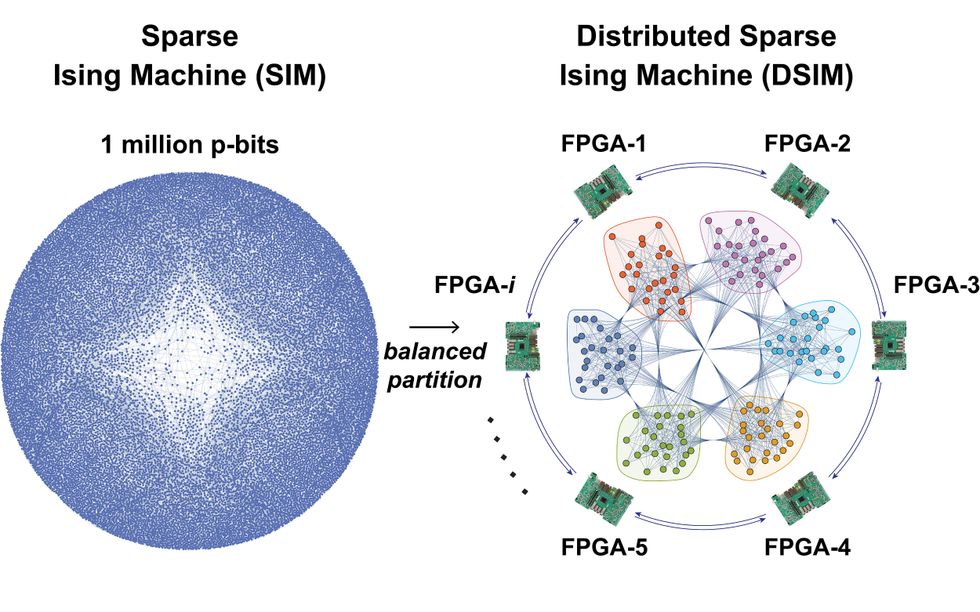 (Left) A conceptual image of a computer with 1 million probabilistic bits, and (right) a diagram of a hardware implementation of this concept using field-programmable gate arrays (FPGAs)—electronic chips that users can reconfigure after manufacture. Navid Anjum Aadit, Xiuqi Zhang, et al.
Wiring up the largest probabilistic machine
Now, in a new study, Çamsarı and his team has created the largest probabilistic computer to date, one with 1 million p-bits spread across multiple chips. They detailed their findings 24 June on the ArXiv preprint server.
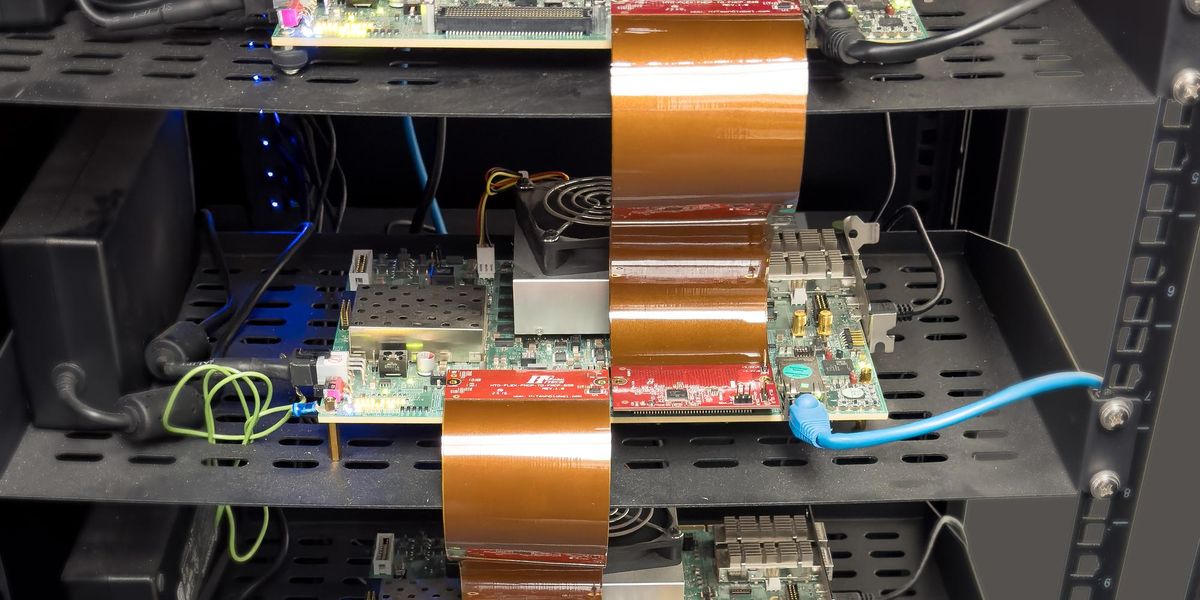
The new computer runs on 18 field-programmable gate arrays (FPGAs)—electronic chips that users can reconfigure after manufacture. There are no physical flipping bits in this design, but the programmable nature of the chips allows for efficient software implementation of probabilistic bits. These chips are networked together into a single machine that altogether is capable of more than a trillion flips per second.
A major concern the scientists faced was how often their machine’s chips had to share data in order to behave as one computer and not just multiple isolated devices. Surprisingly, “our machine communicates without global lockstep synchronization,” says Navid Anjum Aadit, a postdoctoral scholar in electrical engineering at Stanford University.
The researchers discovered a straightforward predictable design rule for how quickly different chips in a probabilistic computer have to exchange data with each other for them all to behave as one machine. Below this threshold, there are tradeoffs a probabilistic computer faces between speed and accuracy, Çamsarı says.
These new findings may open a path toward building arbitrarily large probabilistic computers from many chips, just as is often done with any standard computer today, the researchers say. They also apply to probabilistic computers built from essentially any hardware, they add.
In the future, the researchers aim to explore building large probabilistic computers from specialized chips built for probabilistic computing. For example, the 2019 Nature study built a probabilistic computer using magnetic tunnel junctions, which are more energy-efficient at probabilistic computing than standard chips, Çamsarı notes.
“Systems combining CMOS with dense stochastic memory technologies such as MRAM offer one of the most compelling paths forward,” Aadit adds.
0 Comments
Log in to join the conversation.No comments yet. Be the first to share your thoughts.