

Platform engineering has won the argument. Some 90% of organizations have adopted at least one internal platform; golden paths are orthodoxy, and environment requests that once took days now close in hours. By the standard the discipline set for itself, that is victory.
Then the most demanding customer the platform has ever had showed up, and it is not a developer. A coding agent that wants to validate its work requests an environment the way a client calls an API: in bursts, concurrently, with a lifetime measured in minutes and an expectation measured in seconds.
A 100-developer organization in which each engineer supervises a few agent sessions per day generates hundreds of environment requests before lunch. Each request needs realistic dependencies, and each is dead weight the moment its validation finishes. That is not a ticket queue. That is traffic.
The most demanding tenant the platform has ever had
The demand is not speculative. GitHub’s Octoverse counted 43.2 million pull requests merged per month, up 23% year over year, with Copilot’s coding agent alone opening more than a million pull requests in its first five months. Every one of those changes needs somewhere realistic to run before it merges.
The tenant mix is shifting underneath those numbers. Stack Overflow’s 2025 survey found that half of professional developers already use AI tools daily, and every daily user is a candidate to operate two, three, or five concurrent agent sessions. Environment demand no longer tracks headcount. It tracks headcount multiplied by agents multiplied by iterations.
“Coding agents turned environment requests into traffic: concurrent, short-lived, and relentless. The platform teams that keep up will be the ones that stop provisioning environments and start serving them.”
Platform teams can see what is coming. The latest State of Platform Engineering report found that 94% of organizations consider AI critical to platform engineering’s future, and its central theme is the shift from cloud-native platforms to AI-native ones.
What changed is not only the volume but also the shape. Human environment demand is diurnal, negotiable, and tolerant of a morning’s delay. Agents retry, fan out, and iterate in tight loops, and demand that the shape already has a name across the platform. The name is traffic.
Duplicate everything, and the cost curve kills you
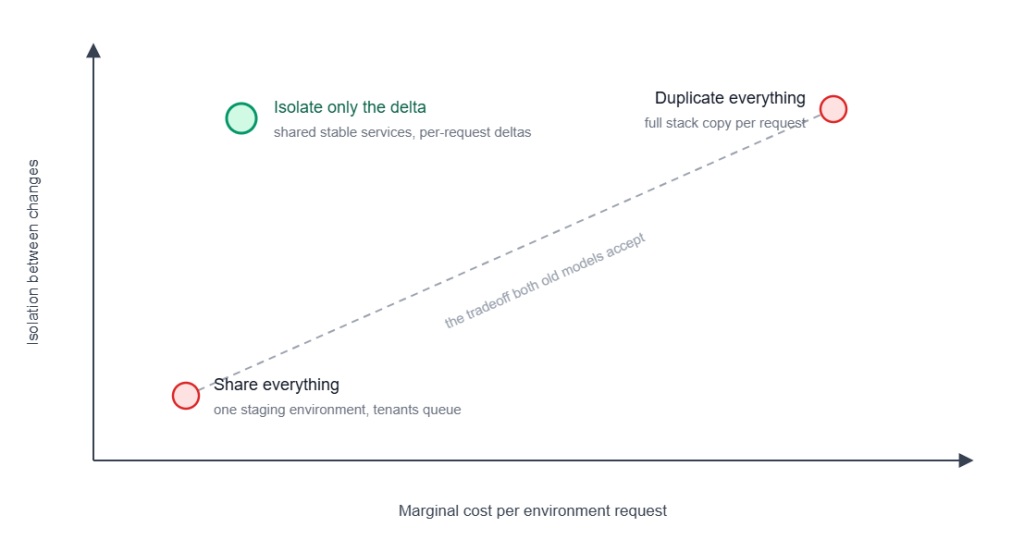
The duplication model hands every request a full copy of the stack. Price one out: a 40-service system with its databases and queues costs a few dollars an hour per copy, takes tens of minutes to assemble, and sits mostly idle during the brief window of validation it exists to support.
Multiply by concurrency, and the model collapses. Hundreds of requests a day with modest overlap means dozens of full copies running at once, and a bill that scales linearly with agent activity. The latency is wrong by an order of magnitude too, because an agent that iterates in seconds cannot wait tens of minutes for its environment to arrive.
Pre-provisioning a warm pool does not rescue the model; it only moves the waste. Agent demand is bursty, so a pool sized for the peak idles through the trough, and a pool sized for the trough queues at the peak. Paying full-copy prices for capacity you mostly do not use is the definition of the wrong cost curve.
Share everything, and the queue kills you
The shared model runs one staging environment and admits tenants in turn. Queueing theory has described this failure mode since 1961. Little’s law says the number of requests in a system equals the arrival rate multiplied by time in the system, so as arrivals approach the rate the environment can absorb, wait times stop degrading gracefully and start exploding. Agents multiply the number of arrivals by 5-10 while the completion rate remains fixed.
Shared staging also fails on isolation. One broken change contaminates the environment for every tenant behind it, so the line does not merely lengthen; it periodically resets to zero while someone hunts down the offending commit.
Teams respond to the wait the way people always respond to a slow shared resource, by batching. Changes pile into larger deployments, making each trip through the environment count, which raises the blast radius of every failure and lengthens each occupancy. The queue teaches exactly the behavior that makes the queue worse.
Both models sit at the wrong ends of the same curve, paying full cost for full isolation or zero marginal cost for zero isolation. Neither is a point from which you can operate a serving system.
Environments are a serving system now
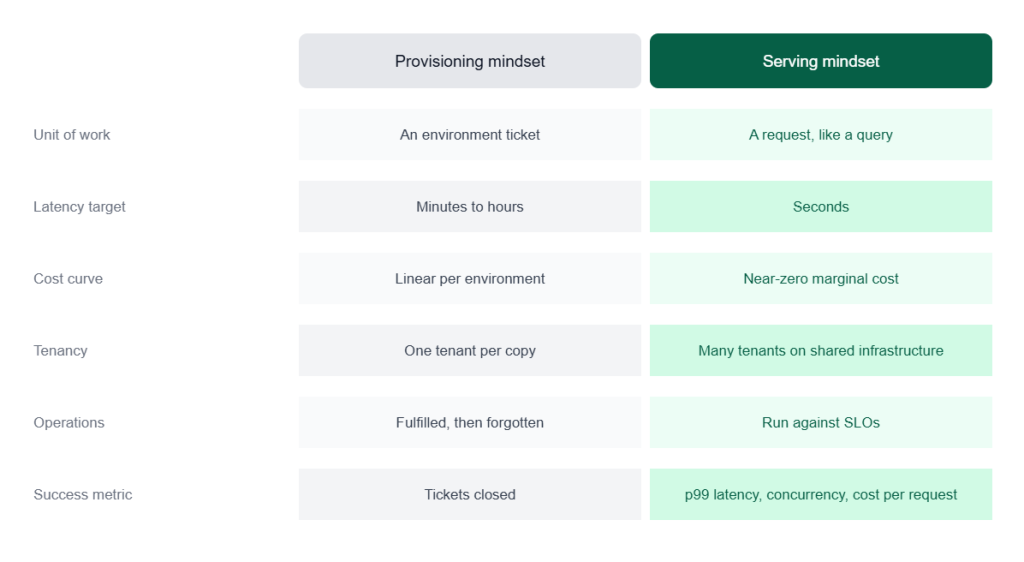
The mental model that fits this demand curve already exists inside every platform team. It is the one used for compute. A serving system is judged on latency, concurrency, marginal cost per request, and safe multi-tenancy on shared infrastructure, and those are exactly the four requirements agent-driven demand imposes on environments. A serving system is also something its clients invoke directly, through an interface rather than a person, which is the property that matters most once those clients are agents.
Renaming the problem matters because it changes who owns it and how it gets measured. A provisioning workflow is done when the environment exists. A serving system is never done. It has dashboards, capacity plans, and error budgets, and it is expected to absorb demand spikes without a human in the loop.
“The unit of work ceases to be a ticket and becomes a request. The latency target drops from hours to seconds.”
The mindset gap shows up on every operational dimension. The unit of work ceases to be a ticket and becomes a request. The latency target drops from hours to seconds. The success metric shifts from closed tickets to p99 latency at peak concurrency.
Serve the delta, not the whole stack
One architecture meets all four serving requirements by refusing to copy anything that has not changed. Run a single high-fidelity, stable copy of the system, deployed continuously from main. When a validation request arrives, deploy only the services that changed as lightweight, ephemeral environments, and route that request’s traffic through their own versions, while everything else falls through to the shared, stable environment.
Each serving property follows from the delta. Latency lands in seconds because starting one or two services is fast. Marginal cost approaches zero because tenants share the stable environment. Concurrency is bounded by cluster capacity rather than by environment count, and isolation holds because each request sees only its own changed services, not anyone else’s.
Fidelity is not the thing you give up. A full duplicate is faithful, which is exactly why teams build one, and also why it is slow and costly to stand up and prone to drift between refreshes. Sharing one stable copy that is continuously deployed from main gives every validation request the same real, current dependencies without reproducing them per request.
Routing is the implementation detail rather than the point. Service meshes can carry the routing label, sidecar-free approaches can too, and propagating a label through a call chain is a solved problem in most modern stacks. This is the pattern Signadot enables off-the-shelf.
Agents provision their own environments
An environment that arrives in seconds and costs almost nothing is not only fast enough to keep up with agents. It is cheap and fast enough for them to operate. When requesting one is an API call rather than a ticket, provisioning becomes a step within the agent’s own loop: ask for an environment, deploy the change to it, run the checks, read the result, tear it down, and repeat in the next iteration.
Both properties are what make that possible. A workflow measured in minutes and gated on human approval can never fit within a build-test-fix cycle, because the agent would spend its run waiting in a queue it cannot influence. Near-zero marginal cost makes a discarded environment a non-event, and seconds of latency lets validation live inside the loop instead of after it. Once the environment is something an agent requests for itself, the human stops being the rate limiter, and the platform’s serving capacity takes over.
Validation throughput is what ships AI code
Agents made generation cheap and pushed the bottleneck downstream, onto whether a change can be validated as fast as it is written. Validation throughput, not lines generated, now decides how much AI-written code actually ships, and it is a property of your platform rather than any model.
“Validation throughput, not lines generated, now decides how much AI-written code actually ships.”
Treat environments as a serving system, and environment capacity becomes a dimension you plan and budget like compute or continuous integration (CI) runners. This turns agent adoption from a surprise infrastructure bill into a demand curve you can plan against. For a decade, platform engineering built self-service golden paths for people.
The next job is self-service for developers and agents that can scale with agent-driven velocity, and we built Signadot for exactly that.
Group Created with Sketch.
0 Comments
Log in to join the conversation.No comments yet. Be the first to share your thoughts.