
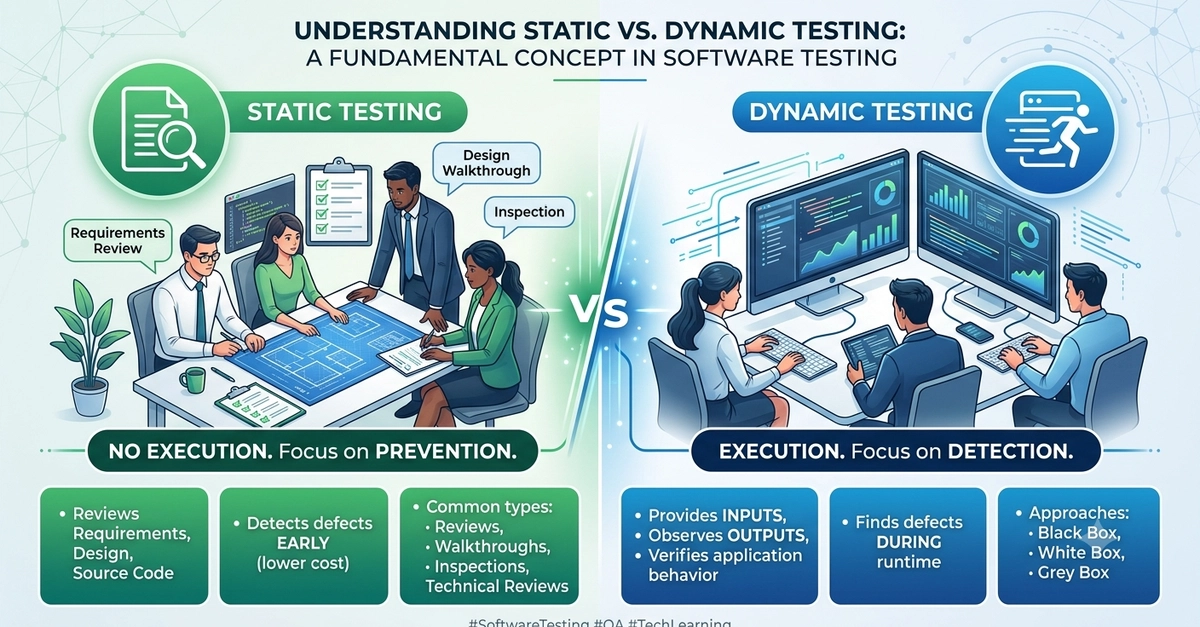


One of the first concepts every software tester should understand is the difference between Static Testing and Dynamic Testing.
Static Testing is performed without executing the software. It focuses on reviewing requirements, designs, and source code to identify issues as early as possible. Detecting defects during the requirement or design phase reduces both development cost and rework.
Common types of Static Testing include:
Review
Walkthrough
Inspection
Technical Review
Dynamic Testing, on the other hand, is performed by executing the software. Testers provide inputs, observe outputs, and verify whether the application behaves as expected. This includes approaches such as White Box, Black Box, and Grey Box Testing.
A simple comparison:
Static Testing: Prevents defects before execution.
Dynamic Testing: Detects defects during execution.
Static: No software execution.
Dynamic: Software is executed.
A simple way to remember:
Static = Test without running the software.
Dynamic = Test by running the software.
Understanding these two testing approaches builds a strong foundation for learning software quality assurance and helps teams deliver more reliable software through both prevention and detection of defects.
0 Comments
Log in to join the conversation.No comments yet. Be the first to share your thoughts.