
[Submitted on 28 Jul 2026]
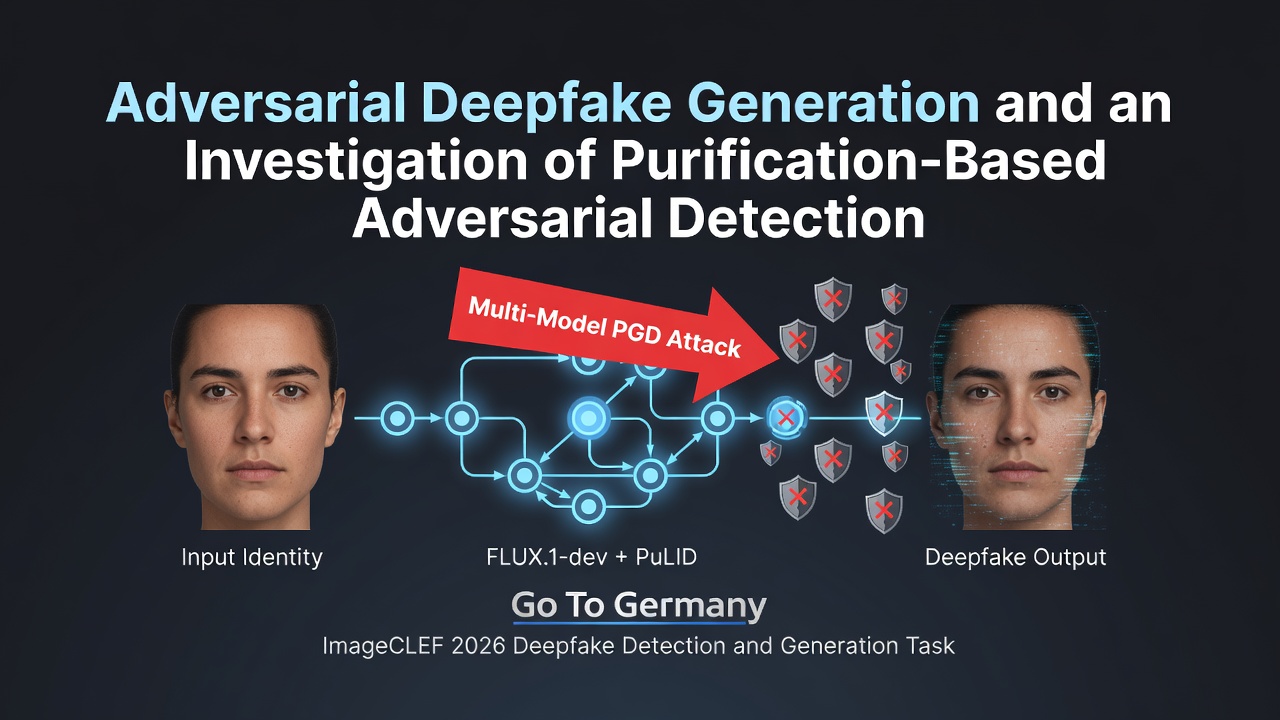
Abstract:This paper describes the participation of team "Go To Germany" in the ImageCLEF 2026 Deepfake Detection and Generation Task. For the image generation task, we employ FLUX.1-dev with PuLID for identity-preserving face synthesis, combined with a multi-model PGD adversarial attack targeting 12 detectors simultaneously (DiffJPEG-in-loop, MI/DI/EoT, adaptive weighting, two-stage warm-start). Our approach achieved 90% evasion against organizer detectors and 57.6% against participant detectors, with a final generation score of 0.4170. For the image detection task, we combine two complementary detectors - SigLIP+DINOv2 for AI-generated images and GenD-DINOv3 for face manipulations - in a max-probability ensemble, achieving 99.4% accuracy on baseline deepfakes but suffering from high false-positive rates on real images, resulting in a final detection score of 0.6986. Beyond the official submission, we conducted a self-initiated investigation of purification-based adversarial detection, comparing three families of detection signals across six detectors that share a CLIP ViT-L/14 backbone. We find that raw $|\Delta \text{logit}|$ under median-3 purification, applied through the EFFORT detector, separates adversarial inputs from clean inputs with AUROC 0.81-0.98 across four adversarial source types - a finding that refutes the simple backbone-preservation hypothesis and exposes a sharp JPEG-quality cliff at Q70 where the signal collapses.
Submission history
From: Junghyun Kim [view email]
[v1]
Tue, 28 Jul 2026 15:19:16 UTC (1,294 KB)
0 Comments
Log in to join the conversation.No comments yet. Be the first to share your thoughts.