
[Submitted on 28 Jul 2026]
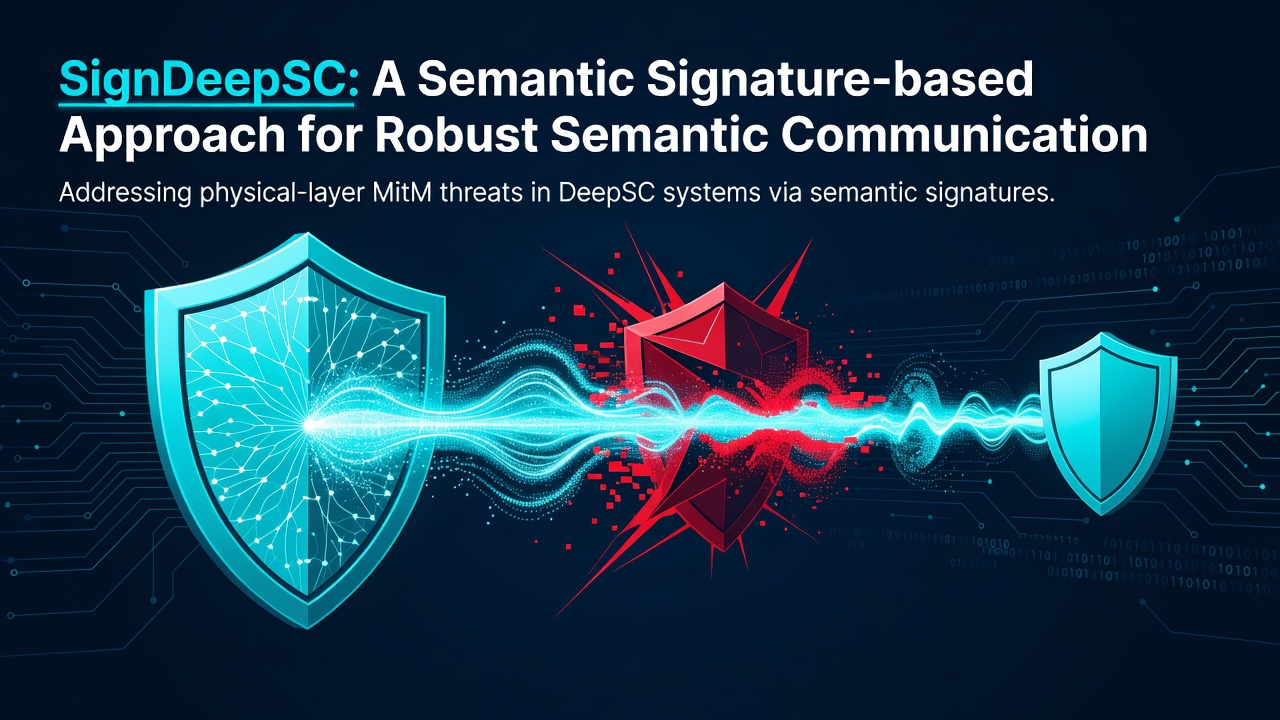
Abstract:Semantic communication systems such as deep semantic communication (DeepSC) offer high efficiency but are vulnerable to adversarial attacks on their underlying neural networks. We address a physical-layer man-in-the-middle (MitM) threat in which an adversary injects perturbations into the transmitted signal to distort its meaning. We propose SignDeepSC, an architectural defense that achieves adversarial robustness without requiring explicit adversarial example generation during training. The approach is built on a perceiver-inspired semantic signature, a compact vector summary of the source features transmitted over a separate low-rate auxiliary channel. This signature is used by a self-repairing decoder that leverages cross-attention to correct distortions and can additionally drive a scrambler that shuffles the feature layout. We evaluate SignDeepSC over Rayleigh fading and additive white Gaussian noise channels under both single-step fast gradient sign method (FGSM) and iterative projected gradient descent (PGD) attacks. Under PGD ($\epsilon = 0.7$), at 12~dB signal-to-noise ratio with Rayleigh fading, SignDeepSC achieves a bilingual evaluation understudy (BLEU-4) score of 0.237 and bidirectional encoder representations from transformers (BERT) sentence similarity of 0.646, outperforming all baselines without degrading clean-channel performance, when the signature channel is well protected.
Submission history
From: Khalil Alhaj [view email]
[v1]
Tue, 28 Jul 2026 12:54:13 UTC (107 KB)
0 Comments
Log in to join the conversation.No comments yet. Be the first to share your thoughts.