
[Submitted on 26 Jul 2026]
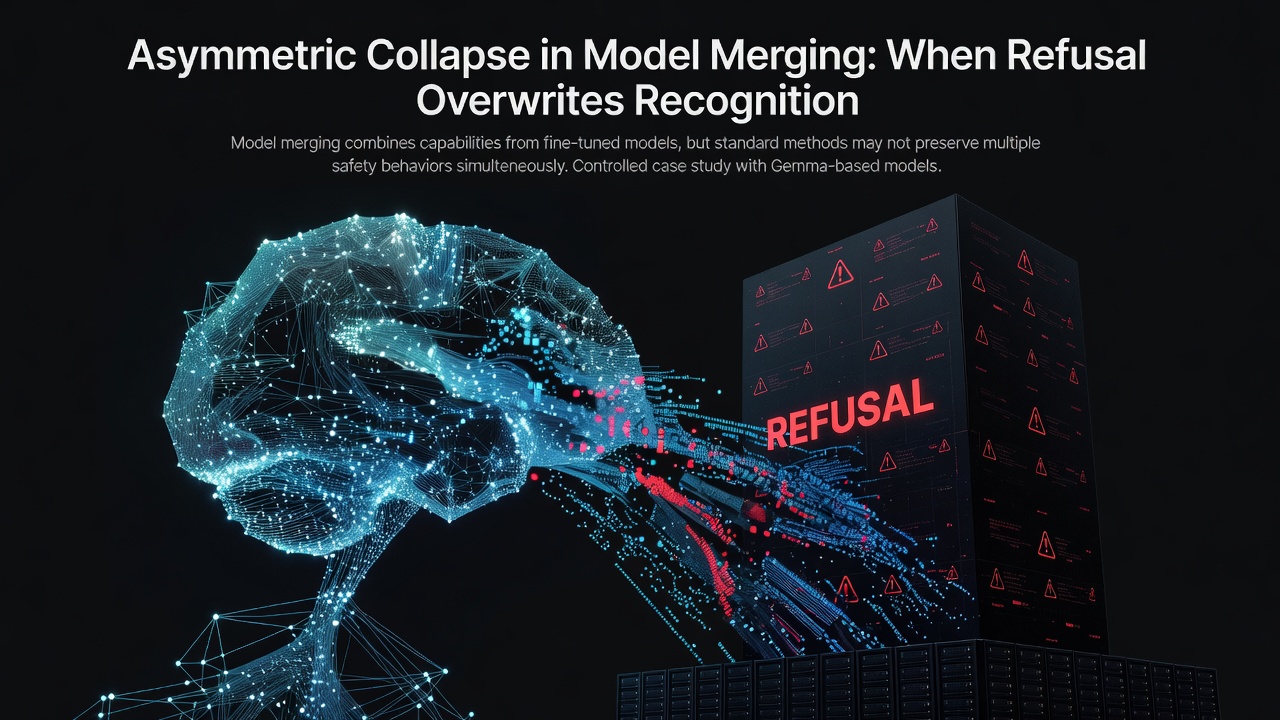
Abstract:Model merging is often used to combine capabilities from separately fine-tuned models without additional training, but it is unclear whether standard merging methods preserve multiple safety-relevant behaviors simultaneously. We study this question through a controlled case study using two Gemma-3-1B-IT finetunes on two complementary safety objectives: CARES harm-level classification and WildJailbreak adversarial refusal. We merge the two fine-tunes using Linear, SLERP, TIES, and DARE-TIES, and evaluate the merged models on classification accuracy, attack resistance, and benign compliance. Across all four methods, attack resistance transfers significantly more than classification accuracy: merged models retain 81-85% jailbreak refusal rates while CARES accuracy falls to at most 12.9%. Weight-space measurements suggest that this asymmetry is not caused by strongly opposing task-vector directions: the two task vectors are nearly orthogonal (cosine similarity 0.011). Instead, the refusal fine-tune induces consistently larger per-layer task-vector magnitudes, causing magnitude-sensitive methods to favor refusal updates. These results show that standard model merging can collapse safety recognition into broad refusal when safety-relevant task vectors differ substantially in scale.
Submission history
From: Aarnav Choudhary [view email]
[v1]
Sun, 26 Jul 2026 19:10:34 UTC (1,924 KB)
0 Comments
Log in to join the conversation.No comments yet. Be the first to share your thoughts.