
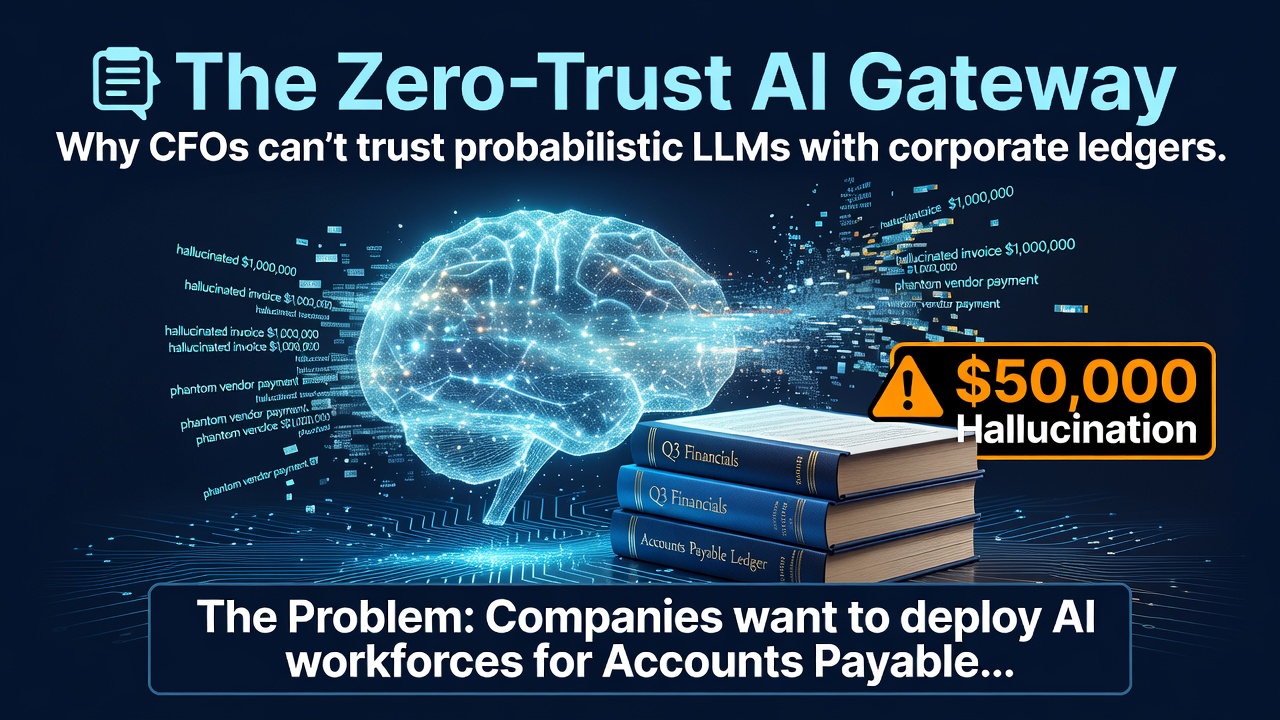

- The $50,000 Hallucination The Problem: Companies want to deploy AI workforces for Accounts Payable and invoice processing, but fear keeps them stuck in manual review.
The Risk: Probabilistic models (LLMs) are great at extracting text, but they will occasionally hallucinate math totals. In financial systems, a 1% error rate is a multi-million dollar liability.
- The Architecture: Hybrid Orchestration Explain the division of labor between probabilistic AI and deterministic code:
The AI Workforce Layer: High-speed extraction, reading messy PDFs, parsing line items, and structuring JSON payloads.
The Gatekeeper Layer: A Node.js validation proxy that sits between the AI agent and the database/ERP.
The Hard Rule: No AI agent ever touches a ledger directly. Every request goes through the gateway.
- The Three Pillars of Financial Guardrails Break down the core engine logic (the code you built):
Deterministic Math Reconciliation: Re-calculating subtotals, tax rates, and line items to the exact cent before anything executes.
The Automated Circuit Breaker: Freezing execution immediately if a severe variance or potential fraud vector is detected.
Cryptographic SHA-256 Ledger: Locking every verified transaction into an unalterable, append-only state chain for auditors.
- The Business Value (Why Enterprise Wins) Audit-Ready AI: How to give compliance teams and auditors total visibility with immutable proof logs.
Risk Mitigation: Turning AI agents from a scary security risk into a controlled, safe operational asset.
- Closing Discussion Ask readers how their engineering teams are handling state-change verification for autonomous agents. Check out the repository on GitHub
0 Comments
Log in to join the conversation.No comments yet. Be the first to share your thoughts.