
[Submitted on 8 Feb 2026 (v1), last revised 29 Jul 2026 (this version, v2)]
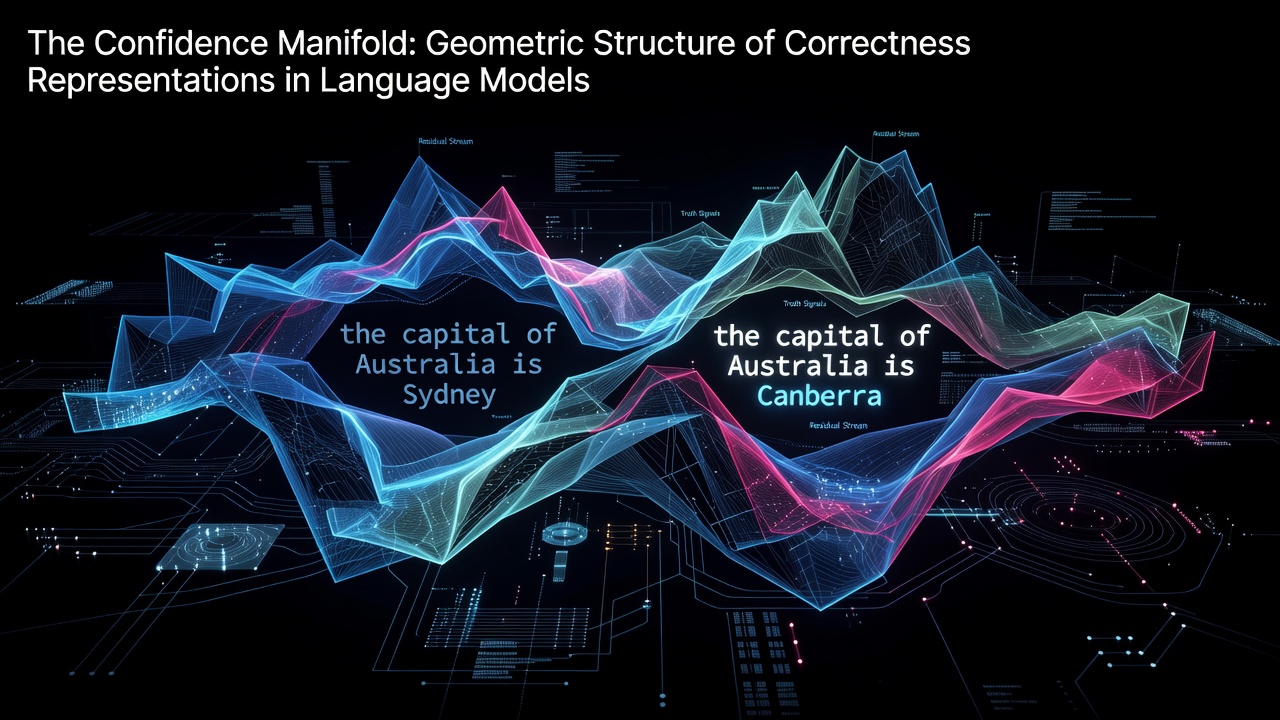
Abstract:When a language model asserts that "the capital of Australia is Sydney," does it know this is wrong? Models assert misconceptions with the same fluency as facts, so the question cannot be answered from output uncertainty. Truth-related signals are known to exist in the residual stream, but not their geometry: how many dimensions carry the signal, how simple a detector can be, and whether it transfers. We characterize this geometry across 11 models (124M-14B) and test it causally with activation steering, concept erasure, and distributed alignment search. The structure is simple: two class centroids in a 2-8 dimensional subspace match a trained linear probe, and 25 labeled examples recover 90% of full-data AUC on GPT-2. Steering shifts hallucination rates by 9.1 points on six models, erasure drops detection to chance, and distributed alignment search, the only method that bounds rank, localizes at most five causal dimensions. The internal advantage is regime-specific: probes far outperform P(True) and semantic entropy on adversarial misconceptions but tie on standard QA. Single-dataset probes transfer near-randomly until joint multi-dataset training restores 0.73-0.91 AUC. That centroid distance matches probe performance indicates class separation is a mean shift, making detection geometric rather than learned.
Submission history
From: Seonglae Cho [view email]
[v1]
Sun, 8 Feb 2026 23:27:10 UTC (606 KB)
[v2]
Wed, 29 Jul 2026 23:20:58 UTC (1,111 KB)
0 Comments
Log in to join the conversation.No comments yet. Be the first to share your thoughts.