
[Submitted on 30 Jul 2026]
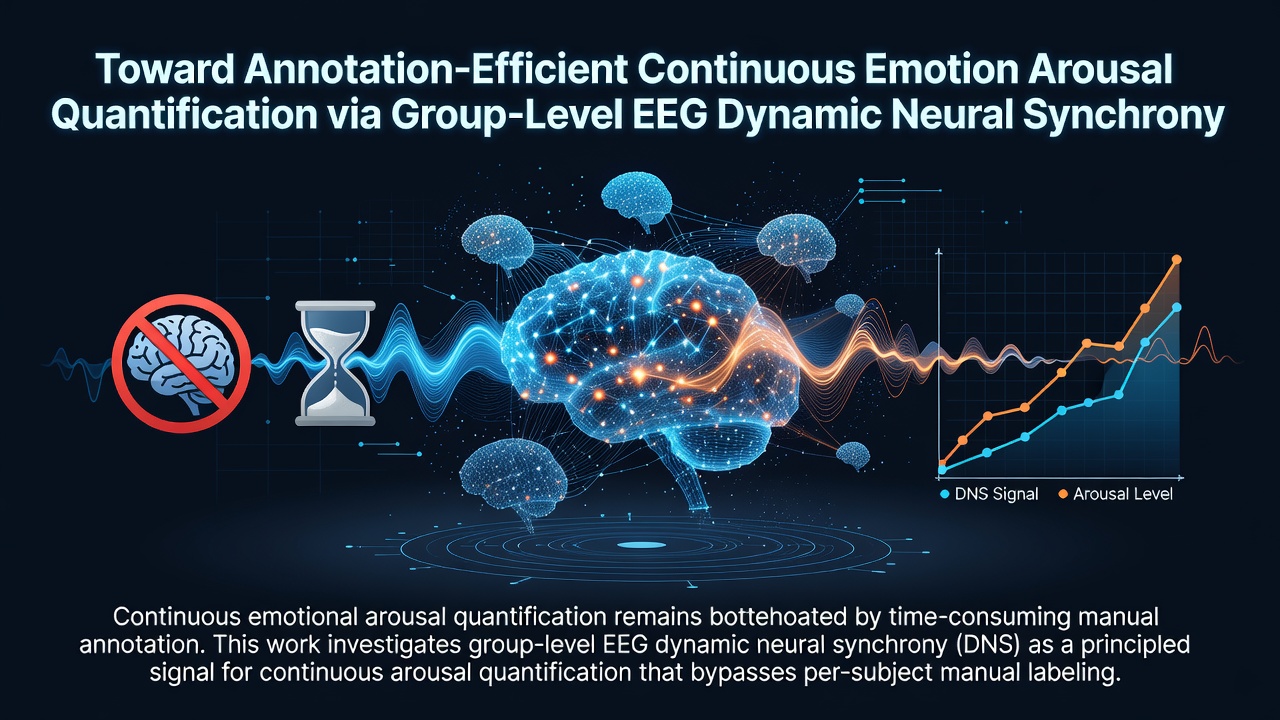
Abstract:Continuous emotional arousal quantification remains bottlenecked by time-consuming and labor-intensive manual annotation. This work investigates group-level EEG dynamic neural synchrony (DNS) as a principled signal for continuous arousal quantification that bypasses per-subject manual labeling. Using Correlated Component Analysis (CorrCA) with sliding-window computation across four EEG datasets spanning 142 subjects and over 207 hours, we systematically evaluate DNS as a group-level marker for emotional arousal dynamics. Three key findings emerge. First, DNS exhibits significant emotion information from valence-dependent differences (all p<0.003), with positive emotions eliciting higher synchrony. Second, DNS correlates more strongly with the first-order derivative of arousal than with raw arousal values, revealing that neural synchrony captures the rate of emotional change rather than static intensity. Third, we provide the first systematic characterization of how DNS-arousal coupling depends on key methodological choices, finding that moderate windows (10-30 s), positive lags (0-10 steps), and First-order Difference feature of EEG from the dominant CorrCA component yield consistently strong coupling. Subject-split replication and block permutation tests confirm these associations are not statistical artifacts. Our findings establish DNS as an empirically validated group-level marker toward annotation-efficient continuous emotional arousal quantification.
Submission history
From: Guandong Pan [view email]
[v1]
Thu, 30 Jul 2026 13:43:40 UTC (1,405 KB)
0 Comments
Log in to join the conversation.No comments yet. Be the first to share your thoughts.