
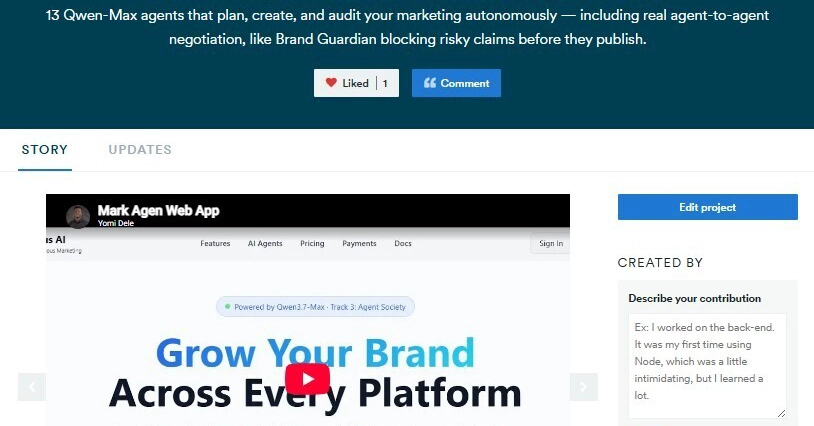


Written for the Qwen Cloud Global AI Hackathon 2026 — Track 3: Agent Society.
The idea
Most "AI marketing" tools are one LLM wearing a lot of hats — a single prompt that
generates a social post, then a different prompt that pretends to be an ads
analyst, then another that pretends to audit its own compliance. Track 3 of this
hackathon asks for something different: an agent society — specialized agents
that actually divide the work and can disagree with each other, the way a real
team does.
That's what I set out to build with Nexus AI: 13 specialized agents —
Social Manager, Brand Guardian, Digital Marketer, Ads Manager, SEO Expert,
Analytics, Conversion Optimizer, Community Engagement, Market Intelligence,
Dynamic CFO, Security SRE, Calendar Planner, and Media Generator — coordinated
by a central orchestrator, all powered by Qwen-Max through Alibaba Cloud's
DashScope SDK.
The moment it became a real "society"
The feature I care about most isn't any single agent — it's what happens
between two of them. Social Manager drafts a LinkedIn post. Before anything
gets auto-published, Brand Guardian independently reviews that exact draft.
In one real run, Social Manager's draft included the line "Guaranteed 4.2x ROAS
in 14 days, or your money back." Brand Guardian caught it, flagged it as an
unsubstantiated financial guarantee, blocked it from publishing, and routed it
to a human-approval queue with a specific reason and a suggested rewrite —
while a second draft, one without that claim, sailed through and got
auto-published in the same cycle.
That's the whole pitch, actually working: two agents, one veto, a real reason
attached. Not a shared script producing two outputs that happen to look
different.
What actually broke (the part nobody puts in the demo)
The honest version of this build: the codebase I inherited had been through a
mid-project migration — from an async PostgreSQL design to a synchronous
SQLite one — that never finished. The database layer had moved to sync, but
every router still expected an async session; the config file had been
rewritten with different field names than the code still expected; the test
suite's fixtures were still async. None of it would even boot.
Getting to a working demo meant tracing that mismatch through the entire stack
before a single agent could run — config, database session handling, every
router, the orchestrator, the test fixtures. Once it booted, the harder bug was
quieter: some agents were silently returning the wrong shaped data. A social
post that happened to mention "SEO" as a topic would make Brand Guardian's
review get hijacked by the SEO agent's response template instead of its own,
because the underlying simulator routed responses by naive keyword matching,
and "SEO" is a normal thing for a marketing post to mention.
I only found this by refusing to trust "the API call returned 200" as proof of
correctness, and instead systematically auditing what every one of the 13
agents actually produced, end to end, for a full cycle. Two of thirteen were
quietly wrong. Fixing it meant re-keying every agent's routing off something
that can never collide with user content: each agent's own fixed system
prompt, instead of generic words its output might happen to share with
someone else's.
Working with Qwen Cloud directly
The integration itself, once the plumbing was fixed, was straightforward:
dashscope.Generation.call() against Alibaba Cloud's native endpoint, one
unified QwenClient that every agent shares, with a high-fidelity local
simulator as a fallback so a demo never depends on live network conditions or
API quota. I verified the real path independently of the simulator — sent a
literal "reply with exactly: REALAPIWORKED" through the actual client class,
got the real word back from Qwen-Max, confirmed the simulator wasn't quietly
intercepting it.
What's next
Real OAuth so the agents can act on real social accounts (starting with
X/Twitter), and deployment so this isn't just a local demo. The agent logic
and the Qwen integration were always the easy part in hindsight — the real
work was making sure "multi-agent" was a fact I could prove, not a claim I
could just assert.
Built for the Qwen Cloud Global AI Hackathon 2026, Track 3: Agent Society.
Code: github.com/MelekhYomi/mark-agen-nexus-ai
Whatsapp +2347068561873
0 Comments
Log in to join the conversation.No comments yet. Be the first to share your thoughts.