
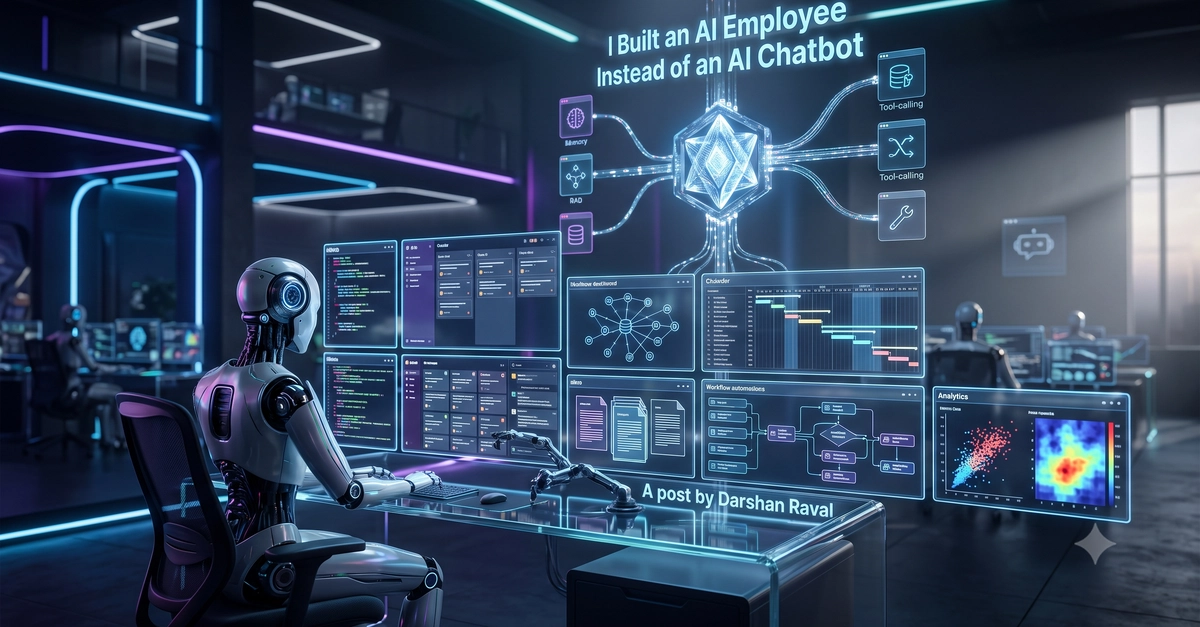
I Built an AI Employee Instead of an AI Chatbot
Everyone seems to be building AI chatbots.
I decided to build something different.
An AI employee.
And it completely changed how I think about AI applications.
We've Been Building the Wrong Thing
For the last couple of years, the default AI project looked something like this:
- Add a chat window.
- Connect it to an LLM.
- Ask questions.
- Get answers.
It works.
But after the initial excitement, I noticed something.
People rarely wanted another chatbot.
They wanted someone—or something—that could actually do the work.
That's when I stopped asking:
"How can I build a better chatbot?"
And started asking:
"How can I build an AI teammate?"
A Chatbot Gives Answers
Imagine asking a chatbot:
"Can you create today's sales report?"
It might generate SQL.
Explain the steps.
Or tell you how to build the report.
Useful?
Absolutely.
But you still have to do the work yourself.
The chatbot is acting like a search engine with better communication skills.
An AI Employee Gets Work Done
Now imagine an AI employee.
You give it the exact same request:
"Create today's sales report."
Instead of explaining how to do it, the AI:
- Connects to your database.
- Retrieves today's sales.
- Generates charts.
- Creates a PDF report.
- Uploads it to Google Drive.
- Sends the report to your Slack channel.
- Notifies your manager.
No copy-paste.
No manual steps.
Just results.
That's the difference.
The Architecture Shift
A chatbot has a simple architecture.
User
 │
 ▼
Prompt
 │
 ▼
LLM
 │
 ▼
Response
Enter fullscreen mode Exit fullscreen mode
An AI employee is much more capable.
User
 │
 ▼
Planner
 │
 ▼
Memory
 │
 ▼
Knowledge (RAG)
 │
 ▼
Tool Calling
 │
 ▼
Business Rules
 │
 ▼
Multiple APIs
 │
 ▼
LLM
 │
 ▼
Completed Task
Enter fullscreen mode Exit fullscreen mode
The language model becomes just one part of a much larger system.
What Makes an AI Employee?
An AI employee usually combines several capabilities.
Planning
Instead of responding immediately, it breaks a goal into smaller tasks.
Example:
Prepare weekly engineering report

↓

Collect GitHub commits

↓

Analyze Jira tickets

↓

Generate summary

↓

Email stakeholders
Enter fullscreen mode Exit fullscreen mode
The AI is thinking in workflows rather than responses.
Memory
A real employee remembers things.
So should your AI.
For example:
- Team preferences
- Previous conversations
- Frequently used documents
- Project context
- Customer history
Without memory, every conversation starts from zero.
Tool Calling
This is where AI becomes genuinely useful.
Instead of hallucinating information, it interacts with real systems.
Examples include:
- GitHub
- Jira
- Slack
- Gmail
- PostgreSQL
- MongoDB
- Google Drive
- Notion
- Calendar APIs
- Internal company services
The AI doesn't just talk.
It acts.
Knowledge Retrieval
Employees don't memorize every document.
They look things up.
Modern AI should do the same.
Using Retrieval-Augmented Generation (RAG), an AI employee can search:
- Product documentation
- Internal wikis
- Company policies
- Technical documentation
- API references
- Support articles
Instead of guessing, it retrieves the right information before responding.
A Real Example
Imagine you're building an AI employee for your engineering team.
Every morning it automatically:
- Reads overnight production logs.
- Checks failed deployments.
- Reviews open GitHub issues.
- Summarizes customer feedback.
- Detects unusual error spikes.
- Creates a daily engineering report.
- Sends it to Slack before stand-up.
Nobody had to ask.
Nobody clicked a button.
The work simply happened.
That's much closer to having a teammate than a chatbot.
Why This Matters for Developers
Building AI employees requires a different mindset.
Instead of asking:
"What should the model say?"
You start asking:
- What tools does it need?
- What information should it remember?
- Which APIs should it call?
- How should it recover from failures?
- Which tasks can it automate?
- What permissions should it have?
You're designing systems, not conversations.
AI Employees Need More Than an LLM
The most capable AI applications today aren't powered by a single model.
They're powered by a complete ecosystem.
That ecosystem often includes:
- LLMs
- Model Context Protocol (MCP)
- RAG pipelines
- Long-term memory
- Vector databases
- Workflow orchestration
- Tool calling
- Observability
- Security and permission layers
The language model is important.
But it's only one component.
Challenges You'll Face
Building an AI employee isn't just about connecting APIs.
You'll also need to think about:
- Authentication and authorization
- Rate limiting
- Error handling
- Human approval for critical actions
- Logging and observability
- Cost optimization
- Data privacy
- Prompt injection attacks
The more responsibility you give AI, the more engineering discipline it requires.
The Future Isn't More Chatbots
Every company already has enough dashboards.
Enough forms.
Enough chat windows.
What businesses actually need are systems that reduce repetitive work.
That's why I believe the next generation of AI products won't be remembered as chatbots.
They'll be remembered as digital teammates that quietly complete tasks in the background.
Final Thoughts
Chatbots changed how we interact with software.
AI employees will change how work gets done.
The shift isn't about making conversations smarter.
It's about building systems that can plan, remember, retrieve information, use tools, and complete real tasks with minimal human intervention.
As developers, that's an exciting challenge.
Because we're no longer just building interfaces for AI.
We're building coworkers.
If you enjoyed this article, follow me for more content on AI Engineering, Node.js, AI Agents, MCP, RAG, System Design, and modern backend architecture.
I'm Darshan Raval, a Technology Lead at Infosys with 7+ years of experience building scalable backend systems using Node.js, NestJS, GraphQL, Microservices, AWS, and GCP. I enjoy exploring practical AI engineering patterns and sharing real-world lessons with the developer community.
Happy coding! 🚀
0 Comments
Log in to join the conversation.No comments yet. Be the first to share your thoughts.