
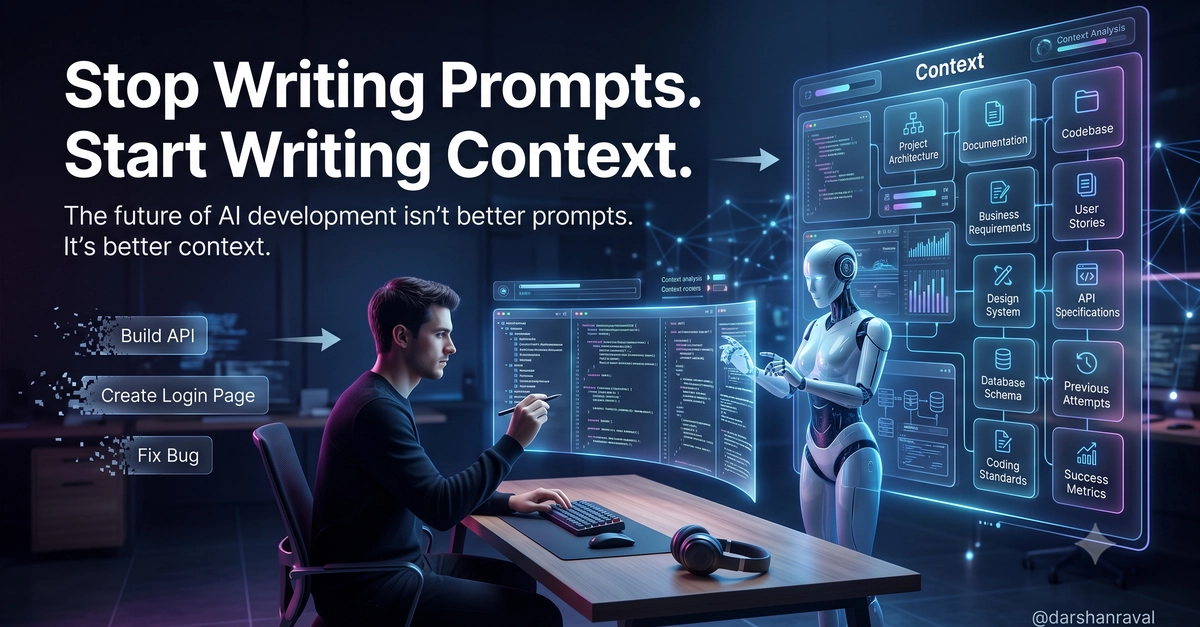


Stop Writing Prompts. Start Writing Context.
For months, everyone talked about writing better prompts.
In 2026, the developers building the best AI products aren't obsessed with prompts anymore.
They're obsessed with context.
The Shift Nobody Saw Coming
A year ago, my prompts looked something like this:
Build a REST API using Node.js.
Enter fullscreen mode Exit fullscreen mode
The result?
Sometimes good.
Sometimes terrible.
Sometimes completely unrelated.
So I kept improving the prompt.
More details.
More examples.
More instructions.
But eventually I realized something:
The prompt wasn't the problem. The AI simply didn't know enough.
That changed everything.
Prompt Engineering Is Reaching Its Limits
A prompt is only one small part of an AI request.
Think about hiring a new developer.
Would you simply say:
"Build me an authentication system."
Of course not.
You'd share:
- Existing codebase
- Tech stack
- Coding standards
- API documentation
- Database schema
- Business rules
- Previous implementation
- Team conventions
The more context they have...
the better the result.
AI works exactly the same way.
What Is Context Engineering?
Context Engineering is the practice of giving AI everything it needs to make good decisions—not just good instructions.
Instead of writing:
Create a login API.
Enter fullscreen mode Exit fullscreen mode
You provide:
Project:
Node.js + NestJS

Database:
PostgreSQL

Authentication:
JWT + Refresh Token

Coding Style:
Repository Pattern

Validation:
class-validator

Existing APIs:
User Registration
Password Reset

Security Requirements:
Rate limiting
bcrypt
RBAC

Expected Output:
Production-ready code
Enter fullscreen mode Exit fullscreen mode
Notice something?
The prompt barely changed.
The context did.
Context Is More Than Just Text
Many developers think context means "write a longer prompt."
It doesn't.
Context includes everything the model can use to make better decisions.
Examples include:
- Source code
- Documentation
- Database schema
- API specifications
- Previous conversations
- User preferences
- Company guidelines
- Error logs
- Design files
- Images
- Test cases
- Memory
- Retrieved knowledge (RAG)
- Tool outputs
This is why modern AI applications feel dramatically smarter.
They're not using bigger prompts.
They're supplying richer context.
A Simple Comparison
| Prompt Engineering | Context Engineering |
|---|---|
| Focuses on wording | Focuses on information |
| One prompt | Complete environment |
| Static | Dynamic |
| Manual | Automatically assembled |
| Good for ChatGPT | Essential for production AI |
| Limited knowledge | Rich business knowledge |
How Modern AI Apps Actually Work
A production AI application rarely sends only your prompt.
Instead, it builds context behind the scenes.
User Request
      │
      ▼
Understand Intent
      │
      ▼
Retrieve Relevant Knowledge (RAG)
      │
      ▼
Load Conversation Memory
      │
      ▼
Collect Project Files
      │
      ▼
Call Required Tools
      │
      ▼
Inject Business Rules
      │
      ▼
Send Complete Context to LLM
      │
      ▼
Generate Response
Enter fullscreen mode Exit fullscreen mode
This hidden pipeline is what separates toy demos from production-ready AI systems.
A Real Example
Suppose your manager asks:
"Generate a new Orders API."
A prompt-only approach might produce something generic.
A context-aware system already knows:
- The project uses NestJS
- PostgreSQL is the primary database
- Swagger documentation is required
- Every API follows repository pattern
- JWT authentication is mandatory
- Response format is standardized
- Validation uses
class-validator - Logging is handled by Winston
- Unit tests are written with Jest
Without changing the prompt...
the output becomes dramatically better.
Why Developers Should Care
As developers, we naturally think in terms of systems.
AI should be treated the same way.
Instead of asking:
"How can I write a better prompt?"
Ask:
"How can I provide better context?"
That one mindset shift changes how you build AI products.
The Rise of Context-Aware Development
Today's AI stack is no longer just:
User → Prompt → LLM
Enter fullscreen mode Exit fullscreen mode
It's becoming:
User
 │
 ▼
Memory
 │
 ▼
RAG
 │
 ▼
Tool Calling
 │
 ▼
Project Knowledge
 │
 ▼
Business Rules
 │
 ▼
LLM
 │
 ▼
Response
Enter fullscreen mode Exit fullscreen mode
This is why concepts like:
- Model Context Protocol (MCP)
- Retrieval-Augmented Generation (RAG)
- Tool Calling
- Long-Term Memory
- Agent Workflows
have become essential skills for modern developers.
They all exist for one purpose:
Deliver the right context to the model at the right time.
Practical Tips
If you're building AI applications today, start thinking beyond prompts.
Instead:
- Give the model your project structure.
- Include relevant documentation.
- Retrieve only the knowledge it needs.
- Maintain conversation memory.
- Let AI use tools instead of guessing.
- Define coding conventions.
- Provide examples from your own codebase.
- Keep context fresh and relevant.
The quality improvement is often far greater than switching to a more expensive model.
Final Thoughts
Prompt Engineering helped us discover what AI could do.
Context Engineering is teaching us how to build AI that people can actually trust.
The future isn't about writing clever prompts.
It's about designing systems that deliver the right information at the right moment.
Because in the end...
AI doesn't make decisions based on your prompt.
It makes decisions based on the context you give it.
If you found this helpful, follow me for more articles on AI Engineering, Node.js, System Design, RAG, MCP, and modern backend development.
I'm Darshan Raval, a Technology Lead at Infosys with 7+ years of experience building scalable backend systems using Node.js, NestJS, GraphQL, Microservices, AWS, and GCP. I enjoy exploring practical AI engineering patterns and sharing what works in real-world development.
Happy coding! 🚀
0 Comments
Log in to join the conversation.No comments yet. Be the first to share your thoughts.