
Has the death of SaaS been greatly exaggerated?
It’s not unreasonable to question whether SaaS really is dead or dying. As with many things in this industry, the answer is ‘it depends’. What is worth bearing in mind though is something my colleague Martin Fowler said 15 years ago: some software is utility and some is strategic, and you shouldn’t run them the same way.
In the pre-AI world, “buy the package” was rational for utility systems because software was expensive and slow to build. AI changes the economics by making software creation dramatically cheaper and faster, so the build vs buy boundary shifts. And there’s a second twist: systems we treated as utility, like CRM, can become strategic in the AI era because the competitive edge is no longer the system of record, it’s the customer intelligence you can extract and act on from it. That’s why startups and mid-sized companies can choose to classify their GTM systems as strategic, and go the custom route without paying the traditional SaaS rent.
However, enterprises are different. With the tech available today, organizations can easily replace point solutions that have a narrow feature set. We did exactly that at Thoughtworks marketing, eliminating three SaaS platforms with a narrow feature set in 2025 and replacing them with bespoke AI workflows, which removes vendor complexity from our stack, and the lower price is also a bonus. The inflection point is when businesses choose to abandon CRM-class systems that are used by hundreds or thousands of employees, with deep feature sprawl, uneven user behavior, support expectations, plus security and privacy obligations that SaaS quietly absorbs. Our first attempt at ripping out a rock system in Thoughtworks marketing and replacing it with an AI-native solution has taught us some important lessons. If you take such a challenge, you need to shift from a traditional pre-AI era, classic agile product/IT team delivery model, otherwise it’s impossible to keep up and build the full feature set, even when using vibe coding tools like Lovable and coding assistants like Claude Code to expedite the development process.
Making replacing SaaS viable
We’ve all seen entrepreneurs using tools like Base44 to generate a CRM for personal use in a few hours. We know that this doesn’t hold in enterprise grounds. The issue is not whether AI can help generate software. It is whether you can deliver enterprise-grade systems fast enough, with the right quality, governance, and cost profile, to make replacement a serious option. To make “replace big SaaS” viable you need a new software development lifecycle.
That is exactly why Thoughtworks launched AI/works™ in January 2026, our agentic development platform. We are now using it internally across sales and marketing as we work to replace a core SaaS platform in our GTM stack. The goal is to reach the full feature set and workflows the business requires, while continuously regenerating application components as business requirements and regulations change, with less human intervention. In that model, humans shift from manually chasing every feature to acting as architects and overseers of an AI-native development process. With such an approach, the economics to replace SaaS in the enterprise can make sense.
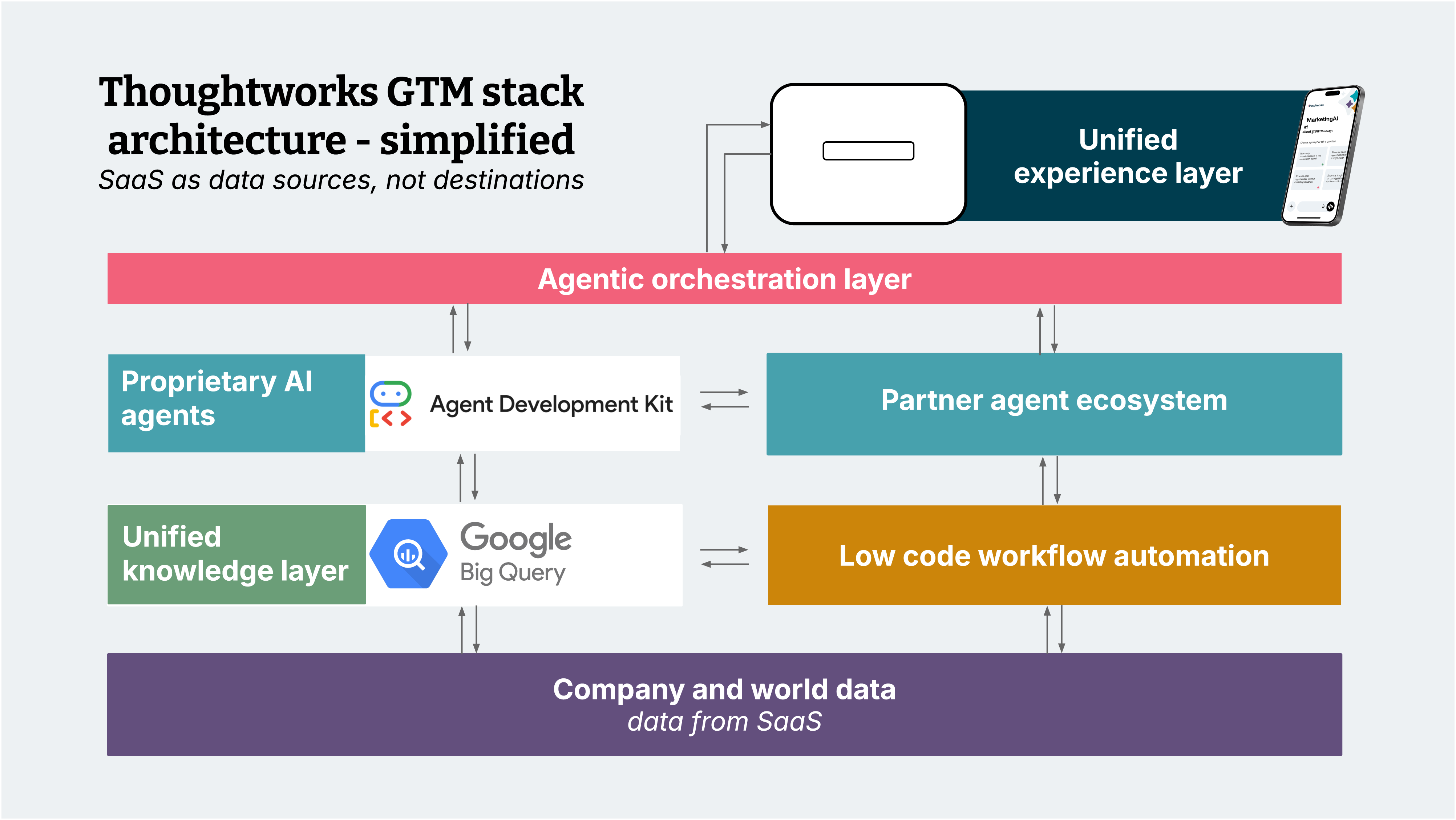
But until that model matures, the more immediate trend is not mass SaaS extinction. It is how to get more value from the SaaS and the data your organization already has. This has been a major focus for us in Thoughtworks marketing. Before touching the core stack, we focused on improving value by building the intelligence layer above the SaaS. The aim was to help our GTM teams get better signals, better recommendations, and better timing than the pre-AI model allowed. To do this, we established an AI marketing applications team and introduced forward-deployed AI engineering graduates to work directly with marketers, sitting alongside them in the business. Their role is to bring together data, context, and business logic to generate more useful intelligence than any single SaaS platform could provide on its own. To act on that intelligence, we introduced GTM Engineers focused on workflow automation using low-code tooling such as n8n, helping turn insight into execution faster. We also built a close working relationship with internal IT, which provides infrastructure, guardrails, agent-building protocols, and other horizontal capabilities.
Once organisations prove they can generate better intelligence and faster action on top of the existing stack, they are in a much stronger position to challenge legacy pricing, reduce vendor sprawl, and decide more selectively which platforms still earn their place.
0 Comments
Log in to join the conversation.No comments yet. Be the first to share your thoughts.