
[Submitted on 23 May 2026]
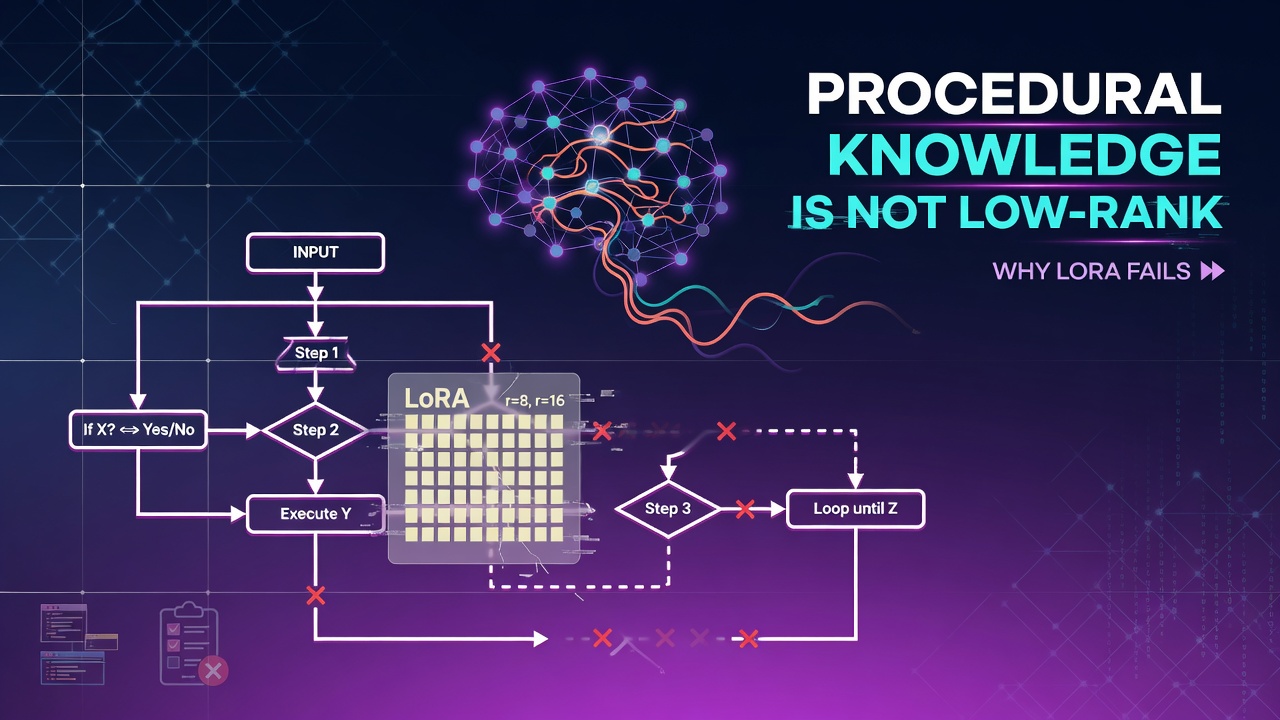
Abstract:Parameter-efficient fine-tuning methods like LoRA have become the default for adapting large language models, succeeding across instruction following, style transfer, and factual adaptation. We show that for procedural knowledge--the ability to follow multi-step procedures with conditional branching through to terminal states--LoRA fails to match full fine-tuning at the ranks where it retains its efficiency advantage. In a systematic ablation (r = 16--128) on a procedural travel booking task (14 nodes), all LoRA configurations fail uniformly (task success <= 2.54 vs. 4.11 for full fine-tuning, all p < 0.001), with scores decreasing at higher ranks--despite maintaining 95--99% conversation completion rates. Cross-domain replication on Zoom support (14 nodes) and insurance claims (55 nodes) at 8B confirms the failure generalizes: LoRA underperforms full fine-tuning by 0.8--2.2 points on average at both r = 32 and r = 128, with the largest gap on the most complex procedure. Quadrupling rank from 32 to 128 provides marginal improvement but does not close the gap. SVD analysis of the weight changes produced by full fine-tuning explains why: across three domains at both 3B and 8B, the mean effective rank of the update ranges from 761 to 1,026, and rank 128 captures only 43--51% of the squared Frobenius norm. Together, these findings establish that for procedural tasks LoRA falls well short of full fine-tuning--a fundamental limitation for agentic applications.
Submission history
From: Simon Dennis [view email]
[v1]
Sat, 23 May 2026 17:06:02 UTC (88 KB)
0 Comments
Log in to join the conversation.No comments yet. Be the first to share your thoughts.