
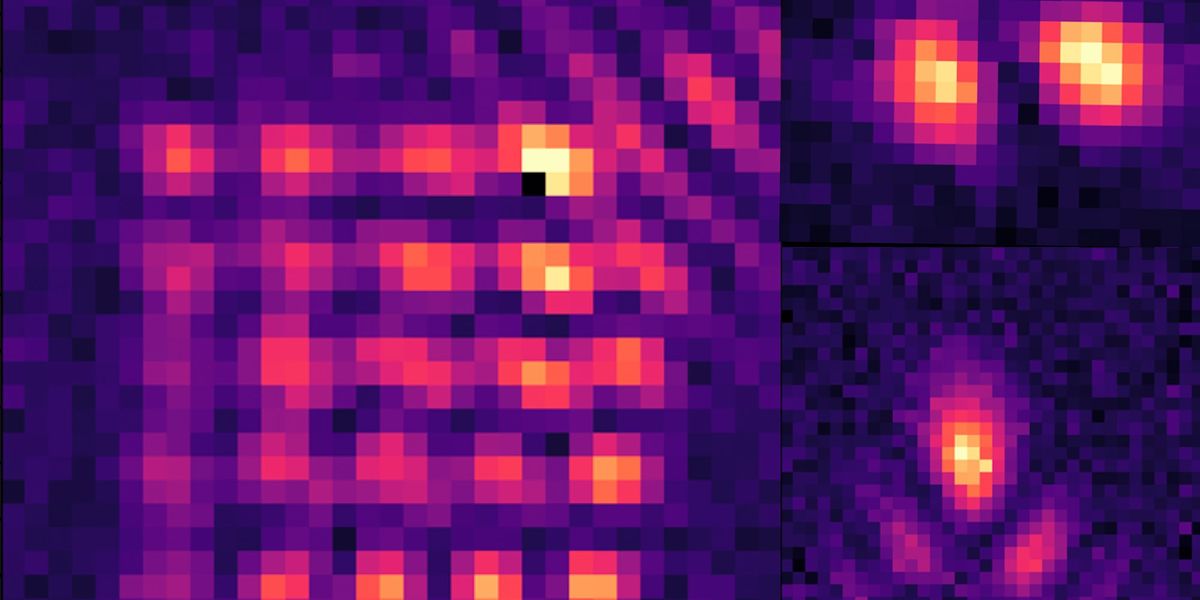
Today, it’s quite possible to 個々の原子を写真に写すことが可能です。これは画像技術の大きな成果の一つです。では、その逆はどうでしょうか。1つの原子を使って画像を撮影することはできるのでしょうか?
Single atoms are probably not replacing smartphone cameras soon, but an atom can be used to measure light. One research group at the Institute for Molecular Science in Okazaki, 日本, has now used this ability to develop what they call an “atom camera,” which can capture patterns of light far too small to see with standard 光学顕微鏡。
More than a physics demonstration, the atom camera could also be an elegant way to see inside certain 量子コンピュータ。The atom camera’s creators are also building quantum computers that use neutral atoms as qubits。
“We expect the atom camera to serve as a valuable diagnostic tool for this effort in our laboratory, and in other similar efforts worldwide as well,” says Kenji Ohmori, a physicist at the Institute for Molecular Science.
Ohmori and colleagues published their work in Nature Communications on 29 May.
The quantum photographer’s guide
The key component of this atom camera is an 光ピンセット, an instrument that traps particles by squeezing them with focused laser beams. The instrument has become a common tool of physicists who handle atoms. A tweezer can catch an atom, then move it around or hold it in place. The researchers chilled a rubidium-87 atom to near absolute zero and 固定しました inside an optical tweezer. The atom camera essentially measures how this atom responds to its environment. As light falls on an atom, it imparts energy onto some of the atom’s 電子。This shifts the エネルギー状態 of those electrons.
By observing these shifts, the researchers could gauge either the light’s intensity or its 偏光。They could measure these properties of their tweezer’s light, or they could measure a second pattern of light cast on the atom.
These patterns are much larger than a single atom, so how do you turn measurement into a full image? Because the atom must be kept still, you have to move the pattern itself across the atom. The researchers dragged a pattern 100 nanometers at a time—up, down, or to the side—and measured the intensity or the polarization of the light at each step.
In the end, they had a 2D map of measurements—which they could render into a nanoscale “photograph.” They photographed several different patterns using this method.
The Okazaki researchers aren’t the first to use atoms for measuring light. 1990年代から, physicists have tried atoms to cheat the 回折限界 of visible light: the tiniest feature that typical 光学系 can see. Atoms are significantly smaller than this, so an atom set up in the proper way could theoretically resolve even tinier details.
As cold-atom physics has grown more sophisticated, more labs have tried their hands (and 光ピンセット) at making atoms fit for purpose. In 2022, two groups at the Institute of Photonic Sciences in Barcelona and at the University of California, Berkeley, separately used rubidium-87 atoms to capture the intensity of oncoming light. The Berkeley group reached a resolution of 300 nm, but they believed their work was only an initial step.
“We envisioned that the method could be made much more sensitive,” says Dan Stamper-Kurn, a physicist who was involved in the aforementioned work, but not the Okazaki group.
In its earlier work, the Berkeley group studied a relatively large shift in energy state. The Okazaki group instead measured a far subtler shift linked to what physicists call a 超微細構造遷移。This has several advantages. For one, the Okazaki group could measure its light’s polarization, in addition to its intensity. For another, the hyperfine transition is far more sensitive: In theory, the Okazaki group can render features as small as 25 nm. (Smaller than that, 量子不確実性 comes into play.)
The more precisely you know your atom’s position, the better your resolution. This is why the atom must be kept as still as possible.
Qubits calling for photographers
What could an “atom camera” capture? Quite a few things, actually, physicists say.
“There’s a lot of relevance to this, because these so-called optical tweezers are what we use in many experiments nowadays,” says Johannes Zeiher, a physicist at the Ludwig-Maximilians-Universität München in ドイツ, who was also not involved with the Okazaki group.
Optical tweezers are particularly prized in the world of 中性原子量子コンピュータ, like the Okazaki group are building. These quantum computers run on atoms such as rubidium-87 chilled to near absolute zero inside a vacuum chamber. Optical tweezers can trap the atoms, which act as qubits, and hold them or move them around. Computing with two neutral atoms might involve precisely positioning them and レーザーを照射する to illuminate both.
Such a light beam is almost never uniform. Even a small beam can contain all manner of subtleties, especially quirks of polarization, which can interfere with a qubit and cause it to lose coherence and collapse. It’s crucial, then, for a qubit operator to understand the tiniest details of their light, but physicists today are still searching for a method to reliably do this.
Traditional optics often aren’t suitable for the task of seeing inside a quantum computer’s vacuum chamber, since they too can easily disturb qubits. The challenge becomes even more tedious as neutral-atom quantum computers gain more qubits and become more complex to control.
The physicists say that their creation, which can map both intensity and polarization at tiny scales, is an enticing alternative.
“Rather than bringing a camera from outside the vacuum chamber, why not use the tools already there inside our quantum playground in the vacuum?” says Takafumi Tomita, a physicist at the Institute for Molecular Science, and another of the authors.
0 Comments
Log in to join the conversation.No comments yet. Be the first to share your thoughts.