


1. Introduction
Hello from Japan! 🇯🇵
I am an active truck driver in Japan self-studying Python and Web technologies, leveraging my logistics domain knowledge to transition into a Web Engineer.
(English is my second language, but I'm excited to share my progress with developers worldwide!)
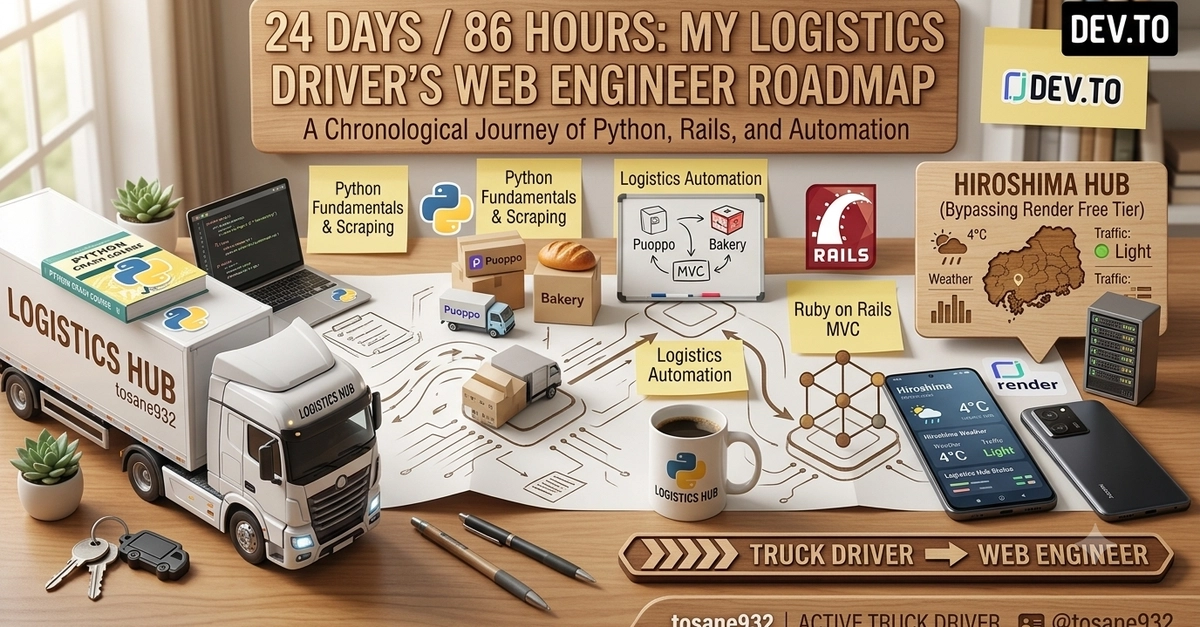
I started my learning journey on May 12, 2026. As of June 4, I have logged 24 days and 86 cumulative hours of study. This article documents my progress, learning roadmap, and project milestones chronologically.
2. The 86-Hour Learning Roadmap
A quick breakdown of my 86 hours: 80 hours were dedicated to hands-on development and implementation, and 6 hours were spent on environment configuration, documentation, and workflow optimization.
Stages 1–3: Automation & Scraping Projects
- ① Fundamentals & Web Scraping (25 hours) Learned core Python syntax and built automated scripts to collect targeted web data.
- ② Puoppo Auto-Analysis System (15 hours) Implemented automated poll data retrieval and AI-powered text analysis on Lubuntu.
- ③ Bakery Sales Aggregation System (12 hours) Integrated web scraping with automated Excel processing to streamline sales data aggregation.
Stage 4: Practical Ruby on Rails
- ④ rails_practice (23 hours) Explored MVC architecture in Ruby on Rails. Practiced configuration management and Git rebasing to build a solid foundation in web framework operations.
Stage 5: Real-World System Integration
-
⑤ hiroshima-logistics-hub (5 hours)
Built a web system to aggregate real-time weather and traffic conditions in the Hiroshima area.
- Technical Fix: To bypass build crashes on Render (Free Tier / 512MB RAM), I precompiled assets locally and configured SQLite3 database storage in writable directories before deployment.
3. Key Takeaways for Resource-Constrained Development
Through these projects, I established three operational principles for developing efficiently within tight constraints:
- Maintaining a Sustainable Pace: Physical and mental fatigue directly reduce output quality. Scheduling intentional rest is a core part of my development workflow.
- Problem-Solving Under Constraints: Instead of seeing hardware specs or memory caps as brick walls, I treat them as "engineering puzzles." I always brainstorm alternative strategies (Plan C), such as tweaking configurations or reducing reliance on heavy libraries.
- Real-Device Verification: Beyond desktop browser checks, I routinely test applications on mobile devices (Xiaomi 15T) to verify UX consistency in real-world scenarios.
4. Future Outlook
It has been 24 days since I wrote my first line of code. Moving forward, I will focus on building production-ready Web applications to build a solid portfolio that proves my practical engineering capabilities.
0 Comments
Log in to join the conversation.No comments yet. Be the first to share your thoughts.