
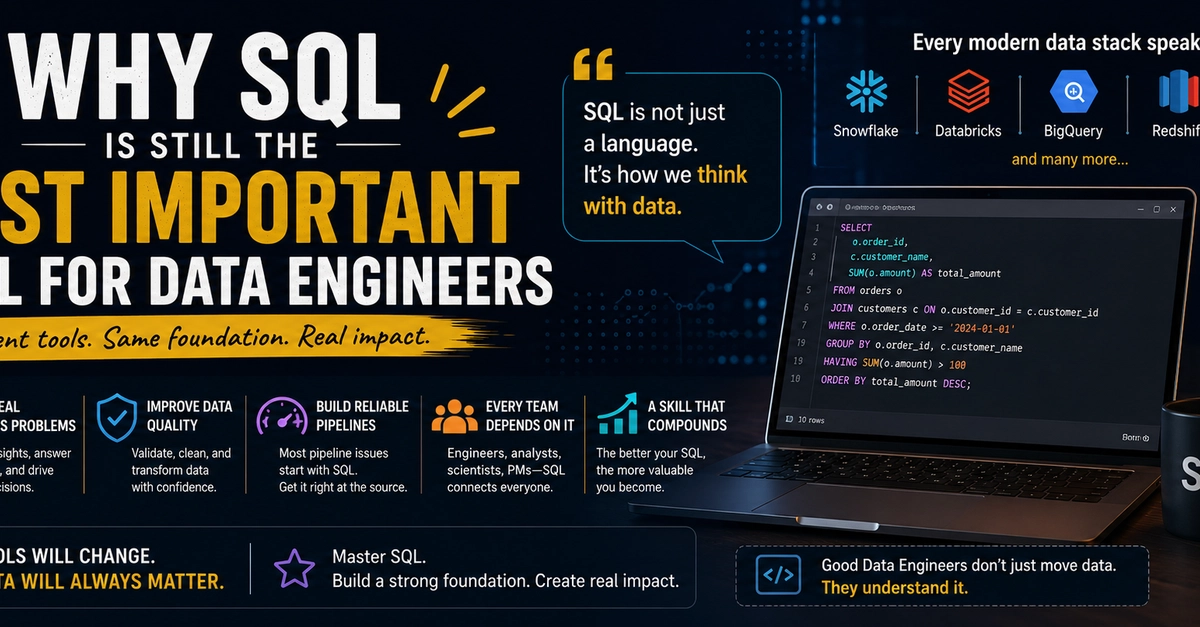
Every year there's a new "must-learn" technology—Spark, Kafka, Databricks, Snowflake, AI, LLMs...
But one skill has remained essential through every wave of innovation:
SQL.
When I first started learning Data Engineering, I thought SQL was just another box to check.
"Learn some SELECT statements, a few JOINs, and move on to Python."
I couldn't have been more wrong.
The more real-world projects I worked on, the more I realized that SQL isn't just a language—it's how data engineers think.
SQL Is Everywhere
No matter what modern stack you're using, SQL is almost always involved.
- Snowflake
- Databricks
- BigQuery
- Redshift
- PostgreSQL
- SQL Server
- Oracle
- Spark SQL
- DuckDB
Different platforms.
Same foundation.
That's why companies don't just hire people who know SQL syntax they hire engineers who can solve business problems using SQL.
SQL Is About Solving Problems
Writing SQL isn't the difficult part.
Understanding the data is.
A good Data Engineer asks questions like:
- Where is the data coming from?
- Why are these numbers different?
- Which records should be included?
- Why are duplicates appearing?
- Why did yesterday's pipeline fail?
SQL helps answer those questions quickly.
Most Data Pipeline Bugs Start With SQL
Many production issues aren't caused by Spark or Airflow.
They're caused by things like:
- Incorrect JOIN conditions
- Missing filters
- Duplicate records
- NULL handling
- Wrong aggregations
- Time zone mistakes
A single bad query can quietly produce incorrect dashboards for thousands of users.
That's why experienced engineers spend so much time validating SQL logic before deploying a pipeline.
SQL Is the Language of Analytics
Every team depends on SQL:
- Data Engineers
- Data Analysts
- Analytics Engineers
- BI Developers
- Data Scientists
- Machine Learning Engineers
- Product Managers (through dashboards)
If you can communicate with data using SQL, you become valuable across the organization.
The Difference Between Knowing SQL and Mastering SQL
Most people can write:
SELECT *
FROM orders;
Enter fullscreen mode Exit fullscreen mode
Fewer people can confidently work with:
- Window functions
- Common Table Expressions (CTEs)
- Recursive queries
- Query optimization
- Execution plans
- Incremental processing
- Slowly Changing Dimensions (SCDs)
- Complex aggregations
- Performance tuning
Those are the skills that separate beginners from experienced Data Engineers.
SQL Makes You a Better Engineer
Strong SQL skills improve more than your queries.
You start to:
- Think logically about data.
- Spot quality issues faster.
- Design cleaner pipelines.
- Debug production problems more efficiently.
- Communicate better with analysts and stakeholders.
In many ways, SQL trains you to think like a Data Engineer.
My Advice for Beginners
If I were starting over today, I'd spend far more time mastering SQL before chasing every new tool.
Learn:
- JOINs (and when not to use them)
- Window functions
- CTEs
- Aggregations
- Query optimization
- Indexing concepts
- Data modeling basics
The frameworks and platforms will evolve.
The ability to understand and manipulate data efficiently won't.
Final Thoughts
AI is changing software engineering.
Cloud platforms are changing infrastructure.
New tools are released every month.
But SQL has remained relevant because every business still relies on one thing:
Data.
If you're serious about becoming a Data Engineer, don't treat SQL as a beginner skill.
Treat it as your superpower.
I'd love to hear from you:
What's the most useful SQL concept you've learned that made your work easier?
Share it in the comments someone starting their journey might learn something valuable from your experience.
If you enjoyed this article, follow me here on Dev.to. I'll be sharing more practical lessons on Data Engineering, SQL, Python, cloud technologies, and building reliable data platforms.
0 Comments
Log in to join the conversation.No comments yet. Be the first to share your thoughts.