
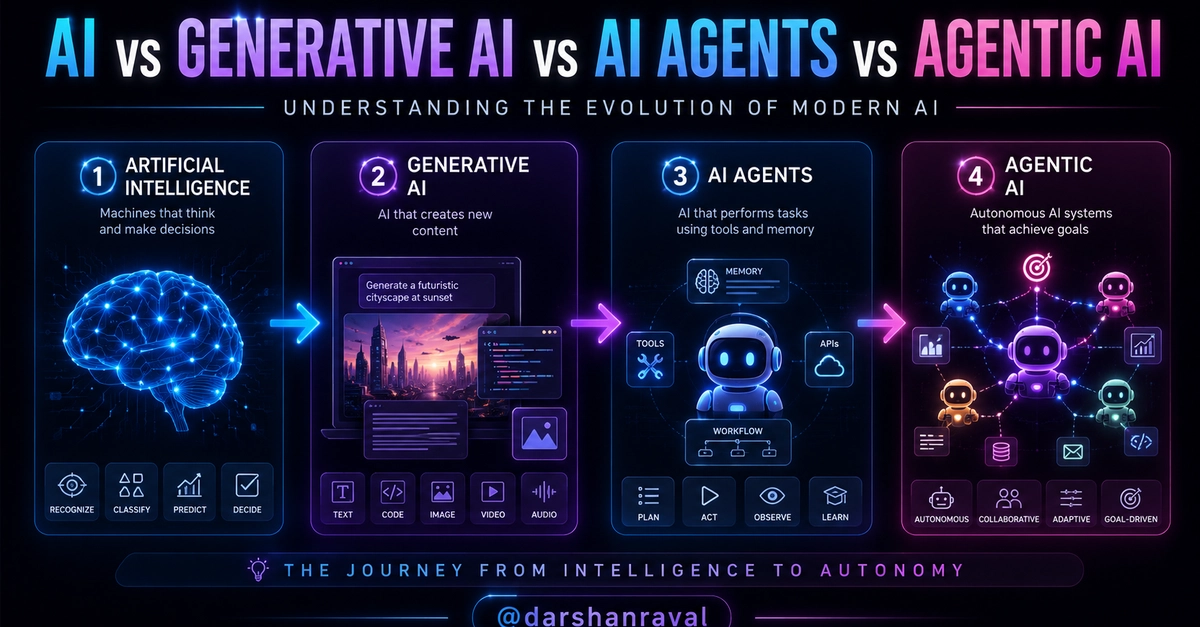


If you've been following AI over the past year, you've probably seen these terms everywhere:
- Artificial Intelligence (AI)
- Generative AI
- AI Agents
- Agentic AI
Many people use them interchangeably.
But they're not the same thing.
Understanding the difference can completely change how you think about building AI-powered applications.
Let's break it down.
🤖 Artificial Intelligence (AI)
Artificial Intelligence is the broad field of creating machines that can perform tasks that normally require human intelligence.
Examples include:
- Face recognition
- Spam detection
- Fraud detection
- Recommendation systems
- Chess-playing computers
Notice something?
None of these generate text or images.
They simply make intelligent decisions based on data.
Think of AI as the umbrella that covers every intelligent system.
✨ Generative AI
Generative AI is a subset of AI.
Instead of just making decisions, it creates new content.
It can generate:
- Text
- Images
- Code
- Videos
- Music
Examples include:
- ChatGPT
- Claude
- Gemini
- Midjourney
- GitHub Copilot
Ask it to write an email.
It writes one.
Ask it to generate React code.
It generates it.
Generative AI is incredibly creative...
But it only responds to your request.
It doesn't take action on its own.
🤖 AI Agents
This is where things become interesting.
An AI Agent doesn't just answer questions.
It performs tasks.
Imagine asking:
"Analyze my GitHub repository, find performance issues, create a report, and open a pull request."
A chatbot would stop after generating advice.
An AI Agent can:
- Read your repository
- Analyze the code
- Use external tools
- Generate fixes
- Create a pull request
- Notify you when it's done
That's a completely different level of automation.
An AI Agent combines:
- An LLM
- Memory
- Tool usage
- Planning
- Decision-making
It behaves more like a teammate than a chatbot.
🚀 Agentic AI
Agentic AI takes the concept even further.
Instead of completing a single task...
It works toward a goal.
For example:
"Reduce customer support tickets by 30%."
An Agentic AI system may:
- Analyze support data
- Identify common issues
- Update documentation
- Improve chatbot responses
- Measure results
- Repeat the process automatically
It continuously plans, acts, learns, and adapts.
In other words...
AI Agents complete tasks.
Agentic AI pursues objectives.
📊 Quick Comparison
| Technology | Main Purpose | Example |
|---|---|---|
| AI | Make intelligent decisions | Fraud detection |
| Generative AI | Create content | ChatGPT writing code |
| AI Agents | Perform multi-step tasks | AI reviewing your codebase |
| Agentic AI | Autonomously achieve goals | AI improving an entire support system |
💡 Why Developers Should Care
The future isn't just about asking AI better questions.
It's about building systems where AI can:
- Use tools
- Access memory
- Plan workflows
- Make decisions
- Collaborate with humans
That's exactly why AI Agents and Agentic AI are becoming the next big shift in software engineering.
Final Thoughts
Think of it like this:
- AI is the entire field.
- Generative AI creates content.
- AI Agents perform tasks.
- Agentic AI pursues goals.
The technology is evolving quickly.
Understanding these differences today will help you build better AI applications tomorrow.
Which stage are you currently working with—Generative AI, AI Agents, or Agentic AI? I'd love to hear your experience in the comments.
👋 About the Author
Darshan Raval is a Technology Lead and Backend Developer with 7+ years of experience in Node.js, NestJS, Microservices, and AI-powered applications. He enjoys exploring AI Agents, Generative AI, and modern software architecture while sharing practical insights with the developer community.
📌 Follow for more content on AI, Backend Development, and Software Engineering.
Author: @darshanraval
0 Comments
Log in to join the conversation.No comments yet. Be the first to share your thoughts.