


Hello, I'm Rijul. I'm building git-lrc, a micro AI code reviewer that runs on every commit. It's free and source-available on GitHub. Star git-lrc to help more developers discover the project. Do give it a try and share your feedback
Imagine your AI agent has a backpack.

It stores your preferences, project details, past experiences, and procedures.
But it doesn't carry everything in that backpack into every conversation. When something becomes relevant, it reaches in and retrieves what it needs.
This is the basic idea behind retrieval memory.
The Context Problem
When you interact with an AI agent, it has a limited context window.
As the conversation continues, more information gets added to that context.
Eventually, the context can become full.
At that point, the system may need to:
- Start a new session
- Compress the existing context
- Remove information that is no longer relevant
But there is another way to prevent the context from becoming unnecessarily large.
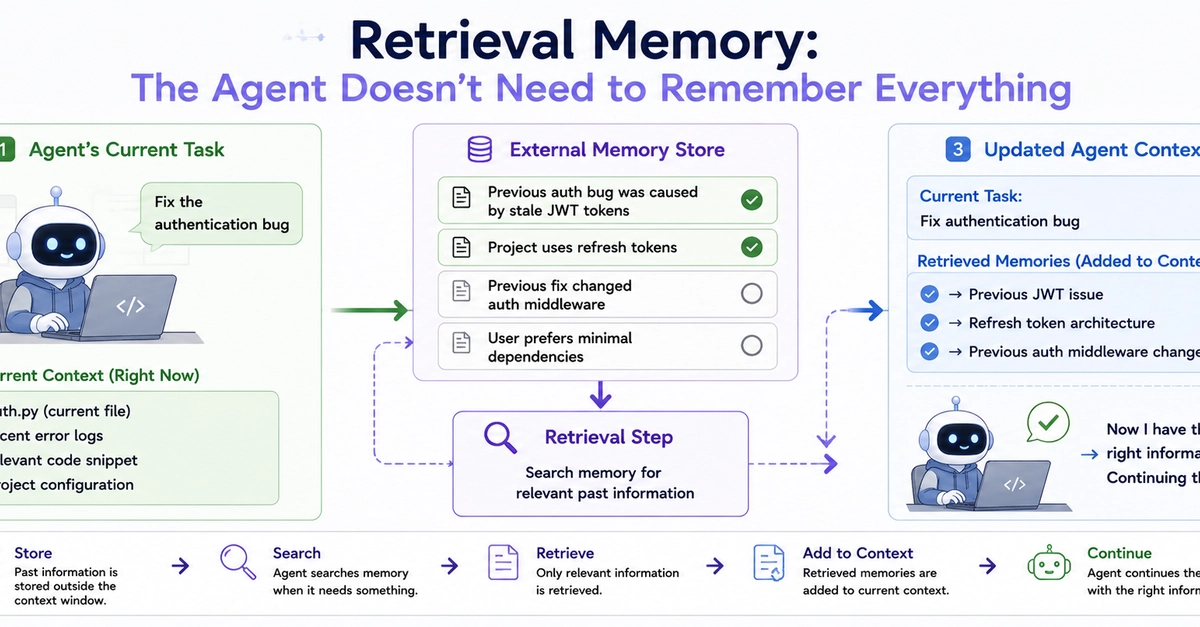
Instead of keeping every piece of information inside the active context, the system can store information externally and retrieve it only when it is needed.
This is the basic idea behind retrieval memory.
What Is Retrieval Memory?
Retrieval memory is a way for an AI system to remember information by storing it externally and retrieving the relevant parts when needed.
The basic flow looks like this:
User asks something
       ↓
Search stored memory
       ↓
Retrieve relevant information
       ↓
Add it to the AI's context
       ↓
Generate a response
Enter fullscreen mode Exit fullscreen mode
The important idea is that the information does not need to remain inside the active context all the time.
It can be stored somewhere else and brought back when it becomes relevant.
A Simple Example
Suppose I tell an AI assistant:
My favourite programming language is Rust.
The system might store this as:
User preference:
Favourite programming language = Rust
Enter fullscreen mode Exit fullscreen mode
Later, I ask:
Suggest a programming language for my next project.
The system can then:
- Search its stored memories.
- Retrieve the fact that I prefer Rust.
- Add that information to the current context.
- Use it when generating the response.
The AI might then suggest Rust, or at least consider it as one of the options.
The important point is that the preference did not need to remain in the active context between the two conversations.
It was stored externally and retrieved when relevant.
That is retrieval memory.
The memory is not directly inside the model. It is retrieved into the context when relevant.
How Is This Different From RAG?
Retrieval memory is similar to RAG, or Retrieval-Augmented Generation.
The basic process is similar:
Query
  ↓
Retrieve relevant information
  ↓
Add it to the context
  ↓
Generate a response
Enter fullscreen mode Exit fullscreen mode
The main difference is usually the source of the information.
With traditional RAG, the system might retrieve information from:
- Documentation
- PDFs
- Websites
- Knowledge bases
- Company documents
With retrieval memory, the system usually retrieves information specific to:
- A particular user
- A particular agent
- A previous interaction
- A project
- A specific workflow
So the source is often personal or agent-specific memory, rather than a general document collection.
What Kind of Information Can Be Retrieved?
Retrieval memory can contain many different types of information.
User Preferences
The user prefers the Fetch API over Axios.
Enter fullscreen mode Exit fullscreen mode
Facts
The user is working on Project X.
Enter fullscreen mode Exit fullscreen mode
Past Experiences
This approach failed previously because the API rate limit was exceeded.
Enter fullscreen mode Exit fullscreen mode
Procedures
When deploying this project, run these commands in this order.
Enter fullscreen mode Exit fullscreen mode
Conversation Summaries
The previous discussion concluded that the system should use PostgreSQL instead of SQLite.
Enter fullscreen mode Exit fullscreen mode
The system can then retrieve the relevant information when it becomes useful.
The Big Idea
Retrieval memory allows an AI agent to separate storage from active context.
Instead of keeping every piece of information in the context window all the time:
Store information externally
            ↓
User asks a question
            ↓
Search stored memory
            ↓
Retrieve what is relevant
            ↓
Add it to the current context
Enter fullscreen mode Exit fullscreen mode
This helps the agent access information from previous interactions without carrying the entire history into every new conversation.
So when you see terms like semantic memory, episodic memory, or retrieval memory, they are describing different ways an AI system can store and use information.
Understanding these concepts makes it easier to understand how modern AI agents build memory systems that go beyond simply keeping a giant conversation history.

AI agents write code fast. They also silently remove logic, change behavior, and introduce bugs -- without telling you. You often find out in production.
git-lrc fixes this. It hooks into git commit and reviews every diff before it lands. 60-second setup. Completely free.
Any feedback or contributors are welcome! It's online, source-available, and ready for anyone to use.
Give it a ⭐ star on Github
0 Comments
Log in to join the conversation.No comments yet. Be the first to share your thoughts.