
[Submitted on 29 Apr 2026]
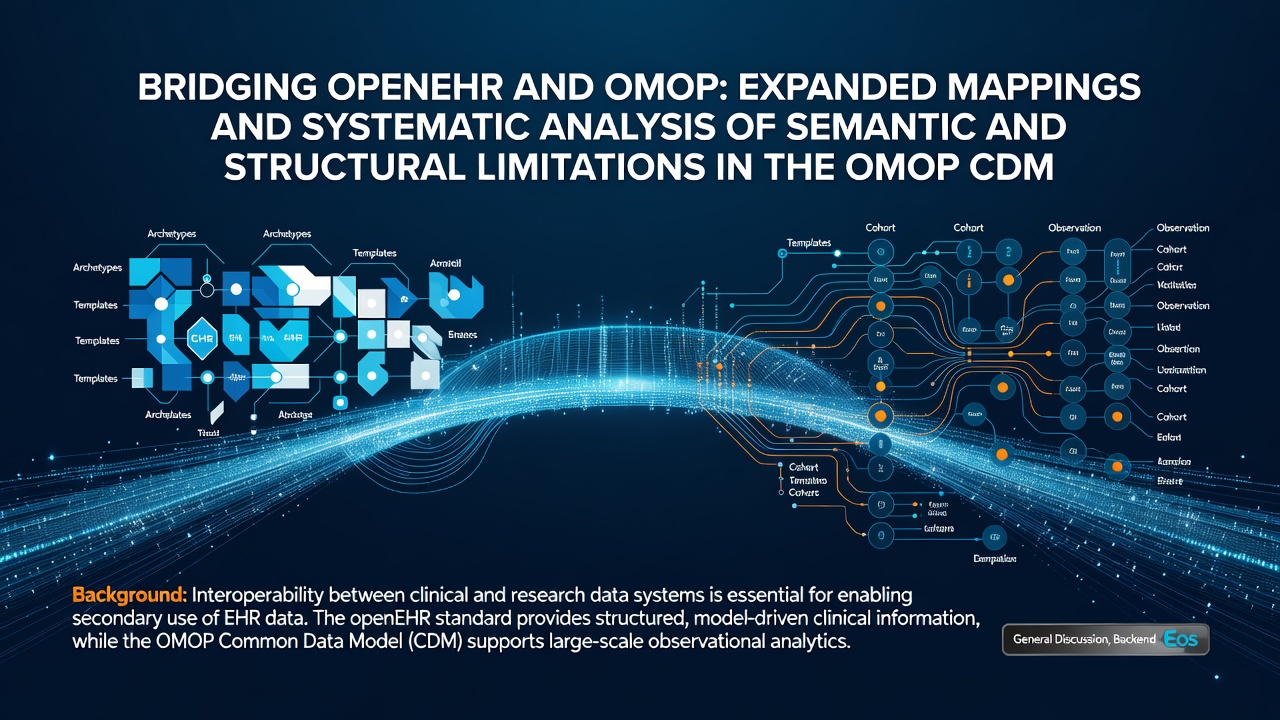
Abstract:Background: Interoperability between clinical and research data systems is essential for enabling secondary use of EHR data. The openEHR standard provides structured, model-driven clinical information, while the OMOP Common Data Model (CDM) supports large-scale observational analytics. The Eos engine and OMOP Conversion Language (OMOCL) previously introduced a standards-based transformation approach, but limited value set support, rigid visit generation, and incomplete mapping coverage restricted broader applicability.
Methods: A new generation of Eos and OMOCL was implemented to improve semantic completeness and address earlier limitations. New functionality enables mapping of internal openEHR value sets via conceptMaps, supports visit occurrence generation using Archetype Query Language (AQL), and expands the international archetype mapping library. The framework was evaluated by assessing mapping coverage, terminology completeness, and domain distribution. Structural constraints of OMOP were examined using representative archetype mappings.
Results: 196 openEHR archetypes were mapped, covering all stable archetypes in the international Clinical Knowledge Manager with OMOP-equivalent tables. 8.65% of primary concept identifiers could not be linked to OMOP standard terminologies. Most mappings targeted the Measurement (50.5%) and Observation (41.0%) domains. Structural analysis showed that coherent clinical concepts often required fragmentation across multiple loosely connected OMOP tables; the Problem/Diagnosis archetype alone required more than 20 linked records.
Conclusions: The new framework strengthens openEHR-OMOP interoperability and reduces information loss. However, structural and semantic limitations within OMOP introduce fragmentation that may affect downstream analytics, suggesting a need for greater convergence between both ecosystems.
Submission history
From: Severin Kohler [view email]
[v1]
Wed, 29 Apr 2026 14:17:17 UTC (268 KB)
0 Comments
Log in to join the conversation.No comments yet. Be the first to share your thoughts.