
There's a story that goes something like this:
In 1925, lightbulb manufactures secretly colluded to standardized lifespans at 1,000 hours. They would test each other's products to ensure compliance.
This is true.
At the time, many bulbs lasted longer than one thousand hours.
This is true.
Therefore, this was done so that people would always need to buy more light bulbs and increase their profits.
This is wrong, but it's the type of wrong that cites its sources and hides in the part you'd never think to fact check:
The assumption that a longer lasting lightbulb is a good product.
In truth, increasing the lifespan of a bulb makes it worse in every other way... but people think they want a long lasting lightbulb: the purpose of standardizing was to avoid a race to the bottom.
A old-school lightbulb is a rather simple device:
A thin tungsten wire (~20 μm) sealed inside a glass envelope to protect it from air. When current is applied, the wire gets white hot and starts glowing.
The most important parameter of a lightbulb is how hot that wire gets: this controls the peak emission wavelength (color) and brightness of the lamp.
Room temperature objects do emit light (this is how thermal cameras work), but it's at the ~10 μm range instead of the 400 nm - 700 nm light that we can see.
In order to put the emission peak in the visible spectrum, the filament would need to run at ~5700 °C
... that is, the temperature of the sun.
No metal can survive these conditions: Tungsten melts at "only" 3422 °C.
Filament materials:Since it has the highest melting point of any metal, tungsten is the obvious choice for filaments. However, the metal is quite brittle and drawing it into a wire isn't easy.
The first commercialized lamps used carbon filaments that were made by charring plant fibers. However, the carbon would evaporate at fairly modest temperatures ~2000 °C.
Tantalum filaments were briefly produced during the 1900s, because the metal was easier to draw into a wire than tungsten. This resulted in the first lightbulbs that could actually be left on at night, although these were quickly replaced with tungsten manufacturing improved.
There ware also some experiments using zirconium dioxide ceramics, which become conductive when heated. These allowed lamps to operate in air (obviating the need for a vacuum pump or glass seals), but were limited by it's melting point of 2,700 °C.
Since any filament must run below it's melting point, the peak emission is always deep in the infrared.
This means that only the extreme high-energy edge of the spectrum is useful for illumination, a small increase in temperature will make a lamp orders of magnitude more efficient. Also, pushing the peak energy upwards allows the filament to produce shorter wavelengths: resulting in something that resembles white light instead of a reddish-orange.
The snag is that when a metal is close to it's melting point, the atoms are barely holding together:
A hot tungsten filament slowly falls apart as the metal crystals slide past each other. Additionally, atoms can evaporate from the surface until there's no wire left.
The rate of both of these processes increases with temperature, so there's a fundamental trade off between color/efficiency and lifespan.
The lightbulb everyone always cites in the story is hanging in a California fire department. It's been running nearly continuously for over 120 years and racked up over a million hours of operation.
Impressive right?
What almost no one talks about is that it's hardly even glowing!
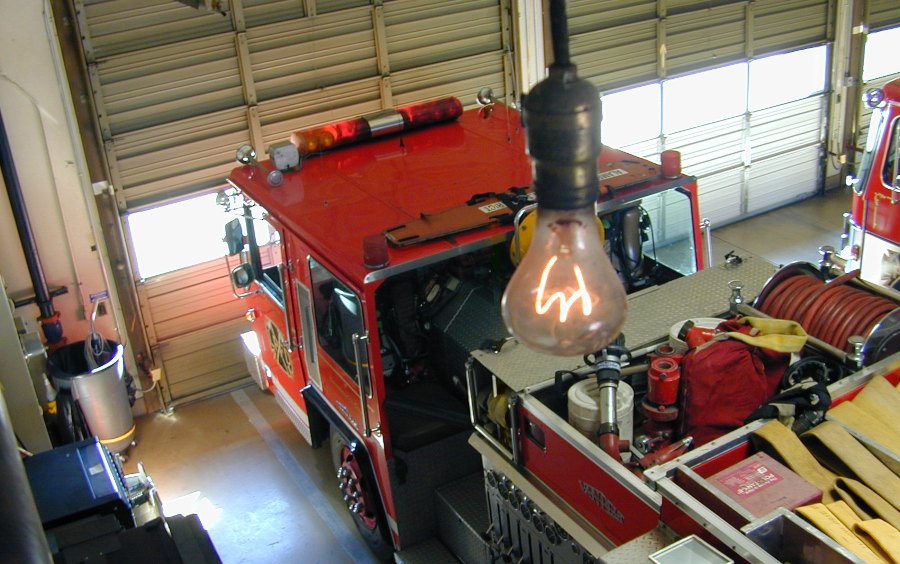
Despite nominally being a 60 W lamp, it draws only 4 watts... and is a lot dimmer than you'd expect from a 4 W lamp due to its poor efficiency.
There isn't any documentation, but in all likelihood, the bulb was made wrong and ended up with a very high filament resistance. That's why it was sold for as a night light, because it wasn't usable for anything else.
Early bulbs (like that one) were handmade, and quite expensive. Because of this, there were universally optimized for long lives.
This resulted in light isn't anywhere near white, and a an efficiency that was a tiny fraction of a modern incandescent lamp. (which are also terrible by any objective standards)
Once the production process was automated, new bulbs cost pennies, so it made sense to optimize them to actually work... because long lasting bulbs cost more money to operate:
Going off modern day prices, electricity costs around 0.10 [$/kW*h], so a 60 W lamp will consume 6$ of electricity over a 1,000 hour lifespan. Considering that such a lamp only costs around 3$, installing one that lasts longer but uses more power would be silly.
Case in point, despite the cartel only lasting for 14 years, non-halogen, incandescent light bulbs still last around 1,000 hours. (usually ranging between 500 to 2,500 hours)
Instead of "making bulbs last longer", manufacturers spent huge amounts of time and money developing entirely new technology: fluorescent and LED lamps. These don't use a wire on the very edge of melting, so they can be made to both work well and last a long time.
(... although bulb-style LEDs tend to overheat)
Lamps intended for other applications often strike a different balance:
In photography, a truly white light is desirable, which results in specialized "photoflood" bulbs that only last for a few hours. In the other direction, many indicator lamps are designed for 100,000 hours because they are difficult to replace.
Ok, but what's with the testing?
If long lived light bulbs are worse products, why would they need a cartel to enforce a the thousand hour limit? Well, it's because people think long lasting bulbs are a good product:
Lifespan is something everyone can understand, and has a direct effect on when you will have to go back to the store: if you saw two 60 W bulbs in a store, one claiming to last 400 hours and the other 2,000 hours, you'd probably get the longer lasting one without thinking about it.
It's not that efficiency is hard to understand, but most people aren't doing homework before buying lightbulbs... and it doesn't help that the packaging often uses input power as a proxy for brightness, so the idea that two bulbs both labeled as "40 W" would have a different brightness is rather confusing.
As a result, competition was forcing lightbulb makers to produce worse products.
To be clear, I'm not defending the Phoebus cartel: they engaged in price fixing and other anti-consumer practices.
... but by nature, tungsten lamps are consumable items: saying lightbulbs were designed to fail is like saying fuel tanks are designed to run out. a railcar full of gas would run an engine for a very long time, but towing that behind your car would be terribly annoying.
The moral here is reality rarely fits into nice stories. Even something so obvious like "products designed to break are bad" often isn't — every manufactured object is the result of hundreds of overlapping compromises, most of which are invisible to the end user.
Also, to preempt the orange site, I'm not saying that planned obsolescence doesn't exist. There are plenty of actual cases of products being made hard to repair or maintain so they can sell you another one.
... but lightbulbs just aren't a good example of this.
Related:
- https://www.mouser.com/datasheet/3/299/1/T_1_Wire_Terminal.pdf: Indicator lamp datasheet featuring a 100,000 hour rating.
- https://www.1000bulbs.com/product/67291/STAG-PH213I.html: A photography lamp that lasts 3 hours. (store page)
- https://www.youtube.com/watch?v=zb7Bs98KmnY: An excellent youtube video on this topic.
- https://doi.org/10.1063/1.1657874: Lab tests of tungsten wire evaporation
- https://doi.org/10.1016/s0016-0032(25)91062-9: Brightness and color of light as a function of temperature.
0 Comments
Log in to join the conversation.No comments yet. Be the first to share your thoughts.