
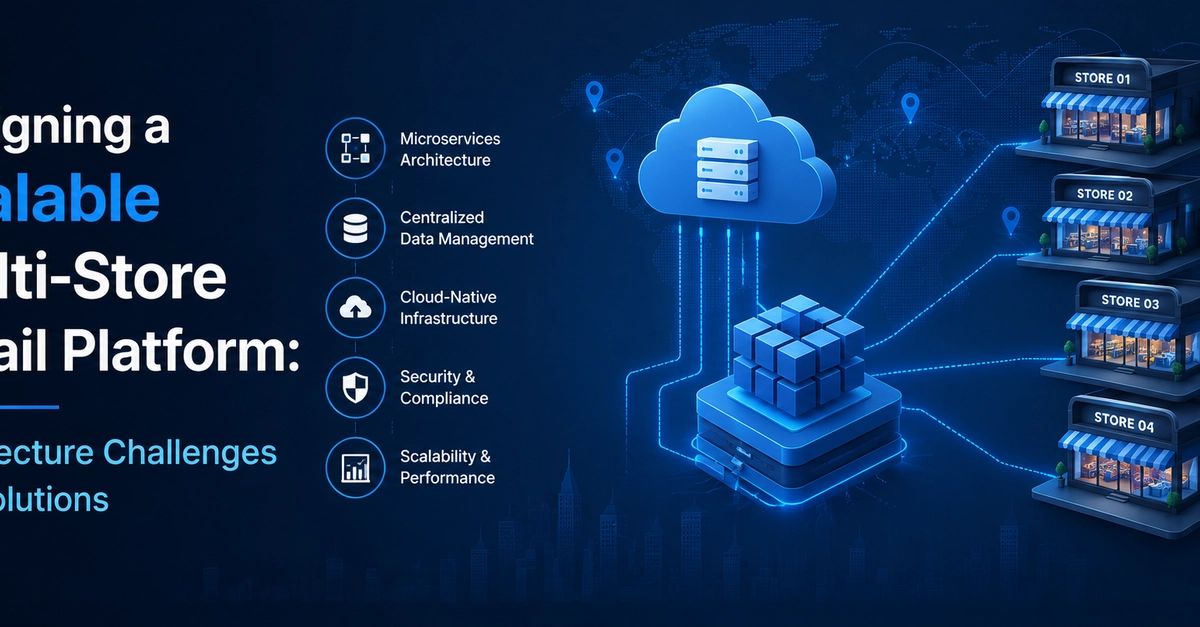
Modern retail is no longer limited to a single physical store. Retailers today operate across multiple locations, ecommerce channels, warehouses, marketplaces, and mobile platforms.
Managing products, inventory, orders, customers, and transactions across these touchpoints requires a retail platform designed for scalability, reliability, and real-time operations.
Building a multi-store retail platform is not just about adding more stores to an existing system. It requires careful software architecture decisions around databases, APIs, integrations, security, and performance.
This article explores the key architecture challenges involved in building scalable retail software and the solutions developers can use to create enterprise-ready platforms.
Understanding a Multi-Store Retail Platform
A multi-store retail platform is a centralized system that enables retailers to manage operations across multiple locations from a unified environment.
A modern retail platform typically supports:
- Multiple store locations
- Centralized product management
- Real-time inventory visibility
- Point-of-sale (POS) transactions
- Ecommerce order processing
- Customer relationship management
- Warehouse operations
- Reporting and analytics
- Third-party integrations
Unlike simple applications, retail platforms must process thousands of transactions while keeping data consistent across different channels.
Key Architecture Challenges
1. Managing Data Across Multiple Locations
One of the biggest challenges in multi-store retail software is maintaining accurate data across locations.
A retailer may have:
- Store-level inventory
- Warehouse inventory
- Online product availability
- Customer orders
- Returns and exchanges
- Price updates
A change in one location may need to be reflected across multiple systems.
For example:
A customer purchases a product online. The platform needs to update inventory, reserve the item, notify fulfillment teams, and synchronize stock availability across sales channels.
Solution: Centralized Data Architecture
A scalable platform typically uses a centralized database architecture with well-designed data models.
Important considerations include:
- Inventory synchronization rules
- Transaction consistency
- Data replication strategies
- Conflict resolution mechanisms
A strong data architecture ensures every channel works with accurate information.
2. Scaling Transaction Processing
Retail management systems handle large volumes of transactions, especially during:
- Holiday shopping periods
- Promotional campaigns
- Product launches
- Seasonal sales events
A platform that works well for five stores may struggle when expanded to hundreds of locations.
Solution: Scalable Application Architecture
Developers can improve scalability through:
- Load balancing
- Application clustering
- Database optimization
- Caching strategies
- Asynchronous processing
Separating business services allows individual components to scale based on demand.
Example:
High Traffic Event

Customer Order
      |
      |
Order Service
      |
      |
Inventory Service
      |
      |
Fulfillment Service
Enter fullscreen mode Exit fullscreen mode
3. Keeping Systems Connected Through APIs
Modern retailers rarely operate with a single system.
A retail platform often connects with:
- Ecommerce platforms
- Payment providers
- Shipping carriers
- Accounting systems
- Customer loyalty platforms
- Marketplaces
Without proper integration architecture, these connections become difficult to maintain.
Solution: API-First Architecture
An API-first approach allows different systems to communicate efficiently.
Common API capabilities include:
- Product synchronization
- Inventory updates
- Order processing
- Customer data exchange
- Shipment tracking
Well-designed APIs improve flexibility and allow retailers to add new technologies without rebuilding the entire platform.
4. Handling Real-Time Business Operations
Retail requires immediate visibility into business activities.
Examples include:
- Inventory availability checks
- Online order processing
- Store transfers
- Customer purchases
- Price changes
Traditional batch processing can create delays and inaccurate information.
Solution: Event-Driven Architecture
Event-driven architecture allows systems to respond to business events as they happen.
Example:
Product Sold Event
--------------------

Update Inventory
      |
      |
Trigger Reorder Rules
      |
      |
Update Analytics
      |
      |
Notify connected channels
Enter fullscreen mode Exit fullscreen mode
Another example:
Order Completed Event
--------------------

Update Fulfillment Status
      |
      |
Generate Shipping Request
      |
      |
Update Customer Records
Enter fullscreen mode Exit fullscreen mode
Using events improves responsiveness and reduces dependency between system components.
5. Designing for Security and Data Protection
Retail platforms handle sensitive business and customer information.
Security challenges include:
- User authentication
- Role-based permissions
- Payment data protection
- API security
- Data encryption
Solution: Enterprise Security Practices
A scalable retail platform should implement:
- Role-based access control (RBAC)
- Secure authentication methods
- Data encryption
- API authentication
- Security monitoring
Different users should have controlled access based on their responsibilities.
Example:
- Store employees manage sales transactions.
- Managers access store reports.
- Administrators manage system configurations.
6. Supporting Cloud, On-Premise, and Hybrid Deployments
Retailers have different technology requirements.
Some businesses prefer:
- Cloud-based platforms for flexibility and scalability
- On-premise solutions for infrastructure control
- Hybrid environments combining both approaches
Solution: Flexible Deployment Architecture
A well-designed retail platform should support different deployment models without changing core functionality.
Using modular architecture helps organizations choose the infrastructure that best fits their business needs.
7. Building Reliable Reporting and Analytics
Retailers need insights into:
- Sales performance
- Inventory trends
- Customer behavior
- Product performance
- Store profitability
However, analytics workloads can impact operational systems.
Solution: Separate Operational and Analytical Workloads
A scalable architecture separates transaction processing from reporting.
Common approaches include:
- Data warehouses
- Business intelligence platforms
- Data pipelines
- Optimized reporting databases
This allows retailers to analyze large datasets without slowing down daily operations.
Example Architecture of a Modern Retail Platform
                 Retail Channels

     POS | Ecommerce | Mobile | Marketplace

                      |
                      |

          API Integration Layer

                      |

          Business Services Layer

             Inventory Management
             Order Management
             Customer Management
             Product Management
             Pricing Management

                      |

          Data Management Layer

            Transaction Database
            Analytics Database
            Data Warehouse
Enter fullscreen mode Exit fullscreen mode
This layered approach improves maintainability, scalability, and system flexibility.
Best Practices for Building Scalable Retail Software
1. Design for Growth from Day One
A system should support future stores, users, products, and transactions.
2. Use Modular Architecture
Independent modules make maintenance and upgrades easier.
3. Prioritize Data Accuracy
Inventory and order information must remain consistent across all channels.
4. Build Strong Integration Capabilities
APIs should support current and future technology requirements.
5. Monitor Performance Continuously
Application monitoring helps identify bottlenecks before they impact users.
Conclusion
Designing a scalable multi-store retail platform requires more than increasing server capacity.
It requires thoughtful architecture that addresses:
- Data management
- System integrations
- Real-time processing
- Security
- Business growth
Modern retail management software must connect physical stores, ecommerce channels, warehouses, and customers through a unified technology foundation.
By adopting scalable architecture patterns, API-driven development, and event-based processing, developers can build retail platforms that support today's complex commerce environment and adapt to future demands.
Platforms like ChainDrive follow these principles by helping retailers manage operations across multiple locations through a unified retail management system.
0 Comments
Log in to join the conversation.No comments yet. Be the first to share your thoughts.