
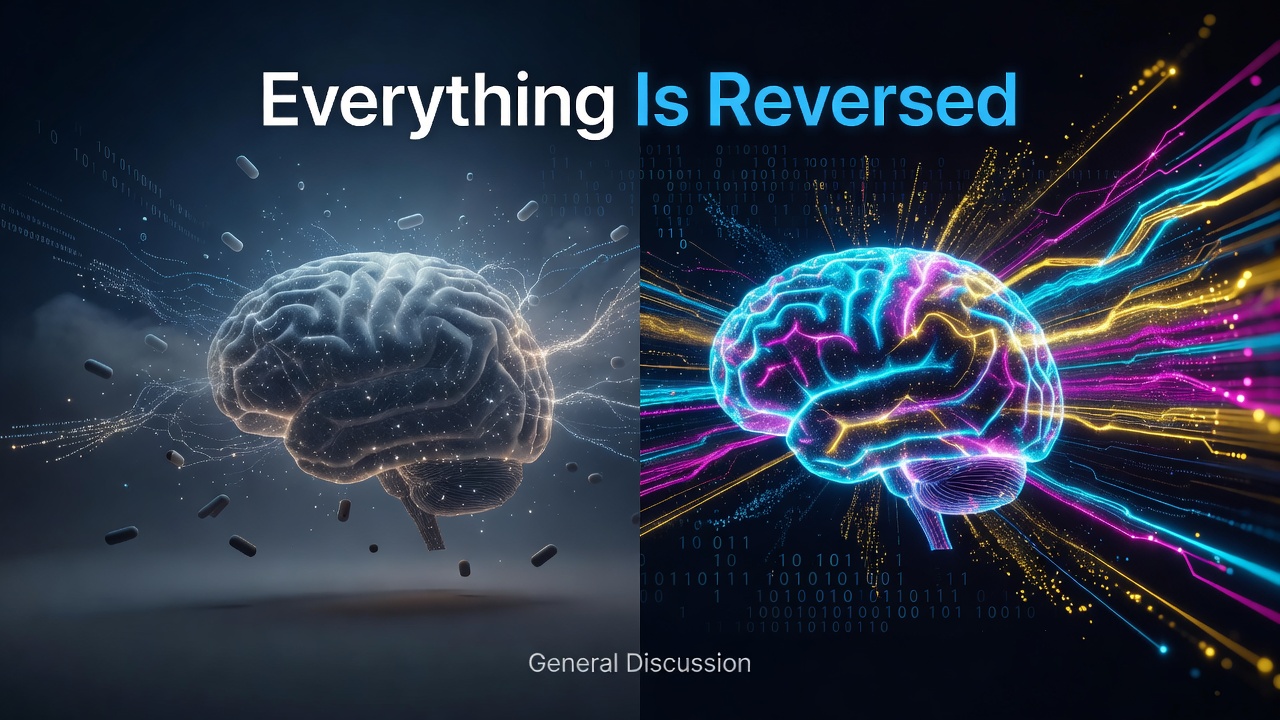

What happens to a medicated ADHD brain when AI removes the last thing that used to slow it down.
I have ADHD, and I am medicated for it. I take it first thing. It lands about thirty minutes later, roughly as I finish the first coffee. Then I sit down to write software with an agent, and the day stops keeping time.
I look up thinking an hour and a half has gone, two at the outside. Six hours have gone. Later I step out for a cigarette, convinced I have been away too long, that it has been the better part of an hour. It has been fifteen minutes.
Both directions, most days. The work compresses and the breaks dilate. Nothing in me reports the difference, so I only find out by looking at a clock, and by then whichever it was has already happened.
The clock has run like that for years, medicated or not. That part is not about AI and I am not going to pretend it is. What AI changed is what fits inside those six hours.
Before the medication it arrived in bursts. A few good hours, occasionally a few good days, and long stretches in between where I could see the task perfectly clearly and could not begin it. Task paralysis is a mild name for what that is like. The bursts were real and I could not schedule them.
That part is gone. What replaced it does not switch off, and one task turns out not to be enough to hold it. There are two laptops on my desk. Some days both of them are working.
The appetite was already there
My brain likes information. Not needs, likes. Give it a thread and it will pull, and pulling feels like progress the entire time it is happening. The only thing that ever limited that was effort. Finding things was slow, so the appetite ran into a wall several times an hour, and the wall was doing something useful even though it felt like an obstacle.
The wall is gone. I can point AI at a repository, a ticket history, a chat archive, a document nobody has opened in two years, and have it back in seconds, summarised, in whatever shape I asked for. Gathering costs nothing now.
This is fuel on a fire that was already lit. The thing my brain most wants to do all day is the thing that just became free and unlimited.
Cheap to gather, expensive to know
Here is the reversal that matters more than the clock.
Gathering information is cheap. Working out which of it is relevant is not. Working out which of it is still true is not. Those decisions are mine, every one of them, and there are now vastly more of them per day because there is vastly more in front of me.
The AI will hand me a summary of a decision made three years ago with exactly the same confidence it hands me something from Tuesday. It has no view on which one the team still believes. I have to hold both, judge both, and pick. Then do it again, on the next thing, having had no gap in between.
That is the cost, and it is the part that does not get cheaper. Everything upstream of it collapsed to nothing, which means the whole day is now made of the expensive part.
Nobody calls out the AI
The thing that keeps this from being a productivity story is that ownership never moved.
Whatever ships with my name on it is mine. If the call was wrong, I am the one it comes back to. Nobody in a review has ever asked the model to explain itself. So the judgment cannot be delegated, cannot be batched, and cannot be skipped, and it sits on top of a brain that has already spent six hours in a state it could not measure.
I do not have a tidy answer to this. I know when it has gone badly, because it is seven in the evening and I would have told you it was three. I know the clock is the only instrument I have that tells the truth. And I know the part that costs me is not the work the tools took over. It is all the work they left behind, which turns out to have been the whole job.
0 Comments
Log in to join the conversation.No comments yet. Be the first to share your thoughts.