
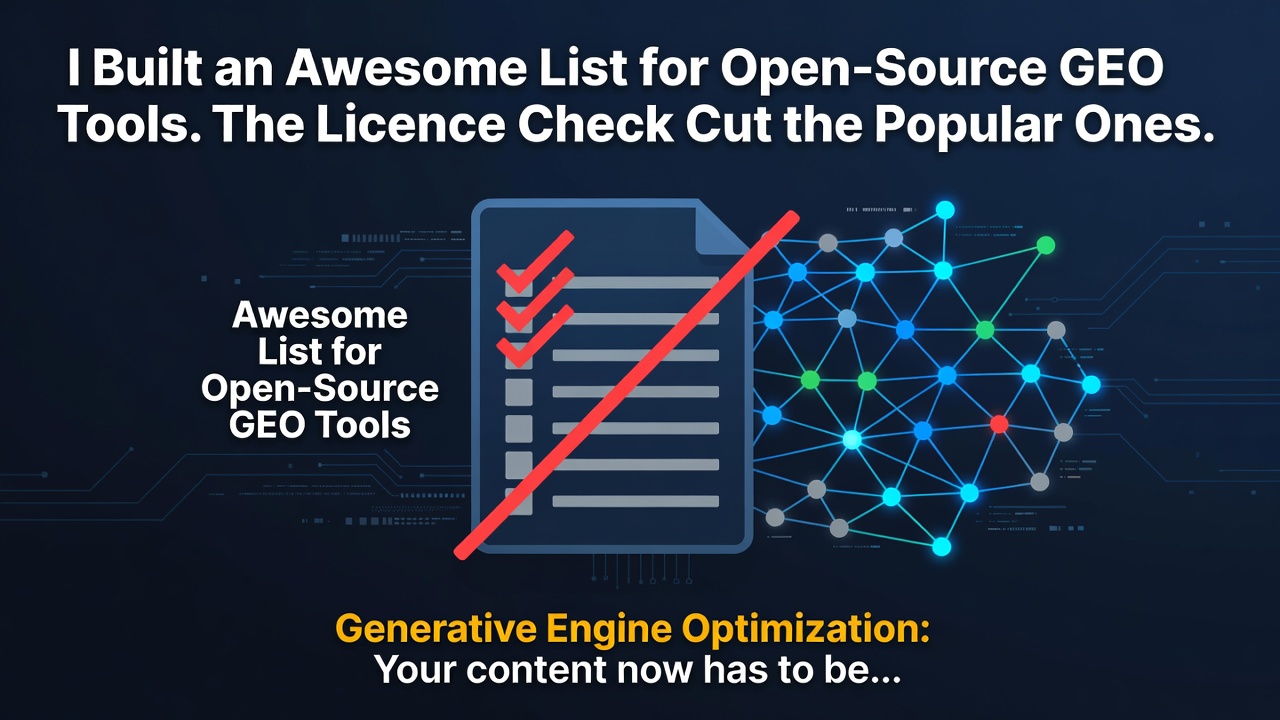


Generative Engine Optimization is the unglamorous name for a real problem: your content now has to be findable, parsable and citable by systems that answer instead of link. ChatGPT, Perplexity, Claude, Google AI Overviews. The original GEO paper from KDD 2024 showed the levers differ from classic SEO — citations, statistics and quotable structure move the needle where keyword density does essentially nothing.
The tooling around it is almost entirely paid SaaS. There are two existing awesome-lists for GEO and both are good, but their tools sections read like a funding announcement: Profound, Otterly, Goodie, Semrush. Useful if you have a budget. Useless if you want to read the source and run it yourself.
So I built the other half: Awesome Open GEO — 62 entries, one criterion, awesome-lint clean.
The criterion
Every entry has to be free to run and published under an OSI-approved licence.
That sounds like a formality. It is the entire list.
What it cut
Two of the most-linked tools in this space didn't make it, and explaining why is more useful than the list itself.
firecrawl/llmstxt-generator — 534 stars, genuinely handy, generates llms.txt and llms-full.txt for any site. It has no LICENSE file. Not a restrictive one. None. Under default copyright law that means all rights reserved: you have no granted right to use, modify or redistribute it, however public the repo is and however obviously the authors intended you to.
Canonry — 99 stars, an AEO monitoring platform, source fully readable. Licensed FSL-1.1-ALv2, the Functional Source License. Source-available, converts to Apache-2.0 after two years, and a perfectly reasonable commercial choice. It is not open source today, and the OSI has been clear about that class of licence.
Neither of those is a criticism of the projects. A missing licence file is usually an oversight, and FSL is a deliberate, defensible business decision. But a list that calls itself open-source has to actually check, or the label means nothing.
I found the same pattern repeatedly: repos described as "open source" in their own README with no licence in the tree, and "open" platforms whose licence quietly excludes competing use. If you're picking a tool to build on, that distinction is the difference between a dependency and a liability.
How the list was actually vetted
I did not want to hand-pick from memory, so:
-
A GitHub API sweep — about 15 topic and keyword queries (
topic:generative-engine-optimization,topic:llms-txt,topic:answer-engine-optimization,topic:ai-visibility, plus keyword searches), producing 603 unique repositories. -
Filtered on stars, licence SPDX id, last push, and archived status. Most of the 603 were false positives — user-agent parsers, Telegram bots, a C# cheat sheet that happened to mention
llms.txt. - Read the README of everything I planned to feature, because a repo description is marketing and a third-party blog summary is worse. That's how I learned OneGlanse drives the real chat UIs in a browser rather than calling model APIs — which turns out to be its whole point, and isn't in its description.
- Sanity-checked the outliers. A brand-new "SEO skill" repo with 12,000 stars deserves a look at its star-to-fork ratio and creation date before you vouch for it.
-
curl'd every link for a 200 before publishing. All 64.
What's in it
Ten sections, ordered so a newcomer can start at the top:
-
Standards & Specifications —
llms.txt, Schema.org,ai.robots.txt, and Joost de Valk's Website Specification - Audit & Linting — CLIs you run against your own site
- Visibility & Citation Monitoring — the widest paid-SaaS gap, and where self-hosting matters most since you pay the inference either way
- llms.txt Tooling — generators and validators
- Framework & CMS Integrations — Nuxt, Astro, VitePress, MkDocs, Sphinx, Laravel, WordPress
- Crawler Access & Log Analysis — including Anubis, listed on purpose: you cannot be cited by a crawler you blocked, so access control is a GEO decision in both directions
- Agent Skills & MCP Servers — with the honest caveat that none of their scoring is calibrated against a benchmark
- Research & Papers — the KDD 2024 original, the 2026 survey covering 45 studies, AutoGEO, and a governance paper that argues against the whole enterprise
- Directories & Datasets
- Related Lists — including the two broader GEO lists, because they complement this rather than compete with it
Contributing
Self-submissions are welcome and don't need an apology — just disclose it in the PR. My own audit tool is in there exactly once, under the same rules, with no special placement.
The bar is in contributing.md. Removals count as contributions too: if something on the list is abandoned, relicensed away from open source, or simply worse than it looked, open an issue and I'll cut it.
Repo: github.com/cloudapp-dev/awesome-open-geo
The niche is young enough that a lot of good work isn't on the list yet. If you maintain something that clears the bar, I'd rather hear it from you than find it in six months.
0 Comments
Log in to join the conversation.No comments yet. Be the first to share your thoughts.