
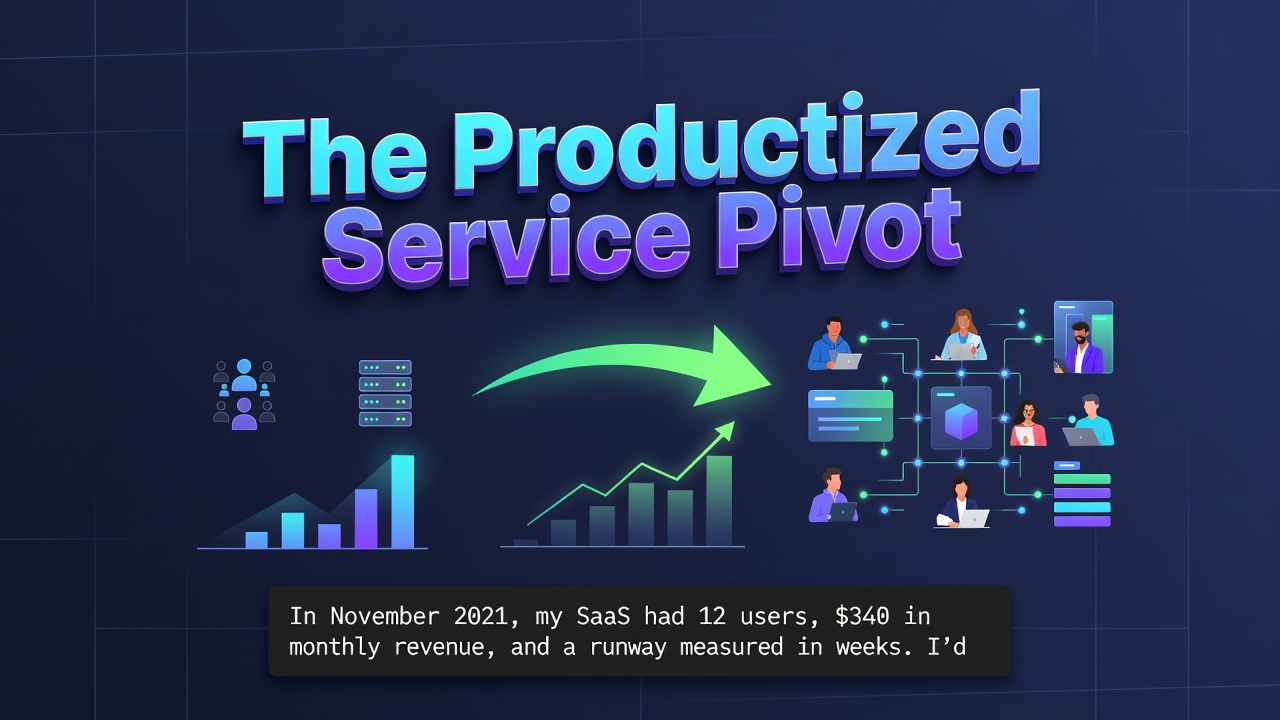
In November 2021, my SaaS had 12 users, $340 in monthly revenue, and a runway measured in weeks. I'd spent seven months building an analytics dashboard for ecommerce brands, and nobody was buying it. The product worked fine. The problem was trust — mid-market ecommerce companies weren't going to hand over $199/month to a solo founder with no track record.
So I stopped selling software and started selling outcomes. I launched a productized audit service: I'd analyze a store's analytics setup, identify revenue leaks, and deliver a prioritized action plan — for a flat $1,500. Within 30 days, I had six clients. Within 90 days, I was at $8,000 in monthly recurring revenue from the service alone.
Here's the part that matters: that productized service didn't just fund my SaaS. It became my SaaS's flagship feature. Eighteen months later, the manual audit I was performing by hand was fully automated inside the product, and those service clients became my first 40 SaaS subscribers at $249/month.
This is the productized service pivot — and it's one of the most underused strategies in bootstrapped SaaS.
Why Productized Services Work for SaaS Founders
The traditional bootstrapped SaaS path goes like this: build a product, launch it, hope people pay for it, burn through savings while you iterate. The productized service path flips the order: sell the outcome first, deliver it manually, use the revenue to fund development, and productize what you learn.
There are three structural advantages to this approach:
1. You get paid to do customer research. Every service engagement is a deep-dive into a real customer's problem. You're not guessing what features to build — you're building what you've already been paid to deliver.
2. You build a case study portfolio. Each client gives you data, testimonials, and a concrete result you can point to. When you eventually sell the SaaS, you're not a founder with a theory — you're a practitioner with proof.
3. You generate immediate cash flow. Productized services typically command $500-$5,000 per engagement. Six clients at $1,500 is $9,000 — enough to fund 2-3 months of solo development.
Brett Williams of Designjoy popularized this model in the design world, generating over $1M in annual revenue from a one-person productized service. The same principle applies to SaaS: package your expertise, charge for outcomes, and let the service teach you what to build.
Phase 1: Package Your Expertise as a Product
The hardest mental shift is moving from "I'll consult" to "I sell a specific product with a fixed scope and price." Consulting is open-ended. Productized services are bounded.
Here's how I structured mine:
The Product: Ecommerce Analytics Audit — a comprehensive review of a store's tracking setup, data accuracy, and revenue attribution, delivered as a 15-page report with a prioritized 90-day action plan.
The Scope: I'd review their Google Analytics setup, check for tracking errors, audit their conversion funnel, identify data gaps, and benchmark their metrics against industry averages. Fixed deliverables, no scope creep.
The Promise: "Find at least $10,000 in annual revenue leaks or your money back." This guarantee removed the risk for buyers and forced me to be thorough.
The key was specificity. I didn't sell "analytics consulting." I sold a product with a name, a fixed deliverable, a timeline (5 business days), and a guarantee. Customers could understand it in 10 seconds.
Phase 2: Price in Tiers That Map to Your Future SaaS
I initially offered one price: $1,500 for the audit. After two months, I introduced three tiers that mapped to where I wanted my SaaS pricing to land:
Tier 1 — Starter Audit ($750): Basic tracking review and top 5 issues. This tier existed to capture smaller stores and generate volume. It was my loss leader — I barely broke even on time, but it fed the pipeline.
Tier 2 — Full Audit ($1,500): Complete review, 15-page report, 90-day action plan, and a 30-minute strategy call. This was my core offering and where 70% of clients landed.
Tier 3 — Audit + Implementation ($3,500): Full audit plus I'd implement all the tracking fixes and set up their dashboard. This tier was manually intensive but generated the highest-margin revenue and gave me the deepest understanding of customer workflows.
The tier structure mattered because it segmented clients by sophistication and budget. Tier 2 clients became my SaaS subscribers at $249/month. Tier 3 clients became my SaaS subscribers at $499/month with a managed tier. The service pricing pre-qualified customers for the SaaS pricing.
According to data from Productize, a community for productized service businesses, the most successful productized services cluster between $500 and $3,000 per engagement. Below $500, you compete on volume and burn out. Above $3,000, you're back in consulting territory with scope creep.
Phase 3: Automate Delivery Without Killing Quality
The biggest risk of a productized service is that it becomes a job. If every deliverable requires 10 hours of manual work, you've built a consulting practice, not a productized business. My goal was to reduce delivery time from 8 hours to 3 hours per audit within 60 days.
Here's what I automated:
Data collection: I built a Typeform intake questionnaire that captured store URL, analytics access, platform (Shopify, WooCommerce, BigCommerce), and business goals. This eliminated the back-and-forth email cycle.
Tracking analysis: I wrote a Python script that checked for common GA4 implementation errors — missing events, duplicate tracking, broken e-commerce data. What took me 2 hours manually took the script 4 minutes.
Benchmarking: I built a simple dashboard in Google Looker Studio that pulled industry benchmark data from a spreadsheet I maintained. Each client report included their metrics against benchmarks, auto-populated.
Report generation: I created a report template in Google Docs with sections that auto-populated from my analysis scripts. I still wrote the strategic recommendations manually — that was the value — but the data sections were automated.
After automation, a Tier 2 audit took me about 2.5 hours: 30 minutes of script review and setup, 1 hour of manual analysis and recommendations, 1 hour for the strategy call. At $1,500 per audit, that's $600/hour — enough to fund development without burning out.
Phase 4: Transition Service Clients to SaaS Subscribers
This is the moment the productized service pivot pays off. Every service client is a warm lead for your SaaS, and you have something no cold outreach campaign can replicate: proof of value.
I transitioned clients in three steps:
Step 1 — The Natural Upgrade (Month 1-2): After delivering each audit, I'd mention that I was building a tool that would run this analysis automatically on an ongoing basis. No hard sell — just a heads-up. About 30% of clients asked to be notified when it launched.
Step 2 — The Beta Invitation (Month 3-4): When my SaaS had a working MVP, I invited existing service clients to join a closed beta at 50% off their eventual price. I framed it as an exclusive opportunity, not a discount. Twelve of my 18 service clients joined.
Step 3 — The Grandfather Pricing (Month 5-6): When I launched publicly, I offered all service clients lifetime grandfather pricing at their beta rate. This created urgency and rewarded their early support. Ten of the twelve beta clients converted to paying subscribers.
The conversion math worked because I wasn't asking them to trust a new product. I was asking them to trust a person who had already delivered results — and to pay less for a tool that would do what I'd been doing manually.
Phase 5: Knowing When to Sunset the Service
Here's the question every founder asks too late: when do you stop doing the service? The answer is when the opportunity cost of delivery time exceeds the revenue.
For me, that happened at month 14. My SaaS had reached $11,000 MRR. Each audit I delivered took 2.5 hours that could have gone toward product development, sales calls, or content marketing. The service was generating $8,000/month but consuming 40+ hours that month — time worth far more when invested in scaling the SaaS.
I sunset the service in three stages:
- Raised the price from $1,500 to $2,500 for new clients (demand didn't drop)
- Capped new clients at 4 per month (created scarcity, increased perceived value)
- Fully sunset at month 18, replacing the service page with a case study showcasing the results and pointing visitors to the SaaS
The service page still drives organic traffic and converts at 4.2% to SaaS trials — 18 months after I stopped offering it.
The Bottom Line
The productized service pivot isn't a detour from building your SaaS. It's the fastest path to building the right SaaS. You get paid to learn what customers actually need, build a case study portfolio that makes your eventual launch credible, and generate cash flow that funds development without giving up equity.
My $8,000/month service funded 14 months of solo development, produced 18 case studies, seeded my SaaS with 40 warm subscribers, and taught me exactly which features mattered. The audit I performed manually 40 times became the automated dashboard that now serves 300+ stores.
If your SaaS isn't gaining traction and your bank account is shrinking, stop building features and start selling outcomes. The service will teach you what to build. The revenue will buy you time. And the clients will become your first hundred subscribers.
Tags: #saas #content #bootstrapping #growth #startup
0 Comments
Log in to join the conversation.No comments yet. Be the first to share your thoughts.