
If you have shipped a serious product in Nigeria (or most of Africa), you have probably integrated both Paystack and Flutterwave. You do it for coverage, for redundancy when one provider has a bad day, and sometimes for better rates on a given card or channel.
And every single time, you rewrite the same fragile glue: two different request shapes, two different webhook signature schemes, two different ideas of what an "amount" is, two different error formats. I got tired of copying that layer between projects, so I built it once, properly, and open-sourced it.
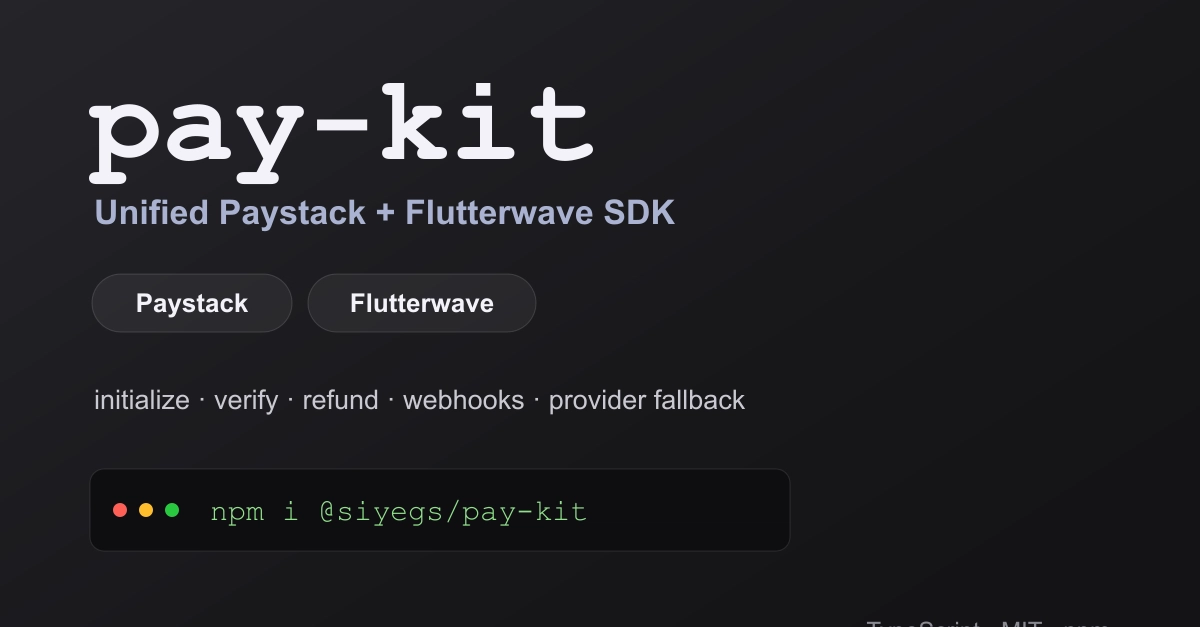
It is called pay-kit: one typed TypeScript SDK over Paystack and Flutterwave. Swap the provider, and your code does not change.
npm install @siyegs/pay-kit
Enter fullscreen mode Exit fullscreen mode
The core idea: one API, two providers
import { createPayClient } from "@siyegs/pay-kit";

const pay = createPayClient({
  provider: "paystack", // or "flutterwave" - nothing else changes
  secretKey: process.env.PAYSTACK_SECRET_KEY!,
});

// Amounts are always in subunits (kobo/cents), Stripe-style, to kill float bugs.
const { authorizationUrl, reference } = await pay.initialize({
  amount: 500000, // NGN 5,000.00
  email: "[email protected]",
  callbackUrl: "https://your-app.com/pay/callback",
});

// after the customer pays:
const result = await pay.verify(reference);
if (result.status === "success") {
  // fulfill the order
}
Enter fullscreen mode Exit fullscreen mode
The whole surface is normalized: initialize, verify, refund, transfer, resolveAccount, listBanks, getBalances, listTransactions, and signature-verified webhooks - the same shape whether you are on Paystack or Flutterwave.
The parts I am most happy with
Automatic provider fallback. If Paystack is having an outage, fall through to Flutterwave without touching your code:
import { createFallbackClient } from "@siyegs/pay-kit";

const pay = createFallbackClient({
  providers: [
    { provider: "paystack", secretKey: process.env.PAYSTACK_SECRET_KEY! },
    { provider: "flutterwave", secretKey: process.env.FLW_SECRET_KEY!, webhookSecret: process.env.FLW_HASH },
  ],
});

const { reference, provider } = await pay.initialize({ amount: 500000, email: "[email protected]", callbackUrl: "..." });
// only outage-like failures (network / 5xx / 429) trigger fallback; a 4xx fails fast
Enter fullscreen mode Exit fullscreen mode
A keyless mock provider. Test your entire payment flow with no API keys and no network - great for CI and local dev:
const pay = createPayClient({ provider: "mock" });
const { reference } = await pay.initialize({ amount: 500000, email: "[email protected]" });
await pay.verify(reference); // { status: "success", amount: 500000, ... }
Enter fullscreen mode Exit fullscreen mode
Payouts, not just collection. Send money out with the same unified API - transfer, verifyTransfer, plus resolveAccount and listBanks to confirm who you are paying before you pay them.
Marketplace splits. Route part of a charge to a subaccount - the primitive behind creator payouts and multi-vendor checkouts.
Being honest about status
pay-kit is beta (pre-1.0). It is fully typed and unit-tested, and the core methods (initialize, verify, resolveAccount, listBanks, getBalances, listTransactions) are verified against the real Paystack and Flutterwave test sandboxes - the SDK even ships a bun run integration harness that runs it against the live sandboxes, which is how I caught and fixed a real Flutterwave initialize bug before this post. A few methods still need a paid transaction or configured subaccounts to fully exercise, and the README says exactly what is and is not verified. Pin a version, test the flows you depend on, and open an issue if anything does not match live behavior.
Try it
If you build for African payment rails, I would genuinely love your feedback - and a star helps more people find it. If a call does not match what a provider actually does, open an issue and I will fix it.
Built with TypeScript and the Bun toolchain. More providers and features are on the roadmap.
0 Comments
Log in to join the conversation.No comments yet. Be the first to share your thoughts.