
A few months ago, if you had asked me whether Structured Outputs solved hallucinations, I probably would have said yes.
Today, I wouldn't.
Not because Structured Outputs don't work-they absolutely do.
But because they solve a different problem.
After building ShapeCraft, an open-source structured output library supporting OpenAI, Groq, Ollama (GBNF), and Anthropic, I realized something that fundamentally changed how I think about production AI.
Structure and correctness are two completely different guarantees.
The misconception
Let's say you're extracting data from an invoice.
The invoice says:
Invoice Total: $900
Enter fullscreen mode Exit fullscreen mode
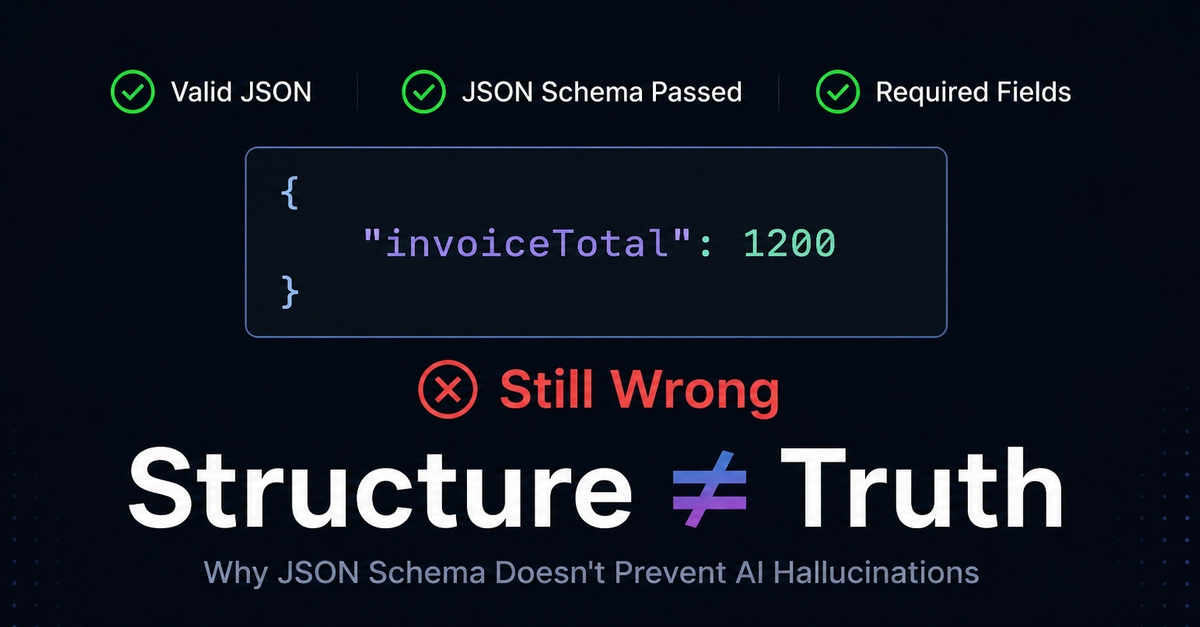
Your model returns:
{
  "invoiceTotal": 1200
}
Enter fullscreen mode Exit fullscreen mode
Let's validate it.
| Validation | Result |
|---|---|
| Valid JSON | ✅ |
| Matches JSON Schema | ✅ |
| Required field present | ✅ |
| Correct data type | ✅ |
| Correct answer | ❌ |
The response is structurally perfect.
The extracted value is still wrong.
JSON Schema didn't fail.
It did exactly what it was designed to do.
What JSON Schema actually guarantees
JSON Schema is responsible for ensuring your application receives data in a predictable format.
It guarantees things like:
- Valid JSON
- Required fields
- Correct data types
- Nested object structure
- Array validation
- Enum validation
That makes applications dramatically easier to build.
But it does not guarantee:
- The extracted value is correct
- The answer exists in the source document
- The model didn't hallucinate
- Business rules were followed
Those are different problems.
Structure ≠ Truth
I've started thinking about AI validation as two independent layers.
Layer 1 - Structural Validation
Can my application safely consume this response?
Examples:
- Is it valid JSON?
- Does it match my schema?
- Are required fields present?
JSON Schema solves this extremely well.
Layer 2 - Semantic Validation
Can I trust the information?
Questions become:
- Did the model extract the correct value?
- Can I trace it back to the source?
- Is there supporting evidence?
- Would I make a business decision based on this response?
This layer is much harder.
And I think it's where the next generation of AI tooling needs to evolve.
Different providers, different guarantees
Another interesting thing I learned while building ShapeCraft is that "structured output" isn't implemented the same way everywhere.
| Provider | Implementation | Guarantee |
|---|---|---|
| OpenAI | Server-side schema enforcement | Native |
| Groq | Server-side schema enforcement | Native |
| Ollama | Grammar-constrained decoding (GBNF) | Constrained |
| Anthropic | Prompt + parsing + retries | Best-effort |
Every provider can return valid structured output.
But they don't achieve it the same way.
Understanding those differences helps you make better architectural decisions.
What I changed in ShapeCraft
One design decision I made was to expose the guarantee level directly instead of hiding it.
const result = await generate(model, schema, prompt);

console.log(result.guaranteeLevel);

// native
// constrained
// best-effort
Enter fullscreen mode Exit fullscreen mode
This doesn't tell you whether the answer is correct.
It tells you how confident you can be that the response structurally matches the schema.
I think that's an important distinction.
Where I think AI tooling is heading
Structured output solved one of the biggest problems in LLM development.
Before it, we spent hours fixing malformed JSON.
Today, that problem is largely solved.
The next challenge isn't generating valid JSON.
It's generating information we can trust.
Imagine every response including:
- Evidence for each extracted field
- Confidence scores
- Source attribution
- Semantic verification
- Reliability metrics
That's where I believe production AI is heading.
Final thoughts
I no longer think of AI validation as a single step.
It's two completely different layers.
First:
Is the response structurally correct?
Then:
Is the information actually correct?
Those are different questions.
And understanding that distinction has changed how I design AI systems.
I'm curious how you're handling this in production.
Do you rely solely on schema validation, or are you adding another verification layer after the model responds?
ShapeCraft
If you're interested in structured generation across multiple providers, ShapeCraft is open source.
It supports:
- OpenAI
- Groq
- Ollama (GBNF)
- Anthropic
With support for:
- Zod
- JSON Schema
- XML
- Regex
- Custom Validators
- Streaming
- Multi-turn structured conversations
GitHub:
https://github.com/aviasoletechnologies/shapecraft
Install
# npm
npm install @aviasole/shapecraft

# pnpm
pnpm add @aviasole/shapecraft
Enter fullscreen mode Exit fullscreen mode
Provider SDKs:
npm install openai
npm install groq-sdk
npm install @anthropic-ai/sdk

# Ollama requires no additional SDK
Enter fullscreen mode Exit fullscreen mode
Quick Start
import { generate, openai } from "@aviasole/shapecraft";
import { z } from "zod";

const schema = z.object({
  name: z.string(),
  age: z.number(),
});

const result = await generate(
  openai({ model: "gpt-4.1-mini" }),
  schema,
  "Generate a fictional user."
);

console.log(result.data);
console.log(result.guaranteeLevel);
Enter fullscreen mode Exit fullscreen mode
0 Comments
Log in to join the conversation.No comments yet. Be the first to share your thoughts.