
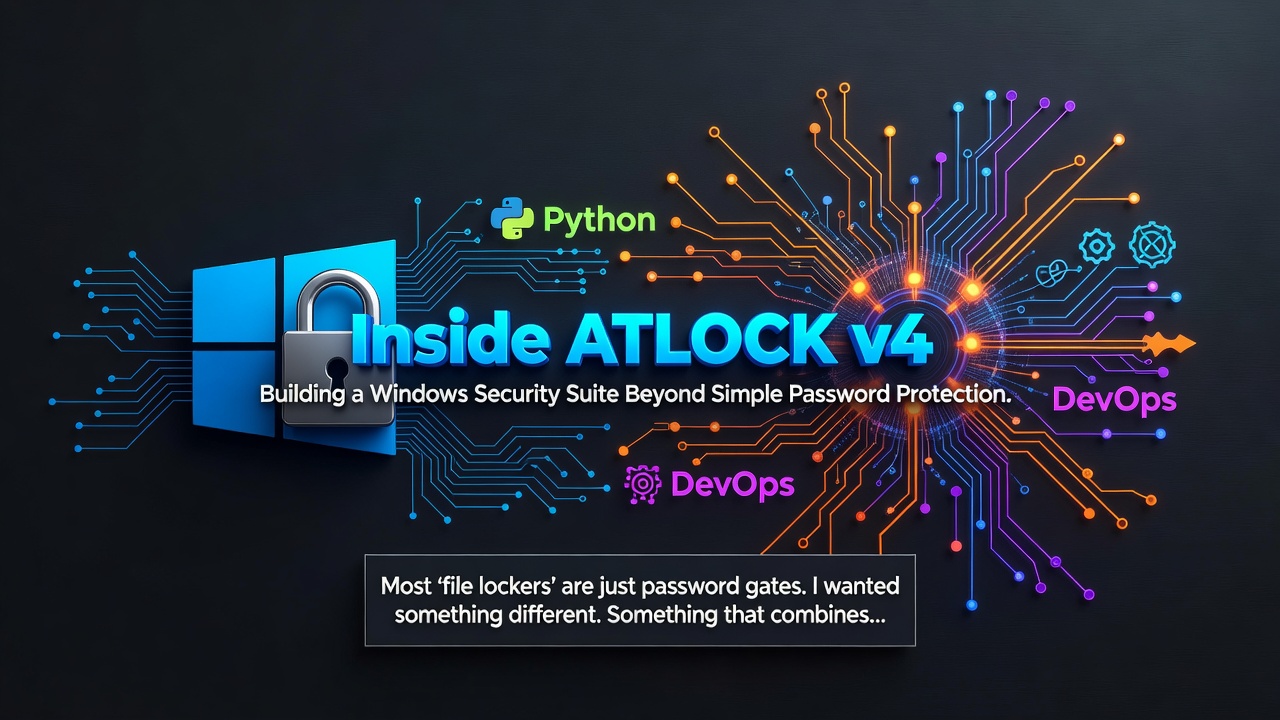
Most "file lockers" are just password gates.
I wanted something different.
Something that combines OS-level security, cryptography, intrusion detection, forensic logging and system lockdown into one desktop application.
⚡ What is ATLOCK v4?
ATLOCK v4 is a Python-based Windows security suite designed around a simple philosophy:
Security shouldn't stop after asking for a password.
Instead, every failed authentication becomes an event that triggers multiple independent security layers.
Wrong Password
│
▼
Intruder Detection
│
┌─────┴────────┐
│ │
Photo Video
│ │
▼ ▼
Notifications Logging
│
▼
Security Escalation
🧩 Architecture
ATLOCK v4
    ┌────────────────────────────┐
    │      Lockdown Engine        │
    └────────────┬───────────────┘
                 │
  ┌──────────────┼──────────────┐
  ▼              ▼              ▼
Enter fullscreen mode Exit fullscreen mode
File Guard Password Vault Intruder Ops
│ │ │
Enter fullscreen mode Exit fullscreen mode
NTFS ACL Fernet AES Camera Engine
  │              │              │
  └──────────────┼──────────────┘
                 ▼
         Notification Engine
Enter fullscreen mode Exit fullscreen mode
Instead of making one giant security module, every subsystem is isolated.
That means:
easier debugging
easier upgrades
less coupling
independent security layers
🔐 1. Real Cryptography (No XOR Tricks)
One thing I wanted to eliminate completely was fake encryption.
Many hobby projects still rely on:
XOR
Caesar shifts
Base64
homemade encryption
ATLOCK v4 instead uses
✅ PBKDF2-HMAC-SHA256
200,000 iterations
for password derivation.
Then derives a Fernet key.
Finally encrypts vault entries using authenticated encryption.
Password
│
Enter fullscreen mode Exit fullscreen mode
PBKDF2-HMAC-SHA256
200,000 rounds
│
Enter fullscreen mode Exit fullscreen mode
Derived Key
│
Enter fullscreen mode Exit fullscreen mode
Fernet AES Encryption
│
Enter fullscreen mode Exit fullscreen mode
Encrypted Vault
This means tampering with encrypted vault data is detected automatically.
🛡️ 2. File Guard Uses Windows ACLs
Instead of hiding files...
Instead of renaming files...
ATLOCK actually interacts with Windows security.
It modifies NTFS Access Control Lists.
User
│
Open File
│
Windows ACL
│
Access Denied
If native APIs aren't available, it gracefully falls back to an alternate protection method.
That fallback makes the software more portable without sacrificing functionality.
🚨 3. Intruder Detection is Event Driven
Authentication failure doesn't simply increase a counter.
Instead every event escalates.
Wrong Password #1
↓
Photo Capture
↓
Notification
↓
Wrong Password #3
↓
10 Second Video
↓
Alarm
↓
Hard Lock
This creates an actual intrusion timeline instead of merely rejecting authentication.
🎥 4. Forensic Evidence Collection
ATLOCK automatically captures:
📸 timestamped photographs
🎥 timestamped videos
These are stored separately inside dedicated directories for later inspection.
Rather than overwriting evidence, each capture receives a unique timestamp and random identifier.
🔔 5. Security Notifications
Another small feature I enjoyed building was the notification system.
Every security event becomes structured metadata.
Event
↓
Timestamp
↓
Category
↓
Masked Credentials
↓
Photo
↓
Video
Notice one important detail:
Passwords are never stored in plaintext.
Only masked representations are logged.
Example:
A******** (8 chars)
instead of
Admin123
🔒 6. System Lockdown
ATLOCK also attempts to reduce bypass opportunities.
During lockdown it uses Windows-specific mechanisms including:
keyboard hook
task manager monitoring
workstation locking
fullscreen interface
This is less about being impossible to bypass and more about significantly increasing the effort required.
⚙️ 7. Defensive Design
Some implementation choices I intentionally made:
✔ background worker threads
✔ graceful degradation
✔ feature isolation
✔ exception logging
✔ modular components
Instead of crashing when optional dependencies are unavailable, the application simply disables that capability.
That makes deployments significantly more resilient.
📂 Project Organization
ATLOCK
├── Lockdown Engine
├── File Guard
├── Password Vault
├── Intruder Detection
├── Notification Manager
├── Camera Engine
├── Settings Manager
├── Sound Engine
└── UI
Each module owns exactly one responsibility.
📈 Why I Built It
I wasn't trying to build another password locker.
I wanted to explore what happens when you combine
Windows internals
modern cryptography
desktop UI
event-driven security
forensic logging
inside one Python application.
The result became ATLOCK v4.
🚀 Future Ideas
Secure cloud synchronization
Hardware security key support
Multi-device vault
Signed update system
Plugin architecture
Memory hard KDFs (Argon2)
Cross-platform security backend
Final Thoughts
ATLOCK v4 isn't trying to compete with enterprise endpoint security platforms.
Instead, it's an exploration of how far a desktop application can push layered security by combining cryptography, operating system features, and intrusion response into a single cohesive architecture.
🔗GitHub 👉https://github.com/Akhouri-Anmol-Kumar/ATLOCK
🔗Direct Download(ATLOCK)👉 https://github.com/Akhouri-Anmol-Kumar/ATLOCK/releases/download/v4.0/ATLOCK.zip
If you're interested in desktop security engineering or Windows internals, I'd love to hear your feedback.
"if it's Akhouri Systems Software then for sure your windows is running THE BEAST" ---- Its Akhouri systems guarantee.
"We Build What Other Forgot To Fix"
0 Comments
Log in to join the conversation.No comments yet. Be the first to share your thoughts.