
The Van Rossem hard fork moved Cardano to version 11 on Saturday. And for the first time, Cardano's community voted in the upgrade, not the company that built it.
- Cardano’s Van Rossem hard fork activated on July 18, moving the network to protocol version 11 and lowering smart contract execution costs while preparing for a future scalability upgrade.
- The upgrade is the first in Cardano’s history to be proposed, debated and ratified entirely through its onchain governance system, rather than by founding developer Input Output, marking a shift in who controls protocol changes.
- While everyday ADA transactions remain unchanged for now, the fork enables cheaper, more capable smart contracts and lays procedural and technical groundwork for the planned Ouroboros Leios scaling upgrade expected in 2026.
Cardano activated its Van Rossem hard fork on Saturday, moving the mainnet to protocol version 11. The technical changes lower smart contract costs and lay groundwork for an upcoming scalability overhaul.
But a more consequential change is who directed the upgrade. For the first time in Cardano's history, it wasn't Input Output, the engineering firm that designed and built the blockchain.
Every previous Cardano hard fork was coordinated top-down by the network’s founding entities, chiefly Input Output, but Van Rossem was initiated, debated and ratified entirely through Cardano's onchain governance system, the framework introduced in the so-dubbed Voltaire era that lets stakeholders vote directly on protocol changes.
It is the first Cardano upgrade approved end-to-end by the network's own participants rather than its creators.
Onchain data from Cardanoscan shows the network moved from version 10 in epoch 643 to version 11 in epoch 644, with the action enacted activated Saturday, July 18 at 21:44 UTC after ratification on July 13. Passage required sign-off from three separate bodies, and the tallies show how differently each treated it.
Delegated representatives — or stakeholders that ADA holders elect to vote on governance proposals on their behalf, similar to representatives in a parliament — voted 78.97% in favor against a 60% threshold.
The constitutional committee, a body of elected members that rules only on whether a proposal complies with the Cardano Constitution rather than on its merits, found the hard fork compliant, with all seven members agreeing where five were required.
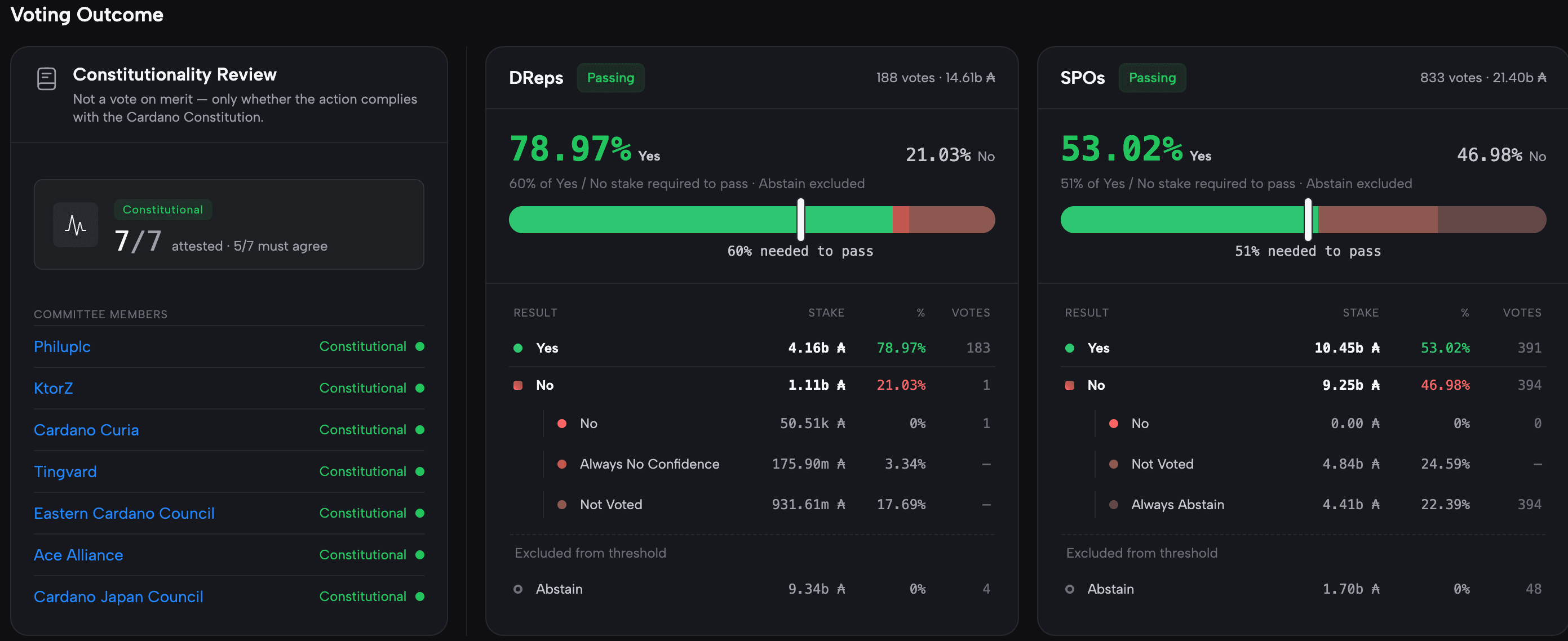
Interestingly, the pool operators who actually run Cardano's infrastructure approved the community's first self-directed hard fork by the narrowest of its three margins, with 53.02% of operators voting to approve the upgrade, a reminder that decentralized governance means the founders' preferred outcome is no longer guaranteed.
Under Cardano's constitution, the upgrade also required at least 85% of stake pools by active stake to run compatible node software before ratification. Network telemetry showed adoption well ahead of that, with roughly 93% of block production already on version 11 heading into activation.
What is version 11
On the technical side, version 11 is an intra-era hard fork, meaning it stays within Cardano's current governance-focused era and does not change the structure of transactions, so the work required to upgrade is minimal for the wider ecosystem.
It adds new capabilities to Plutus, the platform developers use to write Cardano's smart contracts, unifying the built-in functions available across the platform's three versions so older applications gain newer features.
The upgrade also tightens several of the ledger's validation rules, including one guaranteeing that no two stake pools can reuse the same cryptographic identity key.
"As well as Plutus improvements and Plutus Cost Model enhancements, this upgrade lays the foundation for the next upgrade, the Dijkstra era hard fork, which will introduce Ouroboros Leios to Cardano," Input Output wrote in a development report on Friday.
Ouroboros Leios is a scaling proposal for the proof-of-stake consensus model that Cardano runs. It is expected later in 2026 and aimed at sharply increasing transactions per second without weakening the protocol's security guarantees.
Van Rossem is the procedural groundwork for Ouroboros, both in the ledger changes it ships and in the precedent it sets: that Cardano can now upgrade itself by vote.
The hard fork is named for Max van Rossem, a Cardano governance contributor who helped shape the network's constitution and died in October 2025.
What the hard fork means for a Cardano user
There are no visible changes for someone casually holding or spending ADA. Transactions work the same way, wallets do not need updating and the fee to send ADA is unchanged. The upgrade does not alter how the network looks or feels to use.
The benefits arrive through the apps that can be built on Cardano over time. The Plutus changes lower the costs of running a smart contract — the code behind any onchain service — from DeFi protocols to NFT marketplaces.
A user pays a fee every time they interact with one of those apps, and part of that fee reflects how much computation the contract demands. Cheaper execution means those apps can charge less per transaction, though the savings are not automatic, since developers have to rebuild their contracts to capture it.
Over time, the larger shift is over who controls what comes next. On most blockchains, a founding company or core team sets the roadmap and users take what they are given.
Van Rossem showed that Cardano's holders can approve a protocol change themselves, without the founders directing the change. For investors holding ADA, that is the difference between owning a token on a network someone else steers and having a formal vote in where it goes. Whether that is worth more than faster, top-down development is a separate debate, but it is a real change in who holds the wheel.
Meanwhile, the upgrade a user will actually feel is still ahead. Van Rossem lays the groundwork for Leios, the scaling change meant to sharply increase how many transactions Cardano can process. That is what would deliver faster confirmations and more capacity when the network is busy.
0 Comments
Log in to join the conversation.No comments yet. Be the first to share your thoughts.