
Applying lessons from retail in healthcare
When omnichannel was first being discussed as a new concept in retail, it was commonly confused with multichannel — where organizations simply operate through and support multiple channels simultaneously. Omnichannel, however, demands that those channels are woven together seamlessly, enabling journeys to flow freely between them.
As many retailers learned the hard way, that isn’t something that can be facilitated by point solutions alone. You can’t just add new digital elements to physical experiences (or vice versa) and expect that to deliver omnichannel experiences. Instead, it requires holistic change and an end-to-end redesign of patient journeys.
By redesigning and reimagining patient journeys and experiences from the ground up, organizations can find innovative and engaging ways of weaving channels and experiences together to create something far greater than the sum of its parts.
Their work might be very different to the likes of Amazon or Walmart, but the principles today’s retail leaders followed in their own omnichannel transformations hold true across industries. The best way to create winning journeys and facilitate strong omnichannel experiences is to zoom out, challenge what’s possible with new technology capabilities, and redesign journeys in line with what both customers and employees demand today.
Why today’s healthcare organizations need to be thinking about service design
Service design is the concept of designing your organization’s service offerings in a way that maximizes the efficiency, productivity, and quality of customer journeys and how a consumer experiences your offering.
It isn’t a new concept. But, what is new are all of the innovative digital touchpoints and interactions that have emerged to create today’s omnichannel healthcare journeys. Teams need to go through service design processes with all of the aforementioned technology, consumer, regulatory, and demand shifts in mind, carefully considering how they should influence decisions regarding:
Processes and practices
Technology and tools
Training and knowledge management
Communication and touchpoints
Metrics and accountability
Value-drivers and outcomes
It’s a new landscape that calls for new technology, new approaches, new journey considerations, and crucially, new principles of both design and execution.
The five core principles of service design for omnichannel healthcare
Based on our experience helping organizations conquer the evolving omnichannel healthcare space, Thoughtworks has identified five principles of effective omnichannel healthcare design.
Principle #1: Design journeys and ecosystems around key patient moments
In the world of omnichannel healthcare, there are a huge number of digital and physical touchpoints that come together to create connected patient journeys and experiences. Naturally, some hand-offs and connecting points between those touchpoints are tougher to facilitate than others.
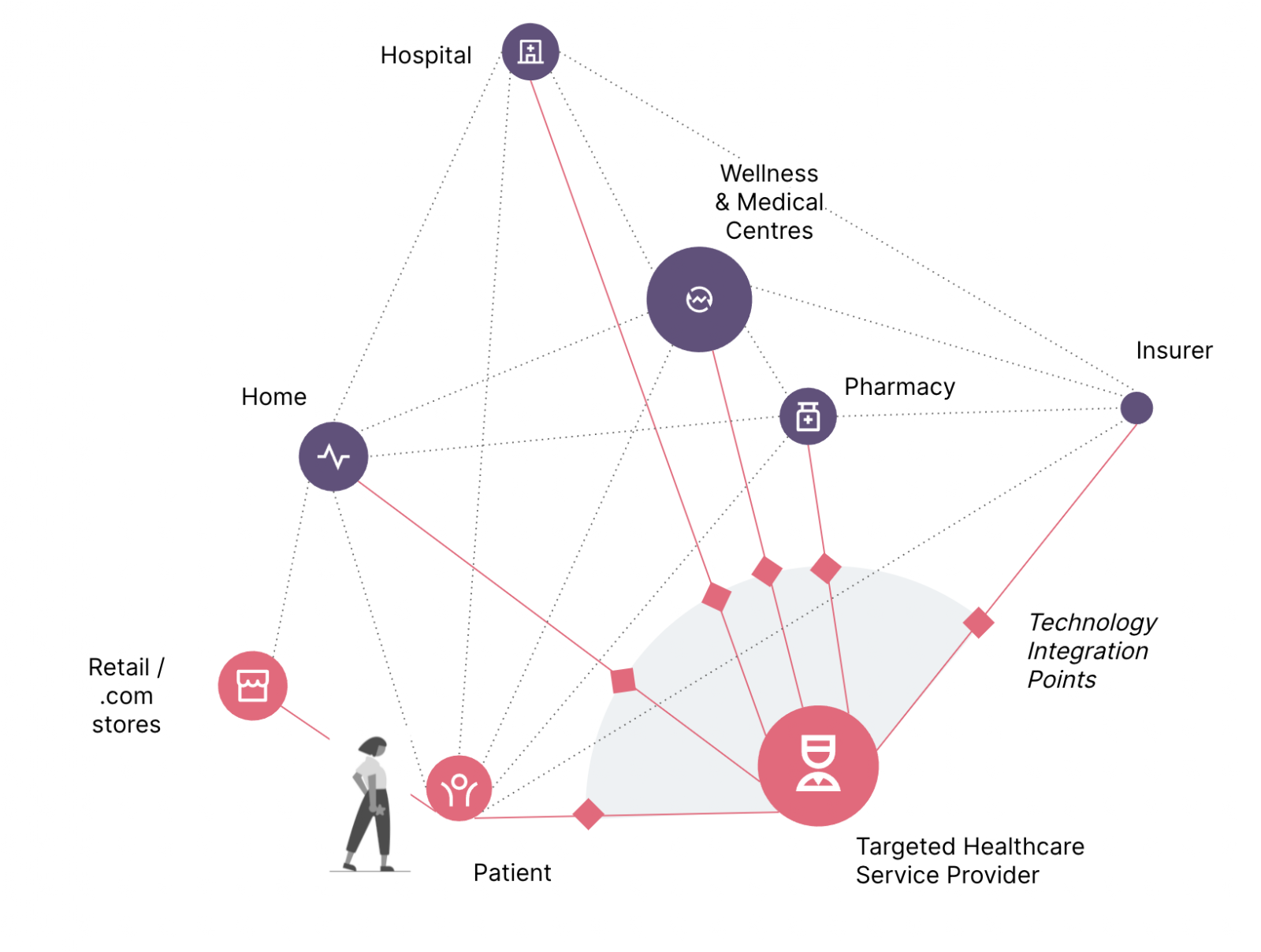
In the omnichannel age, designers need to carefully consider how they’ll support and enable key touchpoints and channels, including:
Virtual care (telehealth) experiences at scale, and journeys that are entirely virtual from first contact to resolution.
Hand-offs between virtual care and testing (MRI, lab, etc), when no physical appointment is held before referral.
Hand-offs between virtual care providers and specialist virtual care providers, with no physical interaction or referral in between.
How patients consume test results or other potentially difficult news digitally, without specialist physical support.
The integration of data from patient-owned wearable technology with Electronic Medical Records (EMRs).
Service designers need to find a way of prioritizing the moments that matter most to modern patients and employees, and create a value framework around them that supports and enables continuous improvement. To do that effectively, they’ll need to:
Clearly define the ecosystem surrounding those customer moments, defining all of the parties involved, creating governance rules, and building relevant APIs to support data interoperability across every organization.
Establish KPIs, tracking mechanisms, and monitoring approaches to measure success, ensure accountability, and enable continuous improvement.
Create customer-driven feedback loops to find out what’s really working for the people that matter most, and keep up with evolving patient and employee needs.
0 Comments
Log in to join the conversation.No comments yet. Be the first to share your thoughts.